
CCIP 2.0: For Issuers, Developers and Infra Teams
Published by Spectrum Nodes on September 28, 2026
Key Takeaways
- CCIP 2.0 went live on September 28, 2026 and is available to all institutions and token issuers.
- Issuers can now add their own Cross Chain Verifier (CCV), which must sign every transaction alongside the Chainlink Committee Verifier.
- Smaller transfers can settle faster than finality, while larger transfers still wait for full finality.
- Compliance rules through Chainlink's Automated Compliance Engine apply automatically on every transfer.
- Every CCV depends on reliable RPC access to the chains it verifies.
What Is CCIP 2.0?
CCIP 2.0 is the latest version of Chainlink's Cross Chain Interoperability Protocol (CCIP), the standard for moving tokens and messages between blockchains. It went live on September 28, 2026 and is available to all institutions and token issuers.
CCIP 2.0 keeps Chainlink's existing security model and adds new controls on top, so issuers can decide who verifies their transfers, how fast those transfers settle and which compliance rules they follow.
Spectrum Nodes is one of the node operators helping secure Chainlink's network, and we run the RPC infrastructure that cross chain systems depend on. This guide covers what CCIP 2.0 means for issuers, developers and infra teams.
CCIP 2.0 at a Glance
| Detail | CCIP 2.0 |
|---|---|
| Launch date | September 28, 2026 |
| Built by | Chainlink |
| Cross chain token value secured | Over $84 billion |
| Default verification | Chainlink Committee Verifier (16 independent node operators) |
| New security option | Cross Chain Verifiers (CCVs) |
| Settlement | Full finality by default, faster than finality optional |
| Compliance | Chainlink Automated Compliance Engine (ACE) |
| Early adopters | Aave, Lombard, Maple, Re |
| Still pending | Ethereum Fast Confirmation Rule support |
What Is a Cross Chain Verifier (CCV)?
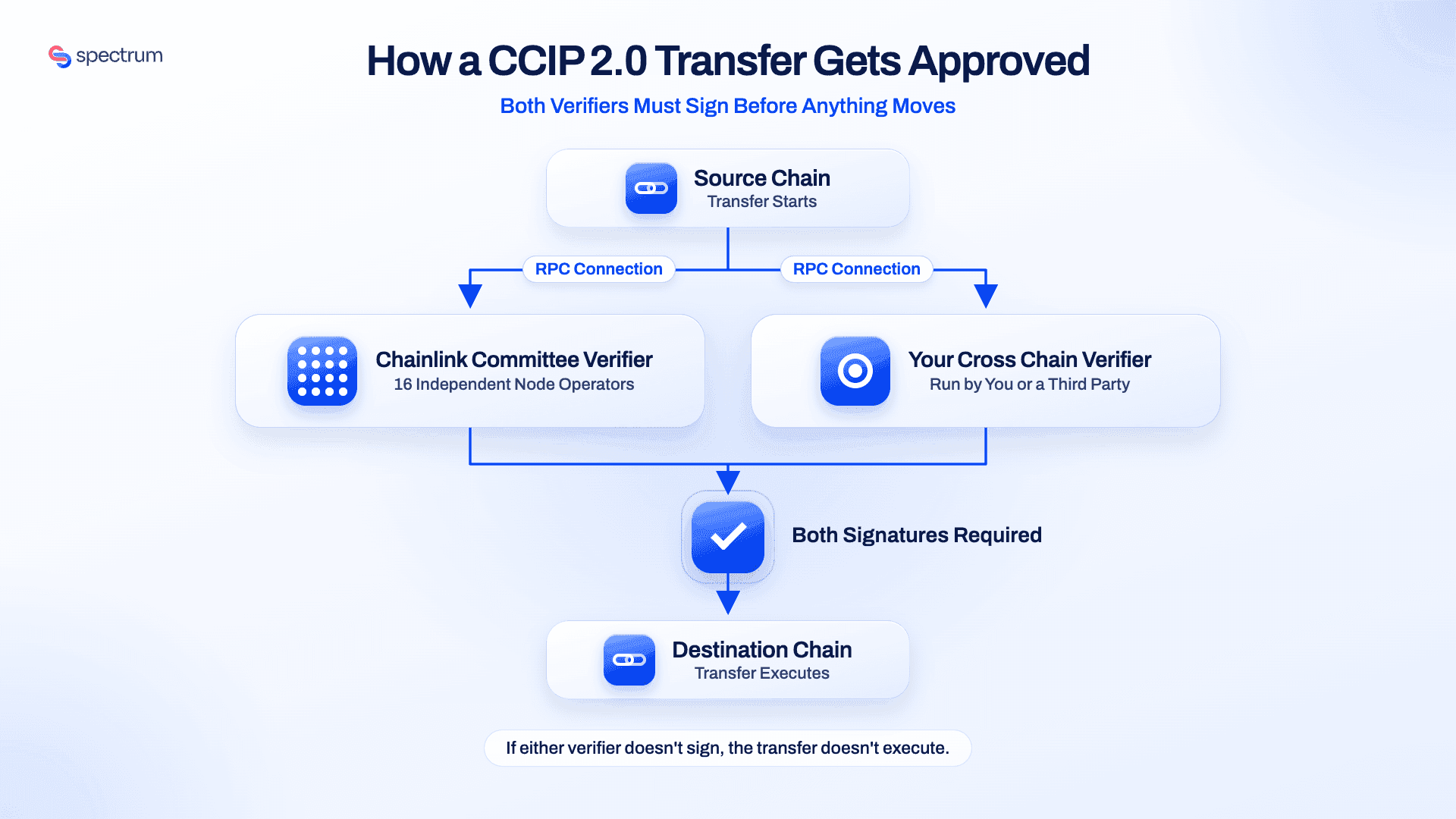
A Cross Chain Verifier (CCV) is an additional verifier that an issuer runs or hires a third party to run. In CCIP 2.0, a CCV must sign a transaction alongside the Chainlink Committee Verifier before the transaction executes on the destination chain. If either verifier does not sign, the transfer does not go through.
Before CCIP 2.0, every CCIP transaction was approved by the Chainlink Committee Verifier alone. That default stays in place. CCVs are optional and add a second layer on top.
CCVs can run on bare metal or in the cloud, and Chainlink provides starter kits for AWS and Google Cloud. Operators such as Infosys and Nethermind already run CCVs on behalf of issuers.
What Does CCIP 2.0 Mean for Issuers?
CCIP 2.0 gives issuers direct control over how their assets move between chains.
Verification. Issuers can require a signature from their own CCV on top of Chainlink's default verifier, and decide when it applies. For example, an issuer could require the extra signature only on transfers above $1M.
Settlement speed. CCIP 2.0 waits for full source chain finality by default. Issuers can set custom confirmation thresholds so small, frequent transfers settle faster than finality while large transfers wait. Issuers decide how much value can take the fast path and can charge extra fees to cover the added risk.
![Comparison of CCIP 2.0 settlement options: full source chain finality by default for large transfers, and faster than finality settlement for small, frequent transfers under issuer set confirmation thresholds.]
Compliance. CCIP 2.0 integrates with Chainlink's Automated Compliance Engine (ACE), which applies issuer rules automatically on every transfer:
- ✅ Sanctions screening, allowlists and denylists
- ✅ Value and rate limits
- ✅ Private token pools for approved wallets only
ACE works with over 20 identity and compliance providers. Issuers set their policies once, and those policies apply on every chain the asset moves to.
What to do now: map out which transfers are small enough to move fast and which are large enough to need your own CCV. Those two decisions shape everything else.
What Does CCIP 2.0 Mean for Developers?
CCIP 2.0 ships a rebuilt API, SDK and CLI. Standard transfers and fast transfers now run through one interface, with more control over execution and token pool behavior.
Developers will also be asked to build and deploy CCVs, using Chainlink's starter kits for AWS and Google Cloud or their own bare metal setups.
What to do now: if you're integrating CCIP for the first time, start on the new tooling. If you already have an integration, check Chainlink's docs for upgrade steps before switching on new features.
What Does CCIP 2.0 Mean for Infra Teams?
CCIP 2.0 creates a new role for infrastructure providers: operating CCVs. Every CCV has to be operated, monitored and kept online, and issuers are already paying specialists to do it. The open CCV marketplace lets operators set their own verification fees on top of CCIP's base rate.
CCIP 2.0 also raises the bar for RPC. A verifier can only sign what it can see. If its connection to the source chain lags or drops, transfers stall. Once settlement moves to seconds, slow RPC responses eat directly into the speed CCIP 2.0 is built to deliver.
Spectrum runs its own Tier III hardware in the US, Europe and APAC, with no rented cloud capacity and no breaches to date. When Robinhood Chain launched, Spectrum had it supported the next day. CCIP adds chains every week, and the infrastructure behind it has to keep pace.
"As one of the operators helping secure Chainlink's decentralised network, we've seen its reliability proven across years of real-world conditions. It remains one of the most battle tested pieces of infrastructure in the industry.
CCIP 2.0 is the culmination of that work, and the bridge that will bring TradFi and onchain finance together at scale."
Francesco Cremona, Lead Engineer
What to do now: decide whether you'll operate CCVs, and check whether your RPC setup can support verifiers across every chain you plan to cover.
What Is Still Coming?
Ethereum's Fast Confirmation Rule is not live yet. Chainlink is working with Ethlabs so CCIP supports it as soon as Ethereum ships it, which will bring Ethereum confirmations down to seconds. Until then, fast transfers involving Ethereum are limited by Ethereum's own confirmation times.
Who Has Adopted CCIP 2.0?
Lombard is building custom CCV logic into its cross chain tokens. Aave, Maple and Re have switched on faster than finality transfers for their native tokens. Institutional launch partners include AWS, Google Cloud, Sygnum and xStocks.
Over $15 billion in token value migrated to CCIP in the four months before launch, including BitGo's WBTC and Coinbase's cbBTC.
CCIP 2.0 FAQ
What is CCIP 2.0?
CCIP 2.0 is the latest version of Chainlink's Cross Chain Interoperability Protocol. It adds issuer controlled verification, configurable settlement speed and built in compliance to cross chain transfers.
When did CCIP 2.0 launch?
CCIP 2.0 went live on September 28, 2026.
What is a CCV in CCIP 2.0?
A Cross Chain Verifier (CCV) is an optional verifier run by an issuer or a third party. It must sign each transaction alongside the Chainlink Committee Verifier before the transaction executes.
Do issuers have to run a CCV?
No. Chainlink's default security still applies to every CCIP 2.0 transfer without one.
Can CCIP 2.0 transfers settle faster than finality?
Yes. Issuers can set custom confirmation thresholds so selected transfers settle before full source chain finality. Full finality remains the default.
Does CCIP 2.0 support Ethereum's Fast Confirmation Rule?
Not yet. Support arrives once Ethereum ships the Fast Confirmation Rule.
What infrastructure does a CCV need?
A CCV needs compute, uptime and reliable RPC access to every chain it verifies.
Can infrastructure providers earn from CCIP 2.0?
Yes. CCV operators can set their own verification fees through the open CCV marketplace.
Sources
Build on Infrastructure That Keeps Up
Deploying a CCV or building on CCIP 2.0?
![CCIP 2.0 Cover Light-selection.png]