
Crypto Market Trends: How Narratives Evolve in Crypto

Updated October 22, 2026 · Spectrum Nodes
Short answer: Crypto market trends follow narratives, and narratives follow incentives, liquidity and attention. When rewards are high, capital moves fast: DeFi total value locked grew more than 20x in 2020, from under $1 billion to over $14 billion (IntoTheBlock), driven largely by yield farming rewards. Each narrative then saturates and capital migrates, so metrics like TVL and volume often overstate demand.
Crypto market trends are often described as unpredictable, yet the data says otherwise. Step back and patterns emerge. Behaviour, incentives and how people respond to opportunity drive those patterns more than technology alone.
In crypto, a narrative is a story that also becomes a measurable shift in activity, because blockchain activity is public. You can see it in total value locked (TVL, the value of assets deposited in DeFi protocols), trading volume, token creation and user behaviour. When a narrative takes hold, capital and attention move together.
This guide breaks down how those shifts happen, why they repeat and what the data shows beneath the surface.
What Drives Crypto Market Trends?
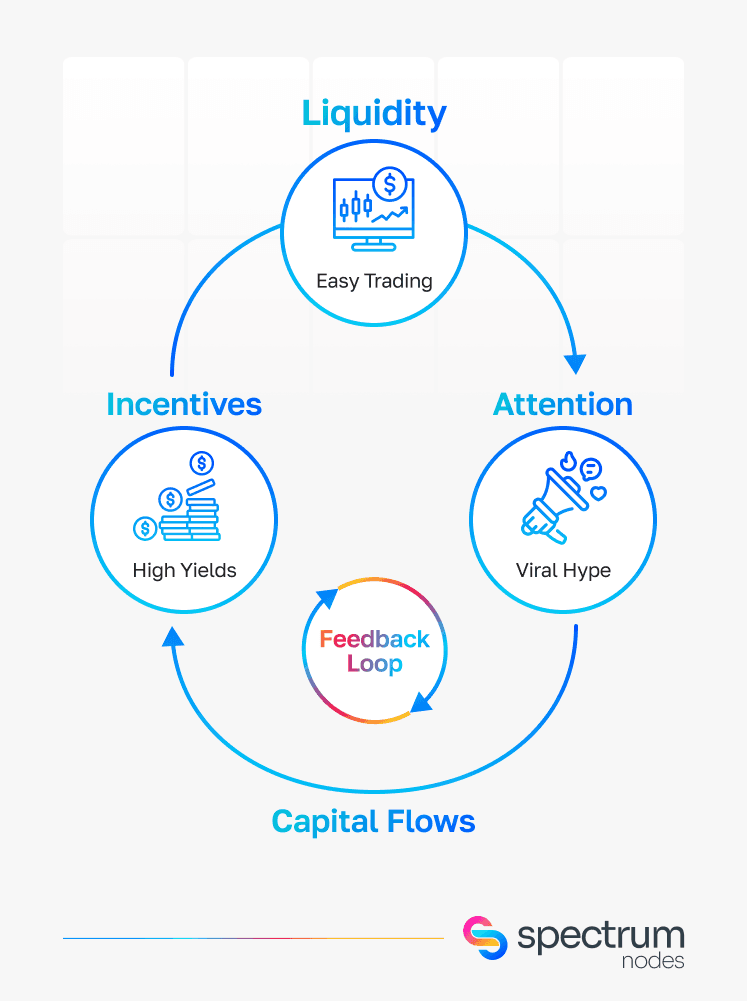
Three forces shape crypto market trends: incentives, liquidity and attention. Together they form a feedback cycle, which explains why trends accelerate quickly once they begin. If you want to understand why crypto markets move, start here.
Incentives
Incentives come first. When rewards are high enough, behaviour changes quickly. During DeFi summer, DeFi total value locked increased more than 20x in 2020, rising from under $1 billion to over $14 billion. Yield farming rewards, where users deposit assets into a protocol to earn its reward tokens, pulled that capital in. Organic adoption alone did not produce that growth.
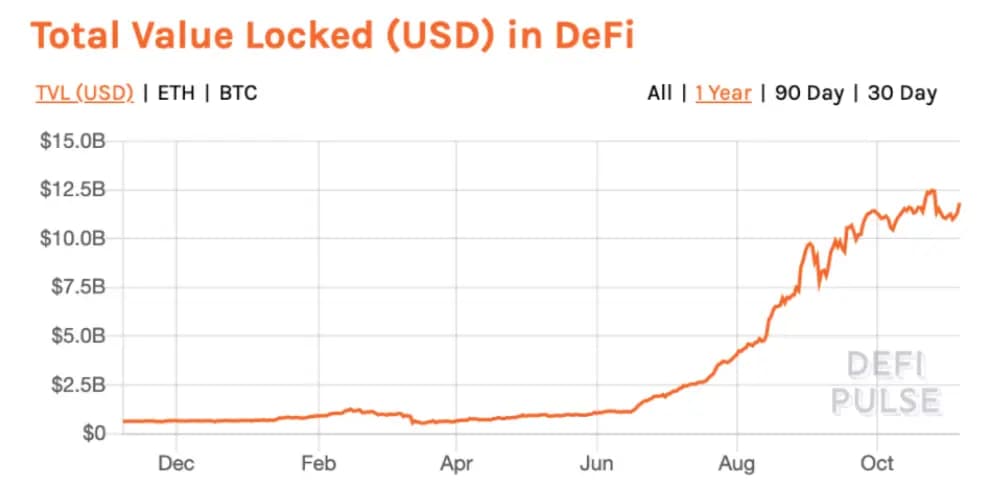
This matters more than it seems, because it challenges a common assumption. Many people treat TVL as a proxy for users or demand, but TVL often reflects supply side behaviour. Capital moves where incentives are strongest, even if underlying usage has not changed.
Incentives define behaviour, and they are a very common tactic among new crypto projects. You can see the same dynamic in staking incentives within crypto ecosystems, where rewards directly shape participation and the security of the chain.
Liquidity
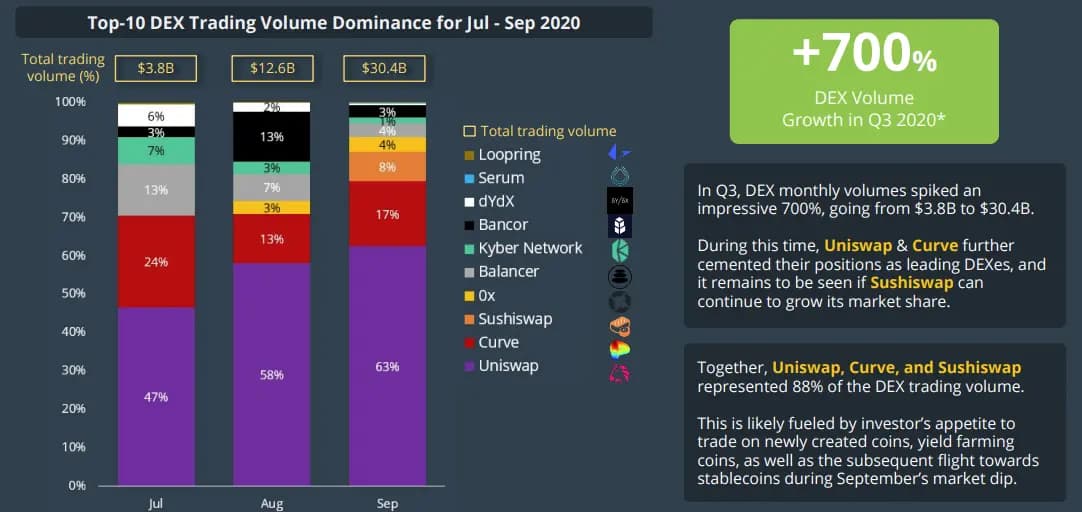
Liquidity amplifies incentives. It determines how easily people can act on an opportunity once they notice it. When decentralised exchanges removed barriers to entry and allowed instant trading, participation rose very rapidly, reflected in DEX volumes growing over 700% in Q3 of 2020. When entering and exiting positions becomes effortless, narratives spread faster because interest turns into immediate action.
Attention
Attention completes the loop. As activity increases, it attracts more participants, which further reinforces the narrative.
How Did Airdrops Change Crypto Market Behaviour?
Airdrops started as a reward for early users, became predictable over time, and that predictability changed behaviour. An airdrop is a free distribution of tokens to wallets that meet a protocol's criteria, and airdrops are a clear case study of how incentives shape crypto market trends.
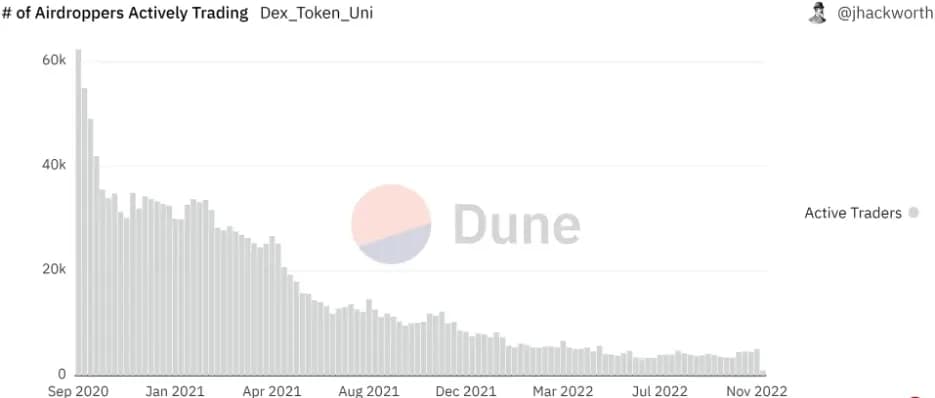
Once airdrops became predictable, airdrop farming followed. Users interacted with protocols because they expected a reward, without needing the product. The data on Uniswap's airdrop is revealing: analysis shows that airdrop driven activity declines sharply over time. Immediately after the airdrop, recipients made up the majority of traders, but over the following years their share of activity dropped significantly.
Two conclusions follow:
- Airdrops create short term engagement. They produce a measurable spike in users and volume.
- That engagement often fades. It does not necessarily equal long term protocol activity, as the vast majority of participants leave once the incentive disappears.
There is also a deeper issue. Airdrops often assume one wallet equals one user, but multi wallet behaviour is very common, so user metrics may be inflated. That distorts the data: activity looks higher than it is, and retention looks stronger than it is.
Airdrops are not purely negative. Some studies show airdrops can increase governance participation. The outcome depends on design, and the takeaway is simple: incentives shape behaviour, and they also shape the data we use to measure that behaviour.
Does High DEX Volume Mean High Demand?
Not always. Spikes in decentralised exchange (DEX) volume can look like rapid adoption, but the numbers can mislead. A DEX is an exchange where users trade directly from their wallets through smart contracts.
Incentive programmes often reward trading activity, so some users devise schemes purely to earn rewards, which creates artificial volume.
NFT markets show the same pattern. Research shows that wash trading accounted for a significant share of NFT trading volume, in some cases a very large portion of total activity. Wash trading means trading an asset back and forth to inflate volume without any change in who owns it.
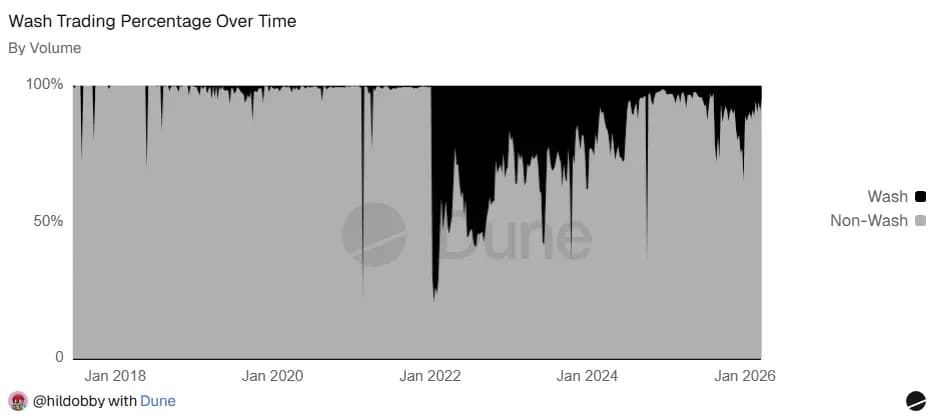
As the chart shows, this is far from a minor distortion. It changes how you should read the entire market.
Concentration matters too. A small number of participants often generate the lion's share of volume, so protocol activity can rise while adoption does not. When you look at DEX metrics, ask deeper questions:
- Who is generating the volume?
- What incentives are driving it?
- How much of it reflects genuine demand?
Data without context will probably lead you in the wrong direction.
What Did pump.fun Change About Meme Coin Trading?
Platforms like pump.fun cut the cost of creating and trading tokens to almost zero, and participation became the product. Meme coin trading is a different kind of narrative: speed and participation drive it, more than utility or long term value.
A study published in February 2026 by a group of Italian academic researchers showed that only a small fraction of tokens reach the threshold needed to keep trading or gain liquidity. In one study, hundreds of thousands of tokens were created, and less than 1% reached meaningful traction.
When the barrier to entry dropped, experimentation increased and the success rate fell sharply. Users on these platforms trade tokens, and they also run a loop of creation, speculation and exit. This environment introduced new dynamics:
- Multi wallet behaviour becomes even more common
- Profitability concentrates among a small group
- Most participants do not succeed
Activity still remains high, with millions of trades occurring daily, even though the majority of tokens fail.
What does this say about crypto hype cycles? Some are driven by engagement more than value creation. The pump.fun model shows how quickly narratives shift when friction disappears, and how quickly they saturate.
What Are the Phases of a Crypto Market Cycle?
Crypto market cycles move through five phases: discovery, incentives, saturation, extraction and migration. The pattern is not perfect, but it is consistent.
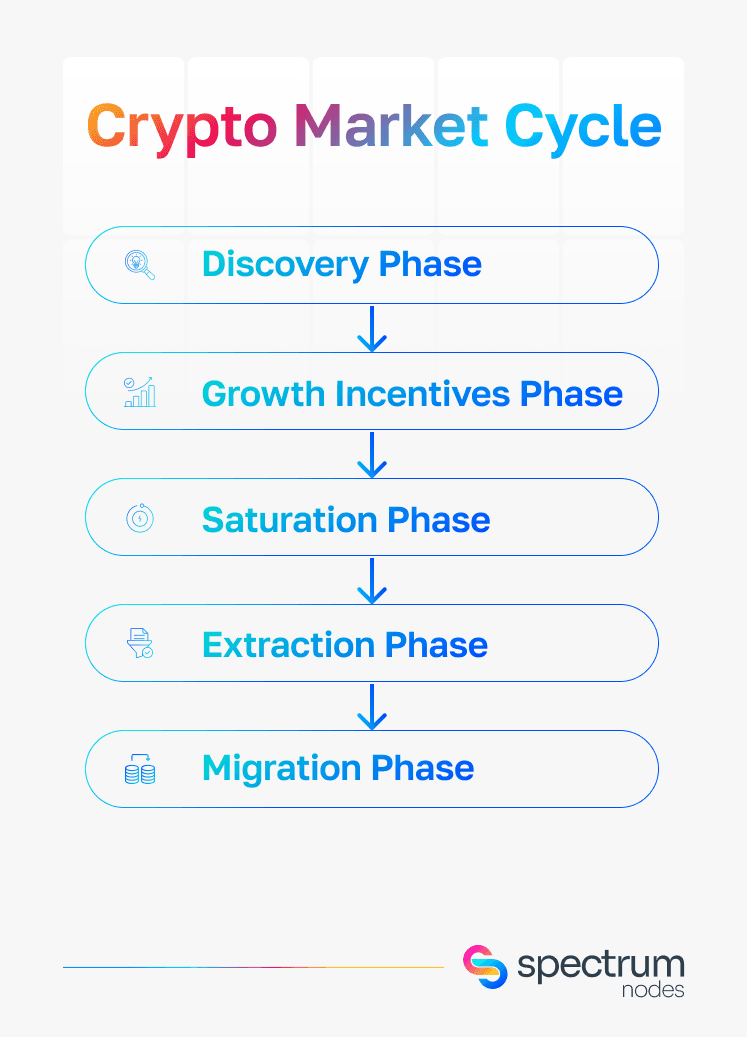
| Phase | What happens |
|---|---|
| 1. Discovery | A new mechanism appears and attracts the interest of early participants |
| 2. Incentives | Rewards drive rapid expansion and push metrics up quickly |
| 3. Saturation | Other protocols copy the success, competition increases, returns fall and activity concentrates |
| 4. Extraction | Participants optimise for profit, and behaviour becomes more predictable and strategic |
| 5. Migration | Capital and attention move to the next hot narrative |
This model explains why trends repeat across sectors: DeFi, NFTs, meme coins and beyond all follow similar paths. It also explains why timing matters. Early participants benefit from incentives, while late participants face more competition and lower returns. The cycle tracks behaviour as much as price.
Why Do Crypto Market Trends Often Mislead?
Crypto market trends mislead because the metrics behind them are imperfect.
| Metric | What it measures | What it can hide |
|---|---|---|
| TVL | Capital deposited in protocols | How many people take part |
| Trading volume | Value traded | Incentivised or artificial activity |
| Reported volume totals | Activity as counted | The same activity counted more than once |
Research published by Paradigm shows that crypto market volume metrics can be misinterpreted due to double counting. In some cases, the same activity is counted multiple times, inflating the perceived size of the market. If the inputs are distorted, the conclusions will be too. For a closer look at one of those markets, see whether Polymarket's data can be trusted.
Different metrics also tell different stories. TVL might increase while user numbers stay flat, or volume might rise while profitability declines. Without the context of where the data comes from, it is easy to misread what is happening.
How Can You Check a Narrative's Data Yourself?
Go to the onchain data. Questions like who generates the volume, how concentrated it is and whether wallets stay after rewards end all need wallet level data.
Spectrum Nodes gives you RPC access to 200+ chains, plus unified APIs for balances, token metadata and portfolios on 16 EVM chains, so you can pull that data without running your own nodes. New to this? Start with what an RPC is.
What Could Shape Future Crypto Market Trends?
Predicting the next narrative is close to impossible, but four conditions are likely to shape future crypto market trends:
- Mispriced incentives: when rewards exceed costs, participation increases, so mispriced incentives will keep creating opportunities.
- Low friction participation: as tools improve, more users can enter the market quickly, which accelerates experimentation.
- Fast feedback loops: when outcomes are immediate, users are more likely to participate repeatedly, which keeps engagement high.
- Capital efficiency: markets are becoming much more competitive, so narratives will need to justify themselves economically as well as socially.
The future of crypto depends more on recognising the conditions that let trends form than on predicting the next trend.
Conclusion
Crypto narratives evolve, and each cycle builds on the previous one. Incentives change, tools improve and participation shifts, but the underlying pattern stays the same.
Behaviour drives markets.
If you enjoyed this article, follow Simply Staking on X to keep up with everything happening in the crypto industry.
FAQ
What drives crypto market trends? Three forces drive crypto market trends: incentives, liquidity and attention. Incentives pull capital in, liquidity lets people act on an opportunity instantly and attention brings in more participants, which reinforces the narrative.
How do crypto narratives evolve? Narratives move through a cycle of discovery, incentives, saturation, extraction and migration. Each cycle builds on the previous one, as capital and attention move to the next new mechanism.
Do airdrops create long term users? Airdrops create short term spikes in users and volume, but that engagement often fades once the incentive ends. Analysis of Uniswap's airdrop shows that recipients' share of trading activity dropped significantly over the following years.
Is DEX volume a reliable measure of demand? Not on its own. Volume can include incentivised trading and wash trading, a small group of participants can generate most of it, and some volume metrics count the same activity more than once.
Does TVL measure the number of users? No. TVL measures capital deposited in protocols, which often reflects supply side behaviour driven by incentives. User numbers can stay flat while TVL rises.
References
- IntoTheBlock, A Comprehensive Overview of DeFi in 2020: https://app.intotheblock.com/static-reports/bitstamp/defi/2020-overview/report/a-comprehensive-overview-of-defi-in-2020.pdf
- CoinGecko, 2020 Q3 Report: https://assets.coingecko.com/reports/2020-Q3-Report/CoinGecko-2020-Q3-Full-Report.pdf
- Dune, Uniswap airdrop analysis: https://www.dune.com/blog/uni-airdrop-analysis
- Dune, NFT wash trading on Ethereum: https://www.dune.com/blog/nft-wash-trading-on-ethereum
- Paradigm, Polymarket volume is being double counted (December 2025): https://www.paradigm.xyz/2025/12/polymarket-volume-is-being-double-counted