
Polymarket Explained: Funding, Growth, and Whether the Data Can Be Trusted

Polymarket is one of the few crypto applications that has managed to truly escape its own niche. Nowadays, it attracts attention from traders, journalists, and investors who are not usually interested in blockchain products, and therefore a natural question arises: is polymarket legit?
Well, the answer is not as simple as many headlines suggest. Polymarket has real capital behind it, real activity, and definitely also a growing influence. At the same time, its metrics are often misunderstood, the data that it produces always requires context, and its market structure introduces risks that are easy to overlook. Therefore, treating it as either fully reliable or fundamentally flawed misses the point, as the reality sits somewhere in between, and understanding that middle ground is where the value lies.
What Polymarket Is and Why It Matters
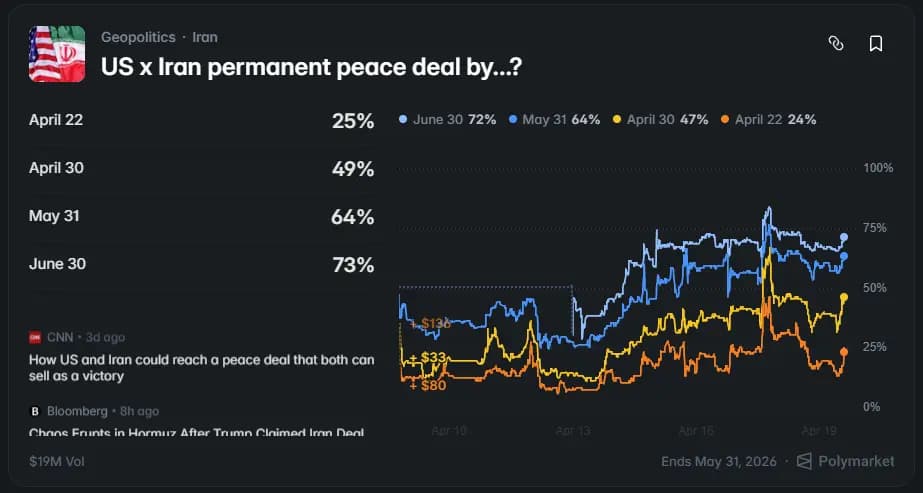
At its core, Polymarket is a prediction market, where users trade contracts tied to future events, with prices reflecting the probability of an outcome based on what traders are willing to pay.
Although this sounds simple, the implications are not. Unlike traditional polling or commentary, these markets force participants to back their views with real capital, and therefore, that creates a feedback loop between information, conviction, and price.
By now, Polymarket became culturally relevant during major global events, particularly elections, where its markets were often referenced alongside traditional data sources. At this stage, it truly began to function less like a niche crypto product and more like a real time information layer.
Therefore, considering its ever growing importance, it is important to understand the project deeply, starting with who funded it.
Let’s dive in!
Who Funded Polymarket and What Its polymarket valuation Really Says
Polymarket’s funding story is often presented as straightforward growth, but a closer shows a more layered capital structure than the headlines suggest, especially when considering funding that occurred in the last couple of years.
For example, in 2024, the company raised $70 million across 2 rounds, with $25 million attributed to a Series A led by General Catalyst and $45 million to a Series B backed by Founders Fund and other crypto-native investors. What this mix shows is that both traditional venture capital and crypto-native investors are backing the platform.
Fast forwarding to 2025, the structure of capital effectively changed. SEC filings show over $82 million sold in a 2024 offering and more than $135 million in a 2025 offering. One should note that these are reported sales and not full round sizes, which makes them difficult to compare directly with headline funding figures. Nonetheless, they confirm that real capital has been deployed into the platform, even if the total scale is often overstated.
At the same time, Polymarket also began attracting strategic capital. In August 2025, it disclosed an investment from 1789 Capital and added Donald Trump Jr to its advisory board, signalling a broader distribution strategy rather than a pure focus on trading.
Furthermore, we cannot conclude this section without mentioning what is probably the clearest inflection point that happened in October 2025, when Intercontinental Exchange agreed to invest up to $2 billion at an approximate $8 billion pre-investment polymarket valuation, combining a $1 billion direct purchase with additional planned secondary transactions. A further $600 million direct investment followed in March 2026.
This level of institutional involvement strongly suggests Polymarket is being treated as emerging market infrastructure rather than a short term product.The funding is not only very real, but also strategically important, and what it confirms is investor belief in future positioning, not that current activity, data, or incentives are fully resolved.
How Polymarket Makes Money
Understanding polymarket revenue structure helps clarify how the platform is evolving. In simple terms, Polymarket charges taker fees on certain markets, while some categories remain fee free. It also redistributes part of those fees through liquidity incentives, rewarding participants who help maintain active markets.
Zooming a bit out, it is not hard to see that this structure looks increasingly similar to exchange economics. Revenue is tied to activity, liquidity, and participation rather than a simple house edge model.
Consequently, this has 2 implications.
First of all, revenue growth depends on sustained trading activity, meaning that if attention drops, revenue follows. Secondly, incentives truly matter. When liquidity providers are rewarded, it can improve market depth, while at the same time, it can also encourage behaviour that inflates activity without necessarily improving signal quality.
So while the polymarket revenue model is credible, it is still closely tied to user behaviour and market dynamics.
Polymarket Growth: Polymarket Users, Polymarket Volume, and the Problem With the Numbers
There is little doubt that Polymarket has grown quickly. Metrics such as Polymarket’s volume and open interest show strong activity, especially during major events, but the interpretation of these numbers is where things become less straightforward.
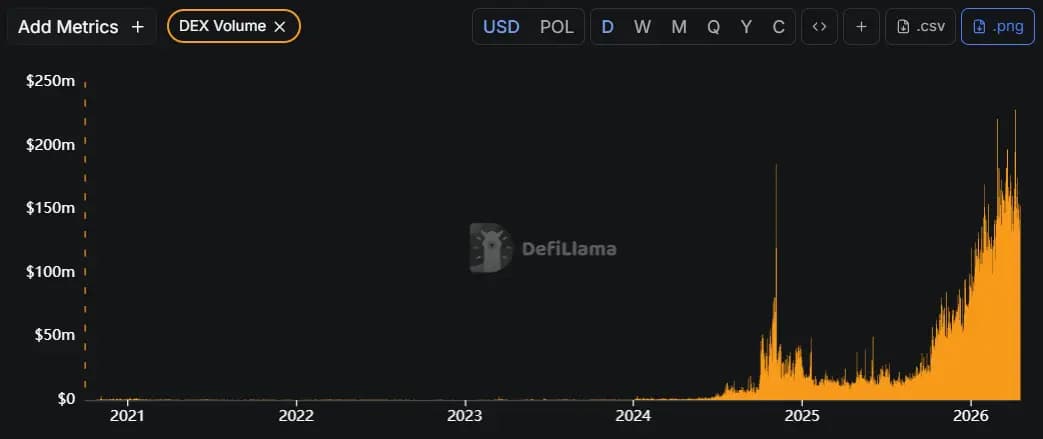
Let’s start with the number of polymarket users. In crypto, users are often measured through the number of wallets or addresses, but that is a flawed proxy. One person can control multiple wallets, some users interact through proxy systems, while others may only participate in specific markets. Effectively, this means that wallet counts do not equal unique users. They are a rough indicator, not a precise measure.
The same issue appears with polymarket volume. Not all on-chain activity represents straightforward trading. Prediction markets involve minting, redeeming, and converting positions, and if you aggregate all flows without distinction, you can overstate real trading volume.
Therefore, does this mean that the growth is fake? No, of course not. It simply means the metrics are easy to misread.
A more useful approach is to look at behaviour over time. Are spreads tightening? Is liquidity improving? Are markets reacting faster to new information? Research suggests that as Polymarket grew, price efficiency improved, and that supports the idea that real participation is truly increasing.
Can polymarket data be trusted?
The question of polymarket data reliability is not binary.
First of all, we must acknowledge that prediction markets can produce useful signals even when the underlying data is imperfect. Prices reflect incentives and collective positioning, which can still capture meaningful information, but that does not mean every metric should be treated as ground truth.
Public dashboards often simplify complex activity into clean categories, and by doing so, they hide important distinctions. Volume, user counts, and engagement can all be presented in ways that look clear but mask underlying complexity.
Therefore, a more grounded view is that Polymarket data is directionally useful but structurally messy. Reliability, in this context, comes from understanding how the data is generated, not from assuming that every number is precise.
Polymarket Wash Trading, Polymarket Manipulation, and Market Risks
As Polymarket grows, questions around polymarket manipulation and wash trading become harder to ignore.
Some research has identified patterns consistent with wash trading during periods of high activity. Obviously, that does not mean all volume is artificial, but it does suggest that part of it may be inflated or strategically generated.
There are also broader manipulation risks that should be considered. Prediction markets create incentives to influence perception, and in thin markets, relatively small amounts of capital can move prices dramatically. Furthermore, in highly visible markets, there may be incentives to shape narratives through trading activity.
That said, we should make sure to clarify that this is not unique to Polymarket by any means, but it is a feature of any market that aggregates information into a price. What changes at such a large scale is the impact. When a platform becomes widely referenced, distortions matter more, as they can influence public perception, not just trader behaviour.
So, is Polymarket Legit?
Yes, but not in the simplistic way the question is often framed. Polymarket is legitimate in the sense that it has real funding, real activity, and increasing relevance. It is not a fringe experiment, but it became a functioning market with meaningful participation.
At the same time, its data is not as clean as it appears, its metrics require interpretation, and its market structure introduces risks around incentives and behaviour.
So the better answer is that Polymarket is real, but it is not simple. Anyone treating it as fully transparent is overlooking complexity, while anyone dismissing it as unreliable is ignoring the evidence of real usage and capital.
The reality is that the truth sits in the middle!
What Polymarket Reveals About the Future of Crypto Applications
Polymarket matters because it shows what happens when crypto produces an application that people actually use to make decisions.
It combines capital, information, and real time interaction in a way that feels closer to financial infrastructure than speculative tooling, while it also highlights the importance of performance, reliability, and data interpretation.
More broadly, it suggests that the next wave of crypto applications may not look like traditional finance or pure decentralisation experiments. In all likeness, they may look like hybrid systems where infrastructure quietly supports products that feel intuitive on the surface.
That shift puts more weight on the underlying systems. If applications like this continue to grow, the quality of the infrastructure beneath them will matter even more. This is where platforms like Spectrum Nodes fit into the picture, supporting the systems that allow these applications to operate at scale. If you are in the process of building a new application within the space, or simply want to learn more about Spectrum Nodes, we highly encourage you to follow us on X or read our docs.
Frequently Asked Questions (FAQs)
Is Polymarket legit?
Yes. It has real funding, real activity, and growing relevance. But its data and metrics require careful interpretation.
Who funded Polymarket?
Polymarket raised capital from General Catalyst, Founders Fund, Polychain, ParaFi, and other investors, with later involvement from institutional players like Intercontinental Exchange.
What is Polymarket’s valuation?
Estimates suggest valuations above $1 billion, with higher implied valuations following later investment rounds. These figures reflect expectations, not certainty.
How does Polymarket make money?
Through trading fees on certain markets, combined with liquidity incentives that redistribute part of those fees.
How many users does Polymarket have?
There is no single precise figure. Wallets and accounts are not the same as unique users, so estimates vary depending on methodology.
Can Polymarket be manipulated?
Yes. Like any market, it can be influenced by trading behaviour, especially in low liquidity environments.
Is Polymarket volume real?
Partly. Some activity reflects genuine trading, but raw volume can include flows that do not represent simple buy and sell activity.