
How Crypto Hacks Happen: A Deep Dive into Smart Contract Vulnerabilities

In 2026, smart contract vulnerabilities still remain one of the most persistent causes of cryptocurrency hacks, but focusing on these types of hacks in isolation may lead you to miss the bigger picture. If one had to pause and analyse the scale and pattern of losses across the ecosystem, an emerging pattern that points to something more structural becomes evident. Exploits are not random failures, but they are the end result of systems that are designed, deployed, and also operated in ways that consistently expose risk.
In the past couple of years, what truly changed was not just how often hacks happen within the crypto space, but in which areas they succeed. Obviously, code still breaks, but increasingly, attackers are targeting everything around it. Unfortunately, many teams continue to act as if smart contract vulnerabilities are the only risks, and therefore focus heavily on contract level security, while the highest impact failures are evidently emerging elsewhere.
Because of this, it is fair to argue that this gap between perception and reality is where most risk now sits.
The Reality of Crypto Hacks: How Common Are They?
More often than not, crypto hacks are discussed as stand alone incidents, but data shows a different story. Hacks not only happen consistently, but their financial impact continues to grow. Just in 2025, research suggested that losses exceeded $3.4 billion, with the February 2025 Bybit incident responsible for nearly half of those losses. Concurrently to these big hacks, hundreds of security incidents are recorded each year, creating a steady baseline of failures across the ecosystem.
At first glance one may feel that this is contradictory. If incident counts are relatively stable and not increasing, it might suggest that security is improving, but in reality the opposite is happening. Risk is not stabilising or decreasing, but it is concentrating. A small number of failures now account for a disproportionate share of losses, which logically points to deeper systemic weaknesses rather than isolated bugs.
Once you view the data this way, the question shifts. It is no longer about how often hacks happen, but why the same types of failures continue to produce such large outcomes.
What Are Smart Contract Vulnerabilities?
Before moving on, it makes sense to define what smart contract vulnerabilities actually are, and just as importantly, what they are not.
Putting it simply, smart contract vulnerabilities are weaknesses in code or overall design that allow for unintended outcomes. To be more specific, that includes technical bugs, flawed and wrong assumptions, and economic behaviours that were never properly tested under adversarial conditions. Due to the nature of blockchain technically, the main problem is that once these vulnerabilities are deployed, they effectively become part of the system, and smart contracts do not allow for quiet fixes. If something breaks, it breaks publicly and often irreversibly.
However, treating vulnerabilities as purely technical issues is where many teams go wrong, as a contract can pass all tests, may be able to compile correctly, but still fail in production.
How? This happens because contracts do not operate in isolation. Smart contracts are constantly interacting with other protocols, they depend on external data, and respond to market conditions that are constantly changing. Therefore, it is important to understand that vulnerabilities are not just coding mistakes, but they are gaps between how a system is expected to behave and how it behaves under pressure.
Most Common Smart Contract Vulnerabilities Exploited in Crypto
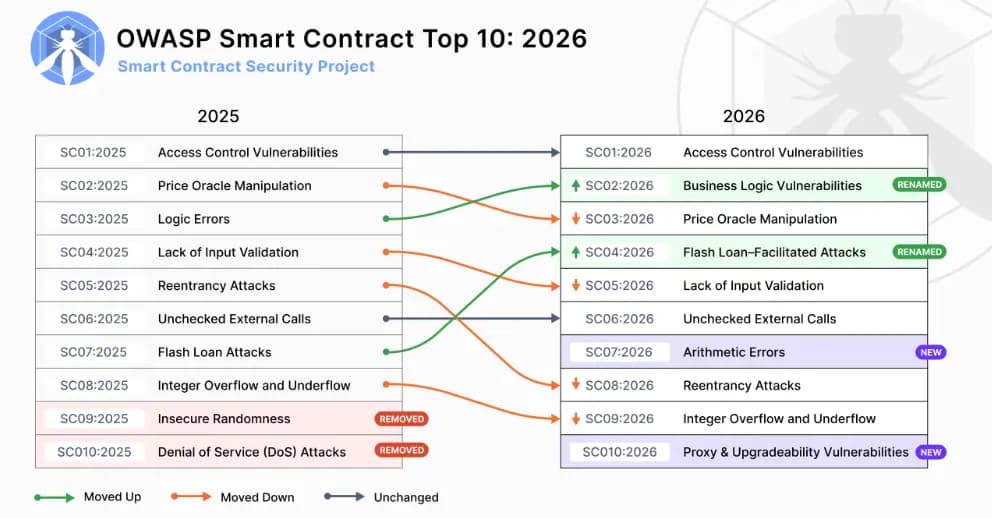
Although no two exploits are exactly the same, patterns may be drawn and similarities can be observed. Therefore, let's invest some time to have a quick overview of some of the most common smart contract vulnerabilities.
Reentracy Attacks
One of the most common types of attacks is known as Reentrancy. This type of exploit occurs when a contract allows an external call before updating its internal state, creating a window where funds can be drained repeatedly. Even though this issue has been understood for years, it still continues to appear because of how small variations in implementation can essentially reintroduce the same risk.
Flash Loan Attacks
Flash loan attacks reveal a different kind of weakness, and demonstrate that attackers do not even need capital to exploit a system. By making use of flash loans, the only thing that an attacker needs is the ability to manipulate the conditions temporarily by pushing a protocol into an extreme state. The contract itself may still behave as designed, but the environment it depends on would no longer be stable, and therefore making the exploit possible. A great example of this type of hack is the 2023 Euler Finance exploit that showed how flash loan mechanics could be used to bypass expected protocol behaviour, leading to losses of nearly $200 million.
Oracle Manipulation Protocols often rely on external price feeds and assume they reflect reality, but in practice, those feeds can be influenced, especially in low markets with low liquidity. When that happens, the contract still treats the data as valid and executes its logic exactly as designed, leading to outcomes that can be exploited. Classic examples of oracle manipulation are DeFi exploits where pricing assumptions break under pressure rather than code itself failing outright.
Access Control
As a final example, let’s discuss Access Control attacks. Although these types of attacks are often simpler, it does not mean they are not devastating. As the name suggests, Access control attacks revolve around misconfigured permissions or exposed administrative functions that end up giving attackers direct control over critical operations. A real world example of this attached occurred in 2022. Essentially, the Nomad bridge exploit had a verification flaw that allowed the attackers to replicate malicious transactions and drain funds at scale.
Why Smart Contract Exploits Keep Happening
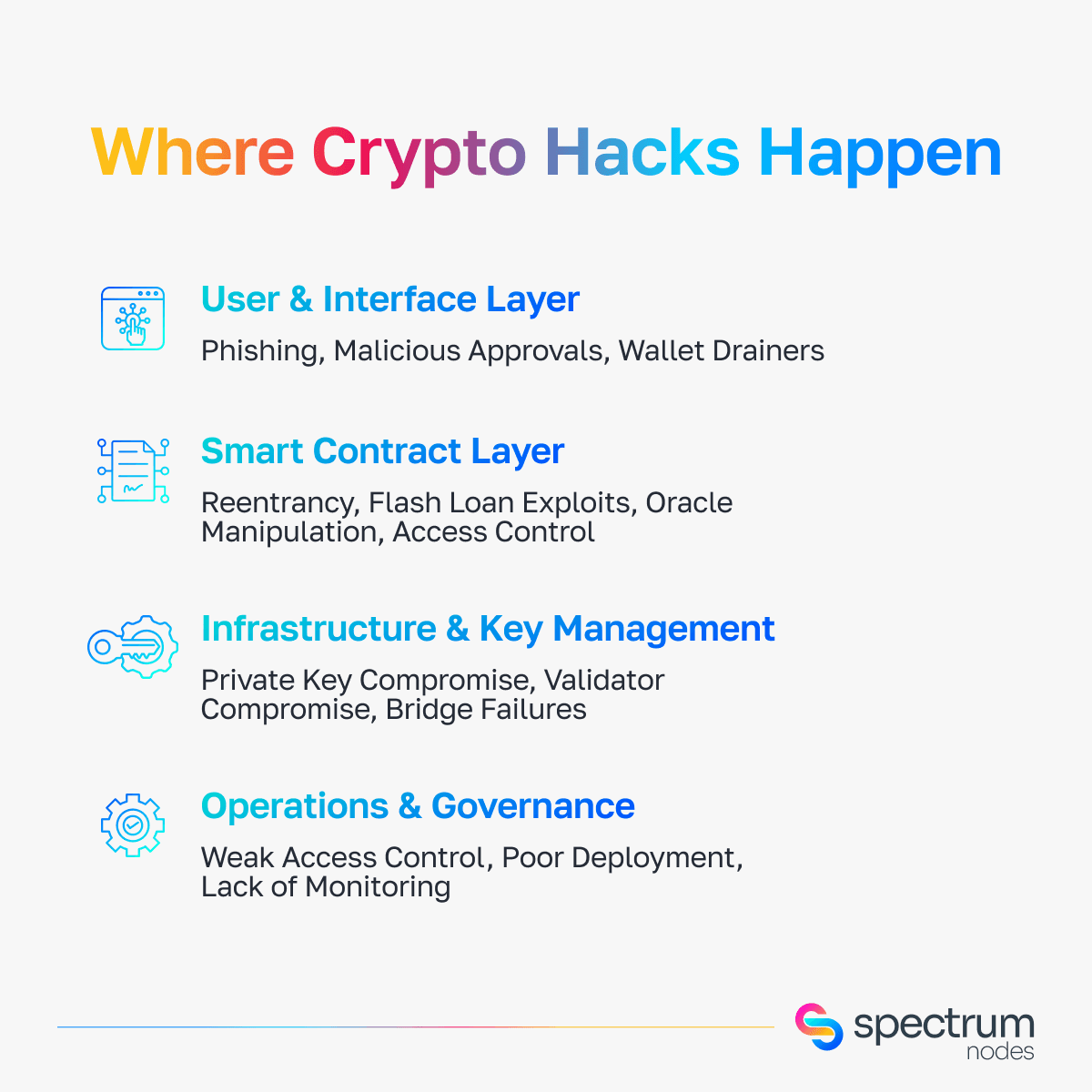
It may be tempting to argue at this point that exploits happen because developers make mistakes, but that explanation is too narrow to be useful. A better and more accurate explanation is that often it is that the environment encourages those mistakes. Regularly, teams work under significant pressure to ship quickly, and therefore security is often treated as a final step rather than something that shapes development from the beginning. At the same time, one has to also appreciate that systems are becoming more interconnected, which in turn makes it harder to fully understand how different components behave together.
Furthermore, there is also a more important shift that changes how these risks should be interpreted. Recent data shows that the largest losses are increasingly driven by infrastructure failures and key compromises rather than pure smart contract bugs. Although this does not reduce the importance of vulnerabilities in any way, it does reframe them as one part of a larger system of risk.
Treating a smart contract audit as just the final checkpoint before deployment is where problems begin. An audit can truly help in identifying issues in code, but it does not secure signing workflows, infrastructure, or operational processes, and when those layers are weak, even well audited contracts can still be compromised.
Who Is Most at Risk?
This layered view of risk becomes much more apparent when looking at what kinds of projects are most frequently affected. First of all, DeFi protocols remain consistent targets because they combine large amounts of capital with complex logic and constant interaction with other systems. Additionally, new projects face additional exposure because they are often deployed before their assumptions have been tested in real conditions.
Although centralised exchanges and custodians operate differently, they experience similar risks, and when they fail, they fail at scale due to the concentration of assets and control. Furthermore, infrastructure providers and staking operators introduce another dimension as a failure at this level can cascade across multiple protocols, affecting systems that depend on them.
At this stage it makes sense to mention that even users themselves form part of the attack surface. Phishing and approval based attacks continue to account for a significant share of incidents, even if they are not always categorised as smart contract exploits.
How to Reduce Risk: From Vulnerabilities to Prevention
Considering that evidently risk is distributed across multiple layers, then reducing risks require a broader approach. First of all, and probably most importantly, secure development practices remain essential, and they need to account for adversarial behaviour rather than expected use. This also includes testing how contracts behave under extreme conditions and also in combination with other protocols.
Secondly, monitoring becomes just as important as prevention, as many incidents escalate because they are not detected early enough to limit their impact. Additionally, governance and access control also need to be treated as core parts of security, as weak permissions often lead to outcomes that no amount of code quality can prevent. Within this context, engaging smart contract audit services early becomes a practical step, as audits help identify vulnerabilities before deployment, when they can still be addressed without operational risk.
Why Smart Contract Audits Are Critical for Preventing Crypto Hacks
A smart contract audit provides an independent assessment of the code and overall design, while at the same time a good audit identifies vulnerabilities, tests assumptions, and highlights areas where the system may fail under stress.
Furthermore, it introduces a different perspective which is probably the most important aspect of smart contact audits overall. Internal teams are often too close to their own systems to see certain risks clearly, and an audit challenges those blind spots. For teams building within the space, an audit is a critical layer of defence, but it is also fair to say that it is not a guarantee of security. Its true value comes from how it fits into a wider system that includes monitoring, governance, and infrastructure controls.
Final Thoughts
Crypto hacks often follow patterns, and they are not unpredictable events. Smart contract vulnerabilities remain a critical part of the problem, but they exist within a broader system that includes infrastructure, governance, and human behaviour. Therefore this essentially means that focusing on one layer while ignoring others leads to incomplete security strategies.
The difference between a secure system and a compromised one is rarely accidental. In our view, it comes down to how well risk is understood and how consistently it is managed across the entire stack.
Protect Your Protocol Before It Becomes a Statistic
If you are building or managing a protocol, the relevant question is not whether vulnerabilities exist, but whether they have been identified and addressed across the full system.
A structured review helps surface risks before they are exploited. If you want to understand your exposure in practical terms, speak with our team about auditing.
Frequently Asked Questions (FAQs)
How do smart contract vulnerabilities lead to crypto hacks?
They create conditions where attackers can exploit unintended behaviour in code or design, allowing unauthorised access to funds or manipulation of protocol logic.
What are the most common smart contract vulnerabilities?
Reentrancy, flash loan attacks, oracle manipulation, and access control issues are among the most common causes of smart contract exploits.
Are smart contract vulnerabilities preventable?
Many can be reduced through secure development practices and audits, though risk cannot be completely eliminated.
What is a smart contract audit and why is it important
It is a detailed review of code and system design that identifies vulnerabilities before deployment and helps reduce the likelihood of exploits.
When should a project get a smart contract audit?
Before deployment and after major updates, especially when changes introduce new risks.
How can projects reduce the risk of crypto hacks?
By combining secure coding, monitoring, strong access controls, and independent audits, projects can significantly reduce exposure to blockchain security risks.