
What Is Bittensor (TAO)? Beginner Guide to the Decentralised AI Network
Updated October 22, 2026 · Spectrum Nodes
Short answer: Bittensor is a blockchain based protocol that runs an open marketplace for machine intelligence. Developers contribute machine learning models to specialised subnets, validators score their outputs, and the most useful contributors earn TAO, the network's native token. Like Bitcoin, TAO has a fixed maximum supply of 21 million and a halving schedule. Bittensor's Subtensor blockchain is built with the Substrate framework.
AI is developing fast. New models appear every year, sometimes every month, and AI now sits inside everything from search engines to financial tools. Behind that progress sits a concern: most of the world's advanced AI systems are controlled by a small number of large companies.
Those companies own the data, the models and the infrastructure needed to train them. The approach has produced impressive technology, and it also concentrates power and limits who can contribute to the future of AI.
Bittensor offers another route. It is a blockchain based protocol designed to create an open marketplace for machine intelligence. Instead of relying on one organisation to build and distribute AI models, developers anywhere contribute models and earn rewards when their outputs are useful.
This guide explains what Bittensor is, how its blockchain works, what the TAO token does and why decentralised AI is a growing conversation in tech.
What Is Bittensor?
Bittensor is a decentralised machine learning network where AI models collaborate and compete in an open ecosystem. Machine learning is the branch of AI where models learn patterns from data instead of following hand written rules.
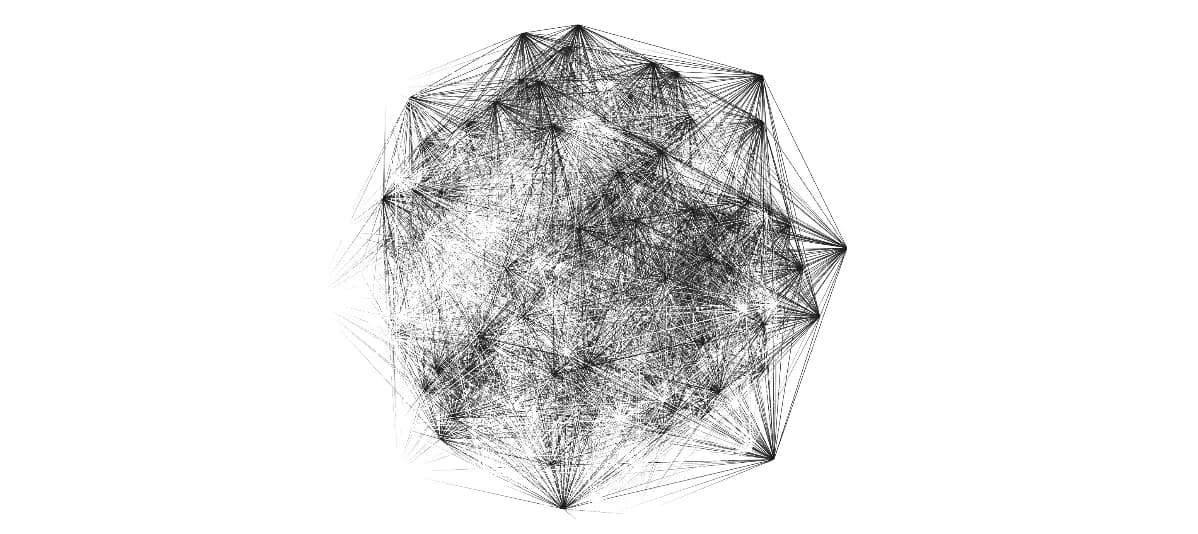
Traditional AI platforms host a single model or service. Bittensor works more like a shared infrastructure layer: you contribute your own model, other participants evaluate it continuously, and useful outputs earn rewards from the network.
That turns machine intelligence into something close to a marketplace. Instead of one company building the "best" model, many models compete and improve over time, and developers are rewarded for better results.
The project launched in 2021 and is closely associated with founder Yuma Rao and a growing open source developer community. From the start, the vision has been an ecosystem where machine intelligence is shared across a global network of contributors rather than owned by one organisation. Bittensor is a framework for coordinating decentralised machine learning across many independent participants.
How Does the Bittensor Blockchain Work?
Bittensor combines blockchain infrastructure with machine learning evaluation, so intelligence can be measured and rewarded in the open. It has three main parts: the Subtensor blockchain, AI subnets, and the miners and validators who take part.
Subtensor: The Blockchain Layer
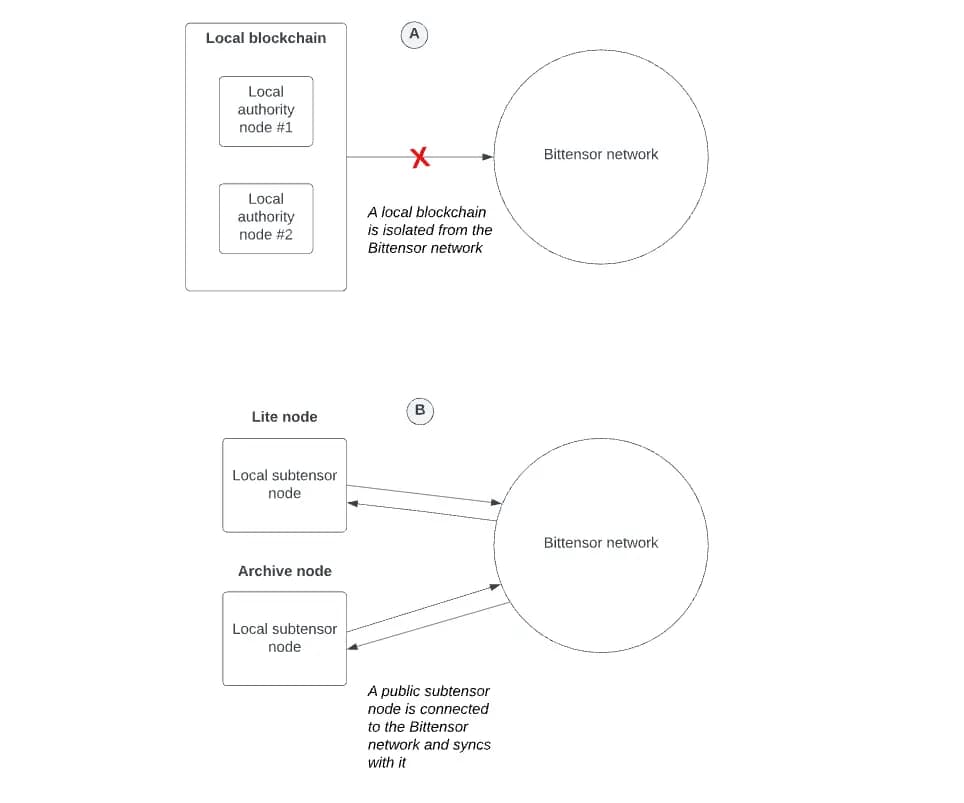
Subtensor is the blockchain at the foundation of Bittensor. It is the coordination layer that manages staking, incentives, governance and rewards.
Subtensor is built with Substrate, a framework for building blockchains that is also used by chains such as Polkadot. Subtensor runs independently and is designed for decentralised AI rather than general purpose apps.
The chain records participation and makes sure rewards are distributed fairly, without a central authority deciding which models are valuable. Value emerges from the interactions on the network itself.
What Are Bittensor Subnets?
A subnet is a specialised environment within Bittensor where one type of AI task is performed, such as language modelling, prediction systems or data analysis.
Subnets let the ecosystem grow organically. Rather than forcing all innovation into a single model, developers create specialised markets for specific problems.
Inside each subnet, participants compete to produce the best outputs. The better a model performs, the more rewards it earns, so competition drives continuous improvement. The result behaves more like a marketplace than a traditional software platform.
What Do Miners and Validators Do?
Bittensor assigns two roles to keep the system running, and the network distributes rewards based on validators' evaluations.
| Role | What they do | How they earn |
|---|---|---|
| Miners | Provide machine learning models and compute, and produce outputs for tasks within a subnet | TAO rewards when validators rate their outputs as valuable |
| Validators | Evaluate miners' outputs, compare results and decide which contributions are most valuable | TAO rewards for evaluating and maintaining the network |
Incentives are tied directly to performance. Participants keep improving their models, which raises the overall intelligence of the network.
What Is the TAO Token Used For?
TAO is the native cryptocurrency of Bittensor. It rewards contributors, enables governance and aligns incentives across the network.
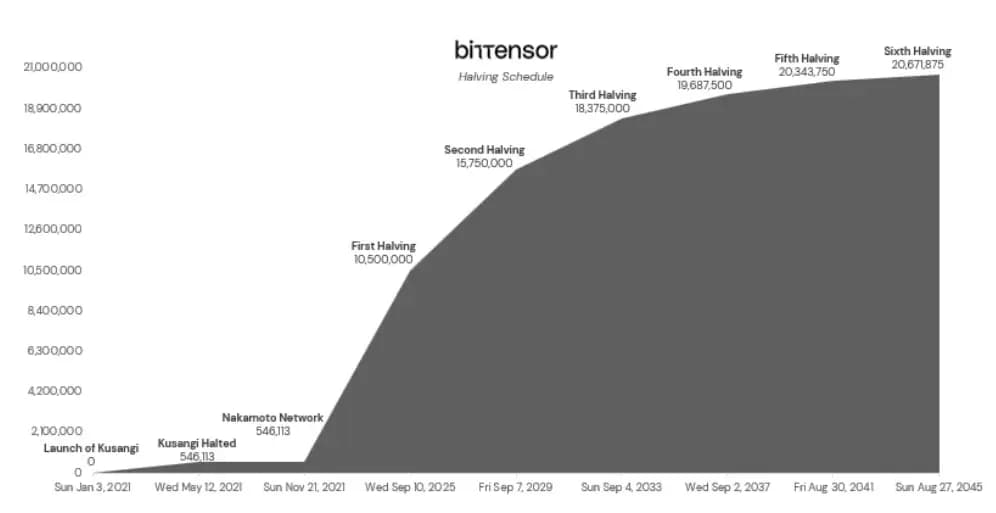
Like Bitcoin, TAO has a fixed maximum supply of 21 million tokens. The network also follows a halving schedule, a planned series of cuts in the rate at which new tokens enter circulation.
TAO has three functions:
- Rewards. It pays miners and validators for contributing useful intelligence and maintaining the network
- Governance. Token holders take part in decisions about how the protocol evolves
- Participation. It regulates participation in the ecosystem by aligning incentives across different contributors
By linking economic rewards to performance, TAO makes sure the most valuable intelligence is prioritised.
Why Does Decentralised AI Matter?
Decentralised AI lowers the barrier to building AI. Developers and researchers without access to large corporate infrastructure can still join Bittensor and contribute valuable models.
- Accessibility. Talent from anywhere can help advance AI
- Global collaboration. Innovation can emerge outside a few major technology hubs, so the ecosystem evolves in a more diverse and open way
- AI marketplaces. Apps could integrate AI capabilities from decentralised networks instead of relying on one provider, which encourages transparency, competition and flexibility
The intersection of blockchain and AI is an active area of research. NEAR, for example, is experimenting with AI focused infrastructure, which we explored in our article on NEAR Intents and AI on the NEAR Protocol.
AI agents that act onchain are another part of this shift. See AI agents in blockchain and what they need from RPC infrastructure.
What Are the Challenges for Bittensor?
Bittensor's biggest challenges are scoring quality fairly and growing adoption on both sides of its marketplace.
- Scoring. Evaluating machine learning outputs in a decentralised environment is hard, and the network has to keep refining its scoring so rewards reflect the quality of contributions
- Adoption. The ecosystem needs both contributors who provide models and users who benefit from their outputs
- Governance and regulation. As decentralised AI systems evolve, policymakers and developers will need to work out how these networks fit existing frameworks
Is Bittensor the Future of AI?
Bittensor is an ambitious attempt to rethink how artificial intelligence is built and shared. By combining blockchain incentives with decentralised machine learning, it lets developers contribute models, compete on quality and earn rewards for useful outputs.
The project is still developing. It makes the case that the future of AI may belong to networks where intelligence is shared, evaluated and improved collectively, rather than to a single company or platform.
To stay updated on emerging blockchain technologies, staking opportunities and infrastructure, explore more guides and research on the Simply Staking blog.
Can I Get Bittensor RPC on Spectrum Nodes?
Yes. Spectrum Nodes runs Bittensor RPC on Bittensor EVM mainnet, live as of October 22, 2026 (see our networks page). Create an endpoint in the dashboard and you get RPC and WebSocket URLs for each region.
| Network | Chain ID | Hex |
|---|---|---|
| Bittensor EVM mainnet | 964 | 0x3c4 |
FAQ
What is the Bittensor chain ID? The Bittensor EVM mainnet chain ID is 964 (0x3c4 in hex), and Spectrum Nodes serves its RPC.
What is Bittensor? Bittensor is a decentralised machine learning network that runs on its own blockchain, Subtensor. Developers contribute AI models to subnets, validators score their outputs, and useful contributions earn TAO.
What is the TAO token? TAO is Bittensor's native cryptocurrency. It rewards miners and validators, gives token holders a say in governance and aligns incentives across the network.
What is the maximum supply of TAO? TAO has a fixed maximum supply of 21 million tokens, the same cap as Bitcoin. A halving schedule gradually reduces the rate of new TAO entering circulation.
How do Bittensor subnets work? A subnet is a specialised market inside Bittensor for one type of AI task, such as language modelling or prediction. Miners compete to produce the best outputs, and the better a model performs, the more TAO it earns.
What is the difference between Bittensor miners and validators? Miners provide models and compute and produce outputs for subnet tasks. Validators evaluate and compare those outputs, and the network distributes rewards based on their evaluations.