
Best Base RPC Providers for 2026
Updated October 22, 2026 · Spectrum Nodes
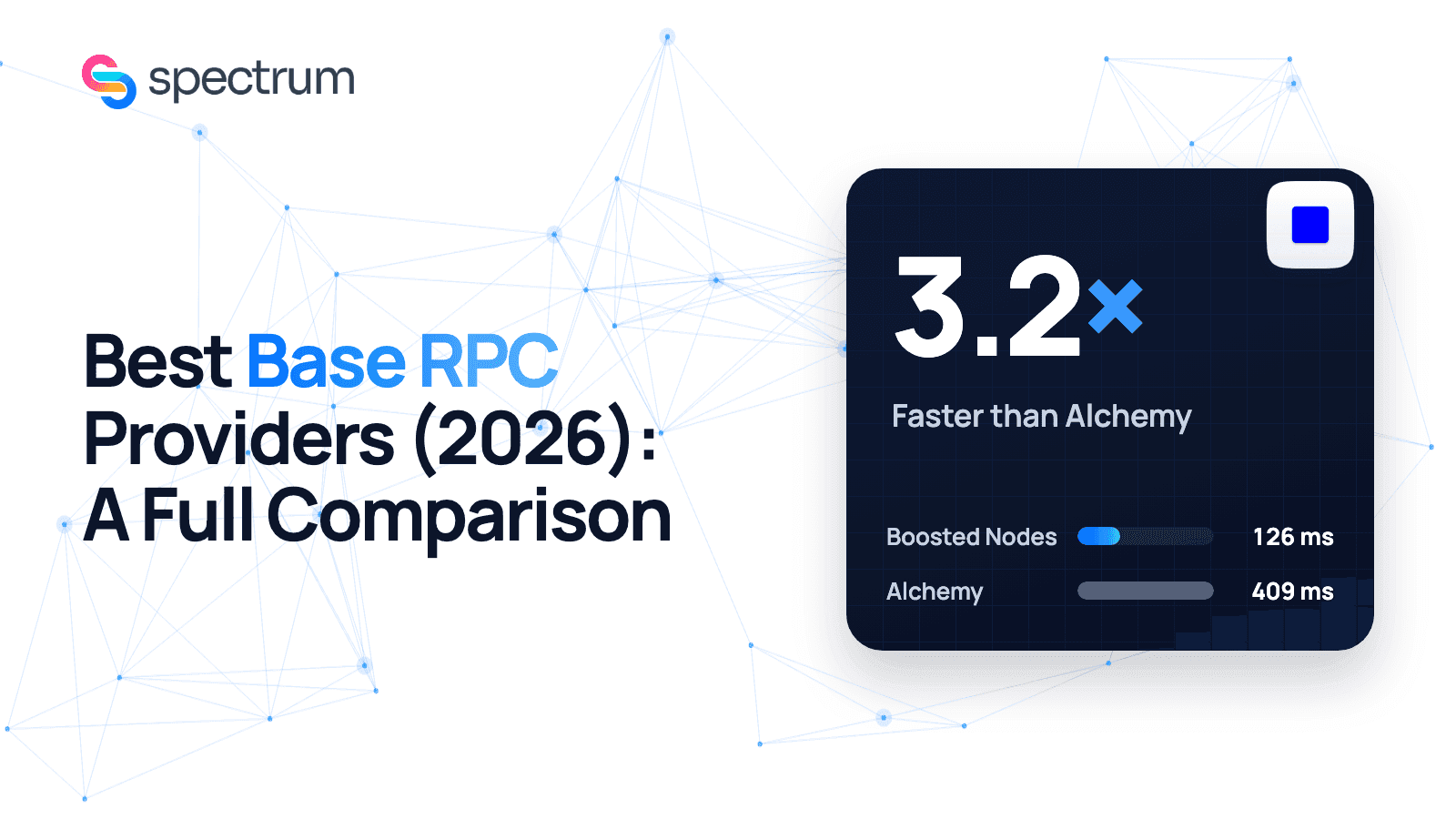
Short answer: if you need a low latency Base RPC for block traces, our pick is Spectrum's Boosted Nodes from Spectrum Nodes. In a head to head test from September 29 to October 14, 2026, they returned Base block traces (debug_traceBlockByNumber) in a median of 126 ms against 409 ms on Alchemy, 3.2× faster, and answered first on 94% of about 50,000 same instant requests.
Alchemy, Chainstack, Infura and QuickNode round out the list. Below you get our test results, each provider's free tier and entry plan, and which one fits which job.
How Did We Rank Base RPC Providers?
We ranked on measured block trace latency first, then on trace access and price of entry.
Base makes a canonical block every 2 seconds. If you index or explore the chain, you call debug_traceBlockByNumber on every one of them, so trace latency sets your pace. A block trace replays every transaction in a block and returns what each one did, which makes it one of the heaviest calls an RPC provider serves.
That pace is about to get faster. Base's Denim upgrade, live on Base Sepolia since October 21, 2026 and targeted for mainnet in November, moves Base to 200 ms canonical blocks. Ten times the blocks means ten times the traces.
- Measured Base block trace latency. Our RPC monitor sent the same call to Spectrum's Boosted Nodes and Alchemy at the same instant, every cycle, from September 29 to October 14, 2026.
- Trace access and price of entry. Which plan gets you the debug namespace on Base, and what it costs.
Our own head to head test covers Spectrum's Boosted Nodes and Alchemy. Chainstack, Infura and QuickNode follow in alphabetical order, with facts from their own pricing and docs pages and the Base latency they have published themselves, source and date next to each figure. Those published tests cover light reads such as balances and receipts, not block traces, so the table names the test behind every number and the section below gives the detail.
How Do Base RPC Providers Compare?
Spectrum's Boosted Nodes had the lower block trace latency of the two providers we measured. The other figures come from light read tests the providers ran themselves, so the table names the test next to each number.
| # | Provider | Best for | Base latency, median, with the test it comes from | Free tier | Entry paid plan | Debug and trace |
|---|---|---|---|---|---|---|
| 1 | Spectrum's Boosted Nodes | Indexers and explorers tracing every block | 126 ms block traces, our test, Sep 29 to Oct 14, 2026 | 10M credits, 25 RPS, Boosted included | Starter, $1.99 a month | Yes, Boosted on every plan |
| 2 | Alchemy | Teams already on Alchemy's SDK and tooling | 409 ms block traces, our test · 9 ms light reads, Alchemy's test, Aug 2026 · 123 ms light reads, Chainstack Compare, Aug 2026 | 30M compute units a month, 15 RPS | Pay as you go, $0.525 per 1M compute units | Yes on Base (used in our test) |
| 3 | Chainstack | Predictable request based billing | 44 ms light reads, Chainstack Compare, Aug 2026 | 3M request units a month, 25 RPS | Growth, $49 a month | From Growth |
| 4 | Infura | Teams that want a daily credit quota | 105 ms light reads, Alchemy's test, Aug 2026 | Daily credit quota | Developer, $50 a month | Not confirmed for Base in Infura's docs |
| 5 | QuickNode | Teams that want published multi region benchmarks | 22 ms light reads, Alchemy's test, Aug 2026 · 33 ms light reads, Chainstack Compare, Aug 2026 | 1 month trial, 10M API credits | Build, $49 a month | Yes, limited on the free trial |
Prices from each provider's pricing page on October 22, 2026. Block trace figures are from our own head to head test. Light read figures are the providers' published medians, rounded to the millisecond; p95, methods and windows are in the section "What Base Latency Do the Providers Publish Themselves?".
What Base Latency Do the Providers Publish Themselves?
Two public datasets give Base latency per provider, and both measure light reads only. Light reads are cheap calls such as balances, blocks, logs and receipts. Neither dataset includes debug_traceBlockByNumber, and both were run by a provider on the list, so read them as each vendor's own view.
Alchemy's Base benchmark, August 8 to 13, 2026. About 1.38 million calls from AWS runners in US East, US West, EU Central and AP Southeast, on standard paid accounts with warm connections. Methods: eth_getBalance, eth_getBlockByNumber, eth_getLogs over 1, 10 and 100 blocks, and eth_getTransactionReceipt.
| Provider | Average | p50 | p95 | Success rate |
|---|---|---|---|---|
| Alchemy | 15.66 ms | 9.34 ms | 49.91 ms | 99.9999% |
| QuickNode | 56.16 ms | 22.45 ms | 234.18 ms | 99.9989% |
| dRPC | 73.89 ms | 38.71 ms | 254.38 ms | 99.8025% |
| Infura | 118.16 ms | 104.93 ms | 276.39 ms | 99.9991% |
Chainstack Compare, seven days to August 28, 2026. Chainstack's public dashboard sends calls to each provider every one to three minutes from serverless functions in Germany, the US and Asia. The figures below are the snapshot Finestel reported on September 1, 2026.
| Provider | Availability | p50 | p95 | p99 |
|---|---|---|---|---|
| QuickNode | 99.99% | 33 ms | 76 ms | 129 ms |
| Chainstack | 99.82% | 44 ms | 540 ms | 1.15 s |
| Alchemy | 99.98% | 123 ms | 850 ms | 1.90 s |
Three things stand out:
- The two tests disagree by an order of magnitude on Alchemy (9 ms vs 123 ms at p50) and by 3× on QuickNode's p95. Each vendor comes first in its own test. Region, account tier and connection reuse change the answer.
- Neither test touches block traces. Light reads on Base sit between 9 ms and 123 ms at the median for every provider measured. Our trace test shows a 126 ms vs 409 ms gap on a single call, which is where the time goes for indexers.
- Chainstack and Infura have no published trace numbers on Base from any source we found. QuickNode publishes a live p95 dashboard, but its Base view loads in the browser only, so we quote the Chainstack Compare snapshot instead.
We will replace the published figures with our own measurements once our RPC monitor covers these providers on Base.
1. Spectrum's Boosted Nodes
Best for: indexers, explorers, analytics platforms and trading teams that trace or replay Base blocks at volume.
Spectrum's Boosted Nodes are our caching and routing layer in front of our own nodes. Block traces are among the heaviest calls an RPC provider serves, which is why the gap is largest there.
Base results, Spectrum's Boosted Nodes vs Alchemy:
| Call | Spectrum's Boosted Nodes | Alchemy | Answered first |
|---|---|---|---|
Block traces, median (debug_traceBlockByNumber) | 126 ms | 409 ms | 94% of requests |
| Block traces, slowest 5% (p95) | 399 ms | 2,120 ms |
That is 3.2× faster on block traces at the median and 5.3× faster in the slowest 5%. The p95 figure is the time within which 95% of requests finish, so it shows the slow tail.
The lead holds from a second test server in Canada: 285 ms on Spectrum's Boosted Nodes vs 620 ms on Alchemy for Base block traces.
What sits under it:
- Our own racks and hardware in Tier III data centers across the US and Europe, plus a bare metal deployment in Singapore
- Over a billion requests a day at 99.999% uptime
- SOC 2 Type II attested, and no breach on record
- Spectrum's Boosted Nodes on every plan, free tier included
- Webhooks on Base, so you stop polling for the wallet activity you care about
Pricing:
- Free: 10M credits at 25 RPS, 3 endpoints
- Starter: $1.99 a month for 14M credits at 50 RPS, unlimited endpoints
- Developer: $9.99 a month for 70M credits
- Growth: $35 a month for 245M credits at 75 RPS
- Business: $150 a month for 1.15B credits at 200 RPS
- Enterprise: $500 a month for 4.2B credits at 350 RPS, with limits opened up on request
Pay by card or USDC. Extra credits from $1.30 per 10M.
Worth knowing: credits are weighted per method, and trace calls cost more than simple reads. Our speed figures compare against Alchemy only.
2. Alchemy
Best for: teams already built on Alchemy's SDKs and developer tools.
Alchemy is the largest name in the category and serves Base mainnet and the Base Sepolia testnet. It supports the debug namespace on Base, which is how we measured it in our test: 409 ms median on block traces and 2,120 ms at p95.
- Free plan: 30M compute units a month at 15 requests per second
- Pay as you go: $0.525 per 1M compute units, from 300 requests per second
- Enterprise: custom pricing with signed SLAs, from 1,000 requests per second
On light reads, Alchemy's own August 2026 test puts it at 9.34 ms p50 and 49.91 ms p95 on Base. Chainstack Compare's snapshot from the same month puts it at 123 ms p50 and 850 ms p95. Pick the test that matches your region and account tier, or run your own.
Worth knowing: pricing is in compute units, and each method has its own weight, so heavy calls such as traces use your allowance faster than simple reads. Flashblocks subscriptions on Base are priced per event.
3. Chainstack
Best for: teams that want request based billing they can forecast.
Chainstack bills in request units across all plans and lists Base with full and archive nodes and debug and trace support.
- Developer (free): 3M request units a month at 25 RPS. Archive data and debug and trace APIs are not included
- Growth: $49 a month for 20M request units at 250 RPS, with archive and debug and trace
- Pro: $199 a month for 80M request units at 400 RPS
- Enterprise: from $990 a month, unlimited RPS and custom uptime SLAs
Published Base latency: 44 ms p50 and 540 ms p95 on Chainstack's own Compare dashboard, seven days to August 28, 2026, light reads only. No published block trace figure on Base.
Worth knowing: you need a paid plan to trace Base blocks.
4. Infura
Best for: teams that prefer a daily credit quota to a monthly one.
Infura bills in credits counted per day and serves Base.
- Core (free): a daily credit quota with full archive data
- Developer: $50 a month for 15M daily credits at 4,000 credits per second
- Team: $225 a month for 75M daily credits at 40,000 credits per second
- Enterprise: custom pricing with an enhanced support SLA
Published Base latency: 104.93 ms p50 and 276.39 ms p95 in Alchemy's August 2026 Base benchmark, the slowest of the four providers in that test, with a 99.999% success rate. Light reads only, and Alchemy ran the test. Infura does not appear in the Chainstack Compare snapshot.
Worth knowing: Infura documents debug methods on other chains, but we could not find a Base debug reference in its docs. Confirm debug_traceBlockByNumber on Base before you build on it.
5. QuickNode
Best for: teams that want to compare providers on QuickNode's own published latency dashboards.
QuickNode serves Base and documents debug_traceBlockByNumber for Base mainnet, with limited usage on the free trial. It also offers Streams and webhooks on Base, and publishes a live P95 benchmark across five regions.
Published Base latency: 22.45 ms p50 and 234.18 ms p95 in Alchemy's August 2026 test, second of four there. In Chainstack Compare's snapshot from the same month it leads with 33 ms p50 and 76 ms p95. Light reads in both. No published block trace figure on Base.
- Free trial: one month with 10M API credits at 15 RPS
- Build: $49 a month at 50 RPS
- Scale: $499 a month at 250 RPS
- Enterprise: custom pricing, SOC 1 and SOC 2 Type 2
Worth knowing: API credits are weighted per method, so trace calls cost more credits than simple reads.
How Do You Choose a Base RPC Provider?
Test the call your product depends on, from your own region, and plan for Denim's 200 ms blocks.
- You index or explore the chain: trace latency is your bottleneck, and Denim's 200 ms blocks will make it tighter. Test
debug_traceBlockByNumberfrom your own region and look at p95, not only the median. Your users feel the slow tail. - You run a wallet, DEX or consumer app: Base streams 200 ms Flashblocks today, and Denim replaces them with canonical block and RPC streams. If your app reads Flashblocks, plan the migration and check how your provider handles it.
- You are prototyping: every provider here has a free tier or trial. Check whether it includes the debug namespace on Base before you build on it. For testnet ETH, see our Base Sepolia faucet guide.
Building on more than one chain? The same test covers Polygon RPC providers and BSC RPC providers.
How Did We Test Spectrum's Boosted Nodes Against Alchemy?
We sent identical calls to both providers at the same instant for 14 days and timed each response to the last byte.
- Method: Spectrum's RPC monitor sent the same calls to Spectrum's Boosted Nodes and Alchemy at the same instant, every cycle
- Window: September 29 to October 14, 2026 (14 days)
- Volume: about 50,000 requests per chain and call type
- Location: a test server in Finland, with a second server in Canada for the North America figures
- Latency: time from sending the request to receiving the last byte of the response
- Answered first: the share of same instant request pairs where Spectrum's Boosted Nodes answered first
FAQ
Which is faster for Base block traces, Spectrum or Alchemy?
Spectrum's Boosted Nodes. In our 14 day test they returned Base block traces (debug_traceBlockByNumber) in a median of 126 ms vs 409 ms on Alchemy, and answered first on 94% of about 50,000 same instant requests. We have not tested Chainstack, Infura or QuickNode yet, and no published Base benchmark we found measures block traces on them.
Which Base RPC provider has the lowest latency on light reads? It depends on who ran the test. Alchemy's August 2026 benchmark puts Alchemy first at 9.34 ms p50, then QuickNode (22.45 ms), dRPC (38.71 ms) and Infura (104.93 ms). Chainstack Compare's snapshot from the same month puts QuickNode first at 33 ms p50, then Chainstack (44 ms) and Alchemy (123 ms). Both measure balances, blocks, logs and receipts, not traces.
Which Base RPC providers support debug_traceBlockByNumber? Spectrum's Boosted Nodes, Alchemy, Chainstack and QuickNode offer it on Base. On Chainstack it starts on the Growth plan, and QuickNode limits it on the free trial. We could not confirm it for Base in Infura's docs.
Is there a free RPC for Base? Yes. Spectrum, Alchemy, Chainstack and Infura have free tiers, and QuickNode offers a one month free trial. Spectrum's free tier includes Spectrum's Boosted Nodes. Free tiers differ on trace access and requests per second.
What does p95 latency mean? The time the slowest 5% of requests take. For Base block traces, Spectrum's Boosted Nodes measured 399 ms at p95 vs 2,120 ms on Alchemy.
What does the Denim upgrade change for Base RPC users? Denim moves Base to 200 ms canonical blocks and replaces Flashblocks with canonical block and RPC streams. It went live on Base Sepolia on October 21, 2026, and mainnet is targeted for November 2026. Apps that read Flashblocks need to migrate.