
Best Polygon RPC Providers for 2026
Updated October 22, 2026 · Spectrum Nodes
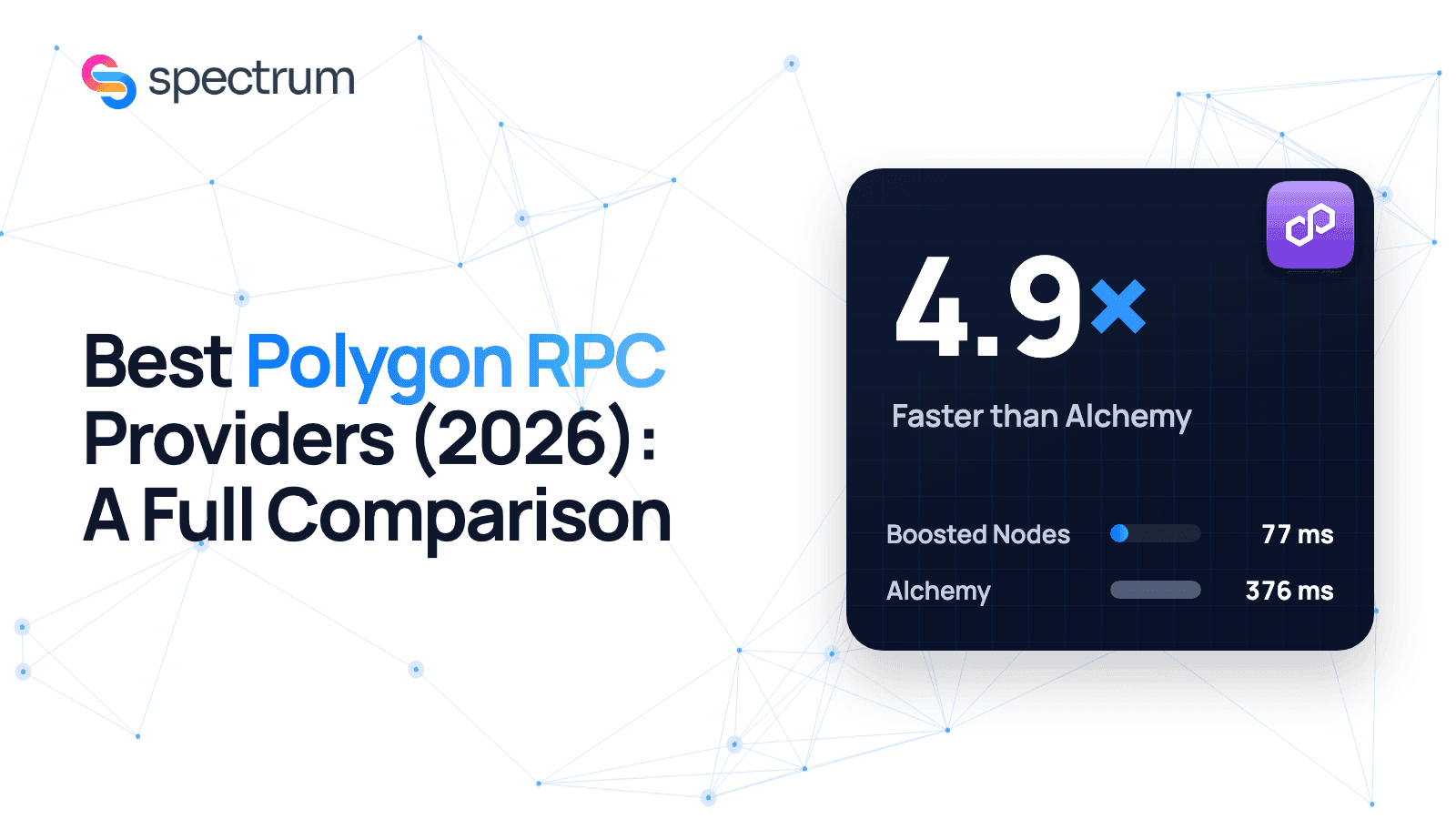
Short answer: if you need a low latency Polygon RPC for block traces, our pick is Spectrum's Boosted Nodes from Spectrum Nodes. In a head to head test from September 29 to October 14, 2026, they returned Polygon block traces (debug_traceBlockByNumber) in a median of 77 ms against 376 ms on Alchemy, 4.9× faster, and answered first on 100% of about 50,000 same instant requests.
Alchemy, Chainstack, Infura and QuickNode round out the list. Below you get our test results, each provider's free tier and entry plan, and which one fits which job.
How Did We Rank Polygon RPC Providers?
We ranked on measured block trace latency first, then on trace access and price of entry.
Polygon makes a block every 1.5 seconds. If you index or explore the chain, you call debug_traceBlockByNumber on every one of them, so trace latency sets your pace. A block trace replays every transaction in a block and returns what each one did, which makes it one of the heaviest calls an RPC provider serves.
- Measured Polygon block trace latency. Our RPC monitor sent the same call to Spectrum's Boosted Nodes and Alchemy at the same instant, every cycle, from September 29 to October 14, 2026.
- Trace access and price of entry. Which plan gets you the debug namespace on Polygon, and what it costs.
Chainstack, Infura and QuickNode have not been through our latency test yet. They are listed alphabetically after the two providers we measured, with facts from their own pricing and docs pages. We will add their numbers when the test includes them.
How Do Polygon RPC Providers Compare?
Spectrum's Boosted Nodes had the lower block trace latency of the two providers we measured. The table adds free tiers, entry plans and debug access for all five.
| # | Provider | Best for | Polygon block trace, median (our test) | Free tier | Entry paid plan | Debug and trace |
|---|---|---|---|---|---|---|
| 1 | Spectrum's Boosted Nodes | Indexers and explorers tracing every block | 77 ms | 10M credits, 25 RPS, Boosted included | Starter, $1.99 a month | Yes, Boosted on every plan |
| 2 | Alchemy | Teams already on Alchemy's SDK and tooling | 376 ms | 30M compute units a month, 15 RPS | Pay as you go, $0.525 per 1M compute units | Yes on Polygon (used in our test) |
| 3 | Chainstack | Predictable request based billing | Not yet tested | 3M request units a month, 25 RPS | Growth, $49 a month | From Growth |
| 4 | Infura | Teams that want a daily credit quota | Not yet tested | Daily credit quota | Developer, $50 a month | From Developer |
| 5 | QuickNode | Teams that want published multi region benchmarks | Not yet tested | 1 month trial, 10M API credits | Build, $49 a month | Listed on Polygon archive nodes |
Prices from each provider's pricing page on October 21, 2026.
1. Spectrum's Boosted Nodes
Best for: indexers, explorers, analytics platforms and trading teams that trace or replay Polygon blocks at volume.
Spectrum's Boosted Nodes are our caching and routing layer in front of our own nodes. Block traces are among the heaviest calls an RPC provider serves, which is why the gap is largest there. For how a cache changes what you get back from a node, see cached blockchain data vs direct node access.
Polygon results, Spectrum's Boosted Nodes vs Alchemy:
| Call | Spectrum's Boosted Nodes | Alchemy | Answered first |
|---|---|---|---|
Block traces, median (debug_traceBlockByNumber) | 77 ms | 376 ms | 100% of requests |
| Block traces, slowest 5% (p95) | 222 ms | 932 ms | |
Block receipts, median (eth_getBlockReceipts) | 45 ms | 59 ms | 77% of requests |
That is 4.9× faster on block traces at the median and 22% faster on block receipts. The p95 figure is the time within which 95% of requests finish, so it shows the slow tail.
The lead holds from a second test server in Canada: 180 ms on Spectrum's Boosted Nodes vs 496 ms on Alchemy for Polygon block traces.
What sits under it:
- Our own racks and hardware in Tier III data centers across the US and Europe, plus a bare metal deployment in Singapore
- Over a billion requests a day at 99.999% uptime
- SOC 2 Type II attested, and no breach on record
- Spectrum's Boosted Nodes on every plan, free tier included
- Webhooks for custom contract events on Polygon, so you stop polling for the events you care about
Pricing:
- Free: 10M credits at 25 RPS, 3 endpoints
- Starter: $1.99 a month for 14M credits at 50 RPS, unlimited endpoints
- Developer: $9.99 a month for 70M credits
- Growth: $35 a month for 245M credits at 75 RPS
- Business: $150 a month for 1.15B credits at 200 RPS
- Enterprise: $500 a month for 4.2B credits at 350 RPS, with limits opened up on request
Pay by card or USDC. Extra credits from $1.30 per 10M.
Worth knowing: credits are weighted per method, and trace calls cost more than simple reads. Our speed figures compare against Alchemy only.
2. Alchemy
Best for: teams already built on Alchemy's SDKs and developer tools.
Alchemy is the largest name in the category and serves Polygon mainnet and the Amoy testnet. It supports the debug namespace on Polygon, which is how we measured it in our test: 376 ms median on block traces and 932 ms at p95.
- Free plan: 30M compute units a month at 15 requests per second
- Pay as you go: $0.525 per 1M compute units, from 300 requests per second
- Enterprise: custom pricing with signed SLAs, from 1,000 requests per second
Worth knowing: pricing is in compute units, and each method has its own weight, so heavy calls such as traces use your allowance faster than simple reads.
3. Chainstack
Best for: teams that want request based billing they can forecast.
Chainstack bills in request units across all plans and serves Polygon mainnet and Amoy.
- Developer (free): 3M request units a month at 25 RPS. Archive data and debug and trace APIs are not included
- Growth: $49 a month for 20M request units at 250 RPS, with archive and debug and trace
- Pro: $199 a month for 80M request units at 400 RPS
- Enterprise: from $990 a month, unlimited RPS and custom uptime SLAs
Worth knowing: you need a paid plan to trace Polygon blocks.
4. Infura
Best for: teams that prefer a daily credit quota to a monthly one.
Infura bills in credits counted per day and serves Polygon mainnet and Amoy.
- Core (free): a daily credit quota with full archive data. No debug or trace API
- Developer: $50 a month for 15M daily credits at 4,000 credits per second, with the debug and trace API
- Team: $225 a month for 75M daily credits at 40,000 credits per second
- Enterprise: custom pricing with an enhanced support SLA
Worth knowing: you need the Developer plan or higher to trace Polygon blocks.
5. QuickNode
Best for: teams that want to compare providers on QuickNode's own published latency dashboards.
QuickNode serves Polygon mainnet and Amoy and lists debug_traceTransaction and trace_block on its Polygon archive nodes. It publishes a live P95 benchmark across five regions.
- Free trial: one month with 10M API credits at 15 RPS
- Build: $49 a month at 50 RPS
- Scale: $499 a month at 250 RPS
- Enterprise: custom pricing, SOC 1 and SOC 2 Type 2
Worth knowing: API credits are weighted per method, so trace calls cost more credits than simple reads.
How Do You Choose a Polygon RPC Provider?
Test the call your product depends on: block traces if you index, receipts if you confirm payments, debug access on the free tier if you are prototyping.
- You index or explore the chain: trace latency is your bottleneck. Test
debug_traceBlockByNumberfrom your own region and look at p95, not only the median. Your users feel the slow tail. - You run a wallet or payments app: Polygon finality takes 2 to 5 seconds, so how fast you read receipts shapes your confirmation screen. Test
eth_getBlockReceipts. - You are prototyping: every provider here has a free tier or trial. Check whether it includes the debug namespace before you build on it.
Building on more than one chain? The same test covers Base RPC providers and BSC RPC providers.
How Did We Test Spectrum's Boosted Nodes Against Alchemy?
We sent identical calls to both providers at the same instant for 14 days and timed each response to the last byte.
- Method: Spectrum's RPC monitor sent the same calls to Spectrum's Boosted Nodes and Alchemy at the same instant, every cycle
- Window: September 29 to October 14, 2026 (14 days)
- Volume: about 50,000 requests per chain and call type
- Location: a test server in Finland, with a second server in Canada for the North America figures
- Latency: time from sending the request to receiving the last byte of the response
- Answered first: the share of same instant request pairs where Spectrum's Boosted Nodes answered first
FAQ
Which is faster for Polygon block traces, Spectrum or Alchemy?
Spectrum's Boosted Nodes. In our 14 day test they returned Polygon block traces (debug_traceBlockByNumber) in a median of 77 ms vs 376 ms on Alchemy, and answered first on 100% of about 50,000 same instant requests. We have not tested Chainstack, Infura or QuickNode yet.
Which Polygon RPC providers support debug_traceBlockByNumber? All five providers on this list offer the debug namespace on Polygon. On Chainstack and Infura it starts on paid plans (Growth and Developer).
Is there a free RPC for Polygon? Yes. Spectrum, Alchemy, Chainstack and Infura have free tiers, and QuickNode offers a one month free trial. Spectrum's free tier includes Spectrum's Boosted Nodes. Free tiers differ on trace access and requests per second.
Which Polygon testnet RPC do providers offer? Amoy is the Polygon testnet. Alchemy, Chainstack, Infura and QuickNode all serve Polygon mainnet and Amoy. Spectrum covers testnets and devnets across its 200+ chains, so check the supported chains page for Amoy before you build.
What does p95 latency mean? The time the slowest 5% of requests take. For Polygon block traces, Spectrum's Boosted Nodes measured 222 ms at p95 vs 932 ms on Alchemy.
References
- https://polygon.technology/blog/polygon-chain-now-supports-5000-payments-per-second-hitting-the-speed-of-a-card-network-at-a-fraction-of-the-cost
- https://docs.polygon.technology/pos/concepts/finality/finality
- https://www.alchemy.com/pricing
- https://chainstack.com/pricing/
- https://www.infura.io/pricing
- https://www.quicknode.com/pricing