
Spectrum Nodes vs Quicknode: RPC Provider Comparison
Choosing an RPC provider affects more than just the uptime. The RPC provider you choose shapes how quickly your application reads chain data, how reliably it submits transactions, and how well your infrastructure holds up when traffic spikes.
This article compares Spectrum Nodes vs Quicknode providers across infrastructure, performance, pricing, scaling, and multi-chain support, with the aim to help you choose the RPC infrastructure provider that fits your technical and operational needs. For teams that already know they need high-performance RPC infrastructure, the details matter.
Spectrum Nodes vs Quicknode at a Glance
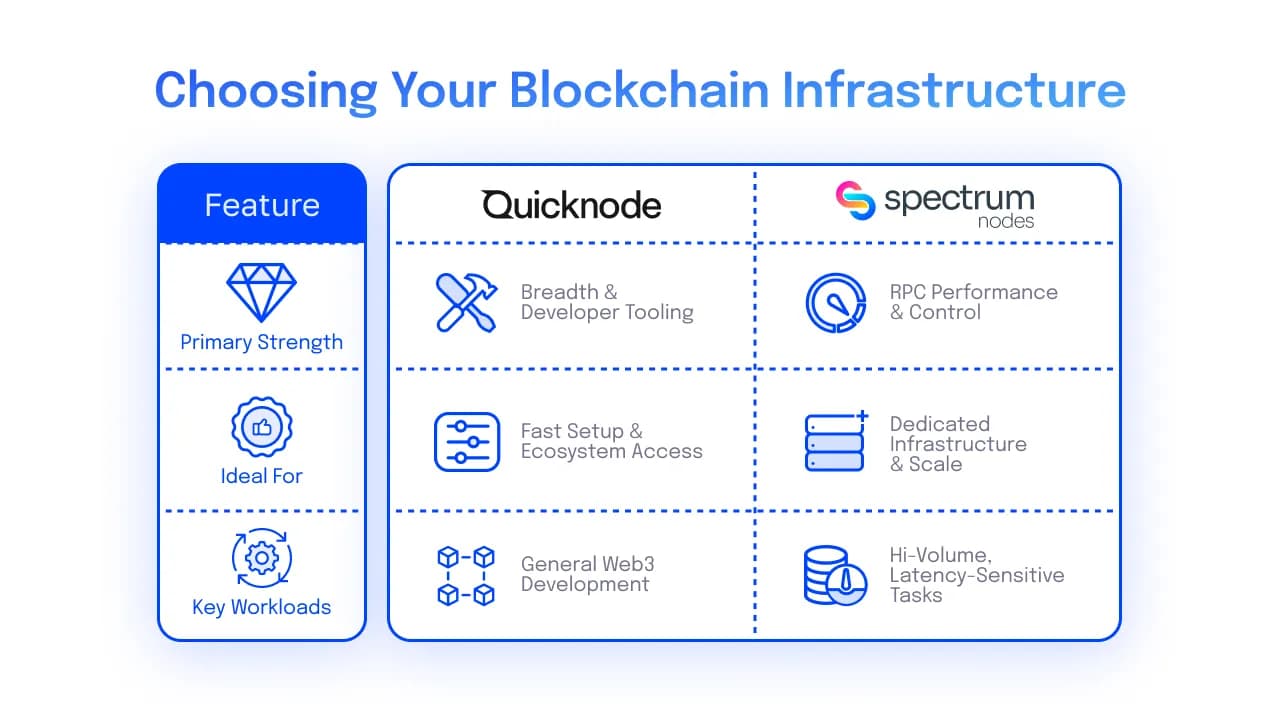
Quicknode is a blockchain infrastructure platform with broad chain coverage, strong developer tooling, marketplace add-ons, Streams, Webhooks, and several API products. Its model best suits teams that want quick onboarding, a large ecosystem, and access to many developer features through one platform.
On the other hand, Spectrum Nodes positions itself more narrowly around high-performance RPC delivery, dedicated infrastructure, geo-distributed endpoints, failover, and predictable scaling. Therefore, Spectrum Nodes is likely to suit teams that care less about a broad marketplace and more about direct RPC performance, control, and infrastructure clarity.
In simpler terms, Quicknode is strong when you want breadth, tooling, and fast setup, while Spectrum Nodes is stronger when you want a more infrastructure-led relationship, especially for workloads where latency, request volume, failover, and endpoint behaviour matter.
Infrastructure and Architecture
Over the years, Quicknode has built a large ecosystem around blockchain access, so much so that its documentation covers core RPC APIs, Webhooks, Streams, IPFS, marketplace add-ons, and custom RPC options for enterprise use cases. That breadth is useful, especially for developers who want infrastructure, data tools, and integrations in the same environment.
OK, great, but are there any trade-offs?
Well, the trade-off seems to be that public details on the underlying architecture, failover design, and infrastructure topology are limited, while, to be fair, that is not unusual for a managed RPC provider. Most users do not need to know exactly how the provider routes traffic, manages degraded nodes, or isolates workloads, but for performance-sensitive teams, those details can become important.
Spectrum Nodes takes a different approach, more focused on infrastructure. From its documentation, it is obvious that the priorities for Spectrum nodes are their bare-metal infrastructure, geo-distributed endpoints, node health checks, and failover. Therefore, for teams running bots, trading systems, analytics pipelines, high-throughput apps, or latency-sensitive services, that level of detail makes it easier to assess how the provider will behave in real conditions.
The practical question is not whether one architecture sounds better on paper, but whether your team needs to understand how the endpoint behaves under pressure. If you do, the Spectrum approach gives you more to evaluate. For a deeper look at the design thinking, see under the hood of RPC infrastructure and how RPC infrastructure scales under load.
Performance and Reliability
RPC performance is usually discussed through latency and requests per second, but in reality, that only covers part of the picture. A truly reliable provider also needs consistent responses, sensible routing, good failover behaviour, and enough capacity for sudden bursts.
Quicknode clearly focuses on low latency and scalable blockchain access. It also offers flat-rate RPS options, where capacity is governed by both requests per second and concurrent connections. It is worth noting that Quicknode's documentation highlights that although both RPS and concurrent connections apply simultaneously, the effective throughput will depend on whichever of those 2 limits is reached first.
Why does it matter? It matters because some blockchain workloads do not fail gradually. What happens in reality is that they hit a limit, queue, time-out, or return inconsistent performance under load. A front-end may tolerate that, but a trading bot, liquidation engine, bridge monitor, or indexer may not.
Spectrum Nodes is easier to assess in practice because it is built around how endpoints behave under load, not just how they perform in ideal conditions. Instead of treating latency and throughput as headline metrics, the focus is on consistency across regions, stable performance during sustained traffic, and predictable failover between nodes. This particularly matters when your application cannot afford sudden drops in response time or inconsistent data between requests.
Dedicated RPC endpoints and private node setups also reduce the variability that often comes with shared infrastructure. For teams running high-frequency systems or handling large volumes of requests, that level of control can make performance easier to manage over time.
Pricing and Scaling Models
Pricing is where RPC provider comparison can become misleading, as a low entry price does not always mean a lower operating cost. What really matters is how the provider charges for the actual workload.
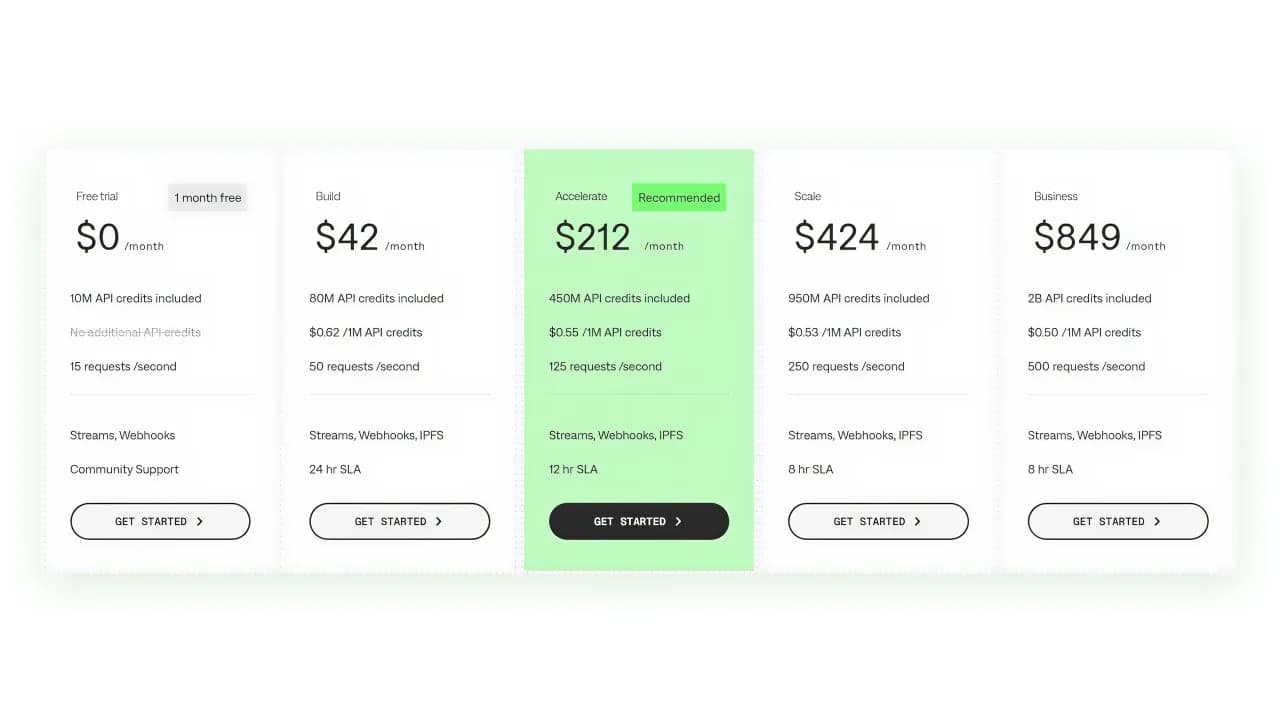
Quicknode offers usage-based API credits and flat-rate RPS options. Its flat rate RPS is a fixed monthly fee for single endpoint RPC access with configured rate limits and concurrent connection limits, which effectively gives teams another pricing route when they want more predictable endpoint costs.
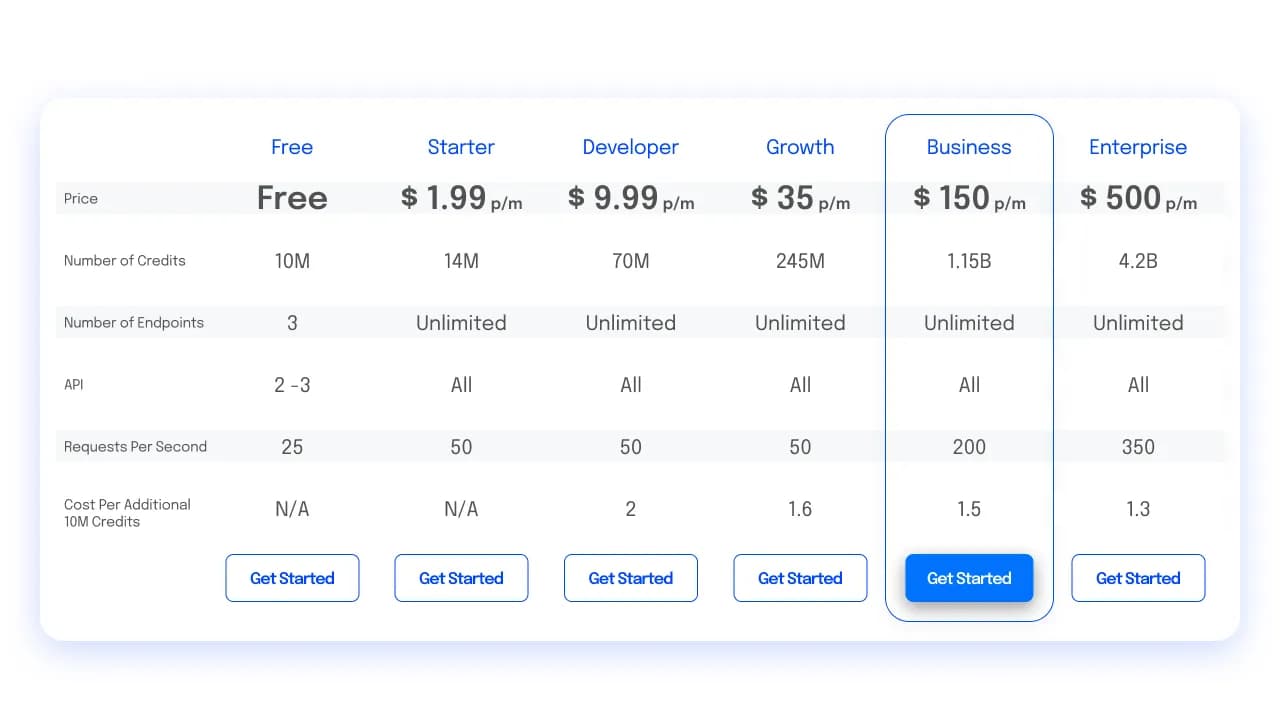
Spectrum Nodes is probably better assessed through expected capacity, required chains, performance needs, and whether a private or dedicated setup is needed. The value is not simply in getting an endpoint, but it is in getting an endpoint that can genuinely support your workload without constant plan anxiety.
Before choosing any blockchain RPC provider, model three things: normal request volume, peak request volume, and the cost of degraded performance. Then compare the pricing structure against those numbers.
Multi-Chain and Feature Support
Quicknode offers broad network coverage and a large developer ecosystem, with support across many networks. However, headline numbers can be misleading. What matters in practice is whether the specific chain, node type, and features you need are fully supported.
On the other hand, Spectrum Nodes takes a more focused approach. Instead of emphasising total network count, the emphasis is on delivering stable, production-ready support for the networks it offers. This can be more relevant for teams that rely on consistent performance across specific chains rather than broad but variable coverage.
In practice, the difference comes down to breadth versus depth. Quicknode is better suited to teams that need access to many networks and tools in one place. Spectrum Nodes is better suited to teams that need fewer networks, but expect predictable performance, consistent behaviour, and infrastructure that holds up under load.
It should be pointed out that before choosing either provider, it is worth checking the details that actually affect your application. That includes method support, archive access, WebSocket or gRPC availability, latency, and rate limits.
When to Choose Quicknode
Quicknode is a strong choice if you want a mature platform with broad coverage and fast onboarding. It works well for teams that value developer tooling, integrations, and access to additional products such as Streams, Webhooks, or chain-specific APIs.
Additionally, it is also well-suited to early-stage builds, where speed and ease of setup matter more than fine control over infrastructure.
When to Choose Spectrum Nodes
Spectrum Nodes is a better fit when performance and infrastructure behaviour matter more than platform breadth.
It suits teams running latency-sensitive or high-volume workloads, where consistency, failover, and predictable scaling are critical. Additionally, dedicated endpoints or private setups can reduce the variability often seen in shared infrastructure.
Finally, Spectrum nodes become particularly relevant when you need to plan for scale before performance issues appear.
Common Mistakes When Choosing an RPC Provider
The first mistake is choosing based on price alone. Please do not do this. Cheap RPC access can be fine for simple workloads, but it may become very costly if heavy methods, rate limits, or degraded performance start affecting the application.
The second mistake is ignoring latency, as average latency can hide problems at the edge. For a global user base, regional routing matters, while for trading or automation, tail latency can matter more than the average.
The third mistake is assuming redundancy guarantees correctness. Multiple endpoints can improve availability, but they do not automatically validate chain data. Critical systems may need independent checks, quorum-based logic, or comparison between trusted sources.
The fourth mistake is treating all chains the same. Ethereum, Solana, and other networks have different RPC behaviours, data models, and performance profiles. Solana RPC, for example, covers methods for reading network state, sending transactions, simulating execution, and subscribing to updates, which can create very different infrastructure demands from a simple EVM read flow.
Final Verdict
Putting it simply, there is no absolute winner between Spectrum Nodes and Quicknode.
Quicknode is the stronger fit for teams that want a broad platform, fast onboarding, strong tooling, and access to a large developer ecosystem, and it is especially useful when the surrounding products matter as much as the RPC endpoint.
Spectrum Nodes is the stronger fit for teams that want performance control, infrastructure transparency, predictable scaling, and a more direct conversation around endpoint behaviour. It is better suited to workloads where RPC is not just a convenience layer, but part of the application’s operational foundation.
Therefore, the right choice depends on your use case. Start with the workload, not the brand. Then look at latency, throughput, failover, data consistency, network support, pricing, and operational risk.
Frequently Asked Questions (FAQs)
What is the main difference between Spectrum Nodes and Quicknode?
The main difference lies in the approach. Quicknode focuses on ecosystem, integrations, and ease of use. Spectrum Nodes focuses on infrastructure performance, dedicated endpoints, and consistency under load.
Which RPC provider is better for high-traffic applications?
For high traffic applications, the key factors are latency, throughput, and failover behaviour. Providers offering dedicated RPC endpoints or private node setups, such as Spectrum Nodes, are often better suited for sustained high-volume workloads.
How do I choose between Quicknode and other RPC providers?
Start with your workload. Consider request volume, latency sensitivity, supported networks, and scaling requirements. A simple application may benefit from ease of use, while a performance-critical system may require more control over infrastructure.
Do all RPC providers offer the same level of reliability?
No. Reliability depends on infrastructure design, failover mechanisms, and how providers handle traffic under load. Redundancy improves uptime, but does not always guarantee consistent or correct data.
Do you offer custom client deployments?
Yes. Spectrum Nodes supports custom client deployments for block builders, HFT systems, MEV strategies, and security forensics. This includes:
- Modified node clients (custom Geth, Nethermind, Besu, Reth builds)
- Custom tracers for transaction simulation and forensic analysis (debug_traceTransaction for MEV detection, reorg analysis, vulnerability scanning)
- Optimized networking (direct-to-leader routing, proximity to validators/sequencers)
- Low-latency tuning (kernel params, CPU pinning, custom mempool configs for sub-ms propagation)
Unlike standard RPC endpoints, we work directly with engineering teams on bespoke setups when microseconds matter. To discuss your requirements, get in touch with us through this form. You can also explore relevant case studies.
How do Spectrum Nodes services work with our existing systems?
Get in touch with us for technical support. Whether you need standard RPC or custom client deployments, we provide software engineers, DevOps engineers, and 24/7 response teams who can be deployed within your team to integrate immediately. We help integrate everything as part of your SOPs, handling the DevOps complexity (kernel tuning, CPU pinning, sync monitoring) so your team can focus on application logic while maintaining familiar RPC endpoints. To discuss your requirements, get in touch with us through this form. You can also explore relevant case studies.