
Why Decentralised Blockchain Infrastructure Matters for Web3
Updated October 22, 2026 · Spectrum Nodes
Short answer: Decentralised blockchain infrastructure means the nodes, RPC endpoints, validators, indexers and data layers behind a blockchain run across independent operators and regions, with no shared single point of failure. It matters because a decentralised chain is only as open as the layer you use to reach it: in the November 2020 Ethereum RPC outage, wallets stopped working while the chain kept producing blocks.
Web3 promises decentralisation, censorship resistance and trust minimisation. Yet much of the infrastructure behind today's blockchains still relies on centralised services, cloud providers and single points of failure. The blockchains themselves are distributed. The infrastructure that lets users and developers reach them often is not.
That contradiction sits under almost every decentralised application, wallet and protocol. Without decentralised infrastructure, decentralisation stays a surface feature instead of a foundation. This guide explains what decentralised blockchain infrastructure is, where centralisation hides risk and how the next generation of Web3 infrastructure is being built.
What Is Decentralised Blockchain Infrastructure?
Decentralised blockchain infrastructure is the set of systems that support a blockchain without relying on a single provider, location or operator.
Most people think of decentralisation only at the blockchain layer: distributed ledgers, consensus mechanisms and validators spread around the world. That is only part of the picture. Decentralisation has to extend below the blockchain itself, into these five components.
Nodes
Blockchain nodes store and verify the ledger, which makes them a core part of the infrastructure. Full nodes independently validate transactions and blocks, while archive nodes keep the full historical state.
When node infrastructure is centralised, access to blockchain data can be restricted, throttled or interrupted. Providers that support many independent chains across regions reduce this risk, especially when their nodes are not concentrated in a single environment.

RPCs
Remote Procedure Calls (RPCs) are the gateways wallets, dApps and services use to read from and write to blockchains. They are often the most centralised component of Web3, despite sitting inside every user interaction.
For a full explanation of how RPCs work and why they matter, read our "What is an RPC?" guide.
Validators
Validators secure proof of stake (PoS) chains by proposing and attesting to blocks. When validator infrastructure is concentrated in a small number of hosting providers or regions, decentralisation weakens even if validator counts look high on paper.
Indexers
Indexers turn raw blockchain data into formats applications can query efficiently. They are essential for performance, but they become a dependency risk when one operator controls them.
Data Layers
Historical data, state snapshots and analytics often live off chain. When these layers are centralised, an application's reliability depends on outside providers staying available.
Decentralised blockchain infrastructure means all of these components are run by multiple independent parties, across different regions, without shared points of failure. Without that, blockchains risk becoming decentralised protocols running on centralised foundations.
Wasn't the Internet Built to Be Decentralised?
Yes. ARPANET, the precursor to the modern internet, was designed to survive failure. Packet routing let data take multiple paths across the network, so if one route went down, traffic flowed around it. No single node or server controlled the system.
That design put fault tolerance, resilience and redundancy first. Over time, convenience and scale drove centralisation. Cloud platforms simplified deployment and data centres consolidated infrastructure, until a large share of the internet came to depend on a small number of providers.
Crypto set out to solve trust problems at the application layer. It removed the need for trusted intermediaries in money, coordination and ownership. Web3, however, inherited much of the Web2 infrastructure stack: many blockchain applications run on the same cloud environments, regions and operational assumptions.
The result is decentralised protocols layered on top of centralised infrastructure. That mismatch creates risks that stay invisible until systems are stressed.
Why Is Centralised Infrastructure a Hidden Risk in Web3?
Centralised infrastructure is a hidden risk because one provider or region failing can cut users off from a chain that is still running. These risks have already played out.
Outages
Major cloud and infrastructure outages have repeatedly disrupted blockchain services. When a single hosting region or provider fails, RPC endpoints, nodes and indexing services can disappear at once.
A clear example came on November 11, 2020. Infura, one of Ethereum's most widely used RPC providers, was running nodes on an older Geth version that split onto a minority chain. Ethereum kept producing blocks, but MetaMask broke and exchanges paused ETH withdrawals because the access layer they depended on was serving the wrong chain.
The lesson: even when a blockchain stays decentralised at the protocol level, a centralised access layer can become an effective single point of failure for users and applications.
RPC Failures
RPC downtime has temporarily broken wallets, decentralised applications and exchanges. In many cases the blockchain itself kept producing blocks while users were unable to interact with it.
For a deeper breakdown, see what happens when an RPC goes down.
Censorship
Centralised infrastructure providers operate under legal and regulatory pressure. They can be required to block addresses, restrict access or filter requests at the infrastructure layer.
A clear example came in 2022, after US sanctions against Tornado Cash. Ethereum itself kept processing transactions without discrimination, but some centralised RPC providers began blocking requests tied to sanctioned addresses. Wallets and applications relying on those providers could not interact with parts of the chain, even though the blockchain was fully operational.
Censorship can appear through infrastructure dependencies, without any change at the protocol level.
Systemic Failure
When many applications depend on the same provider, failures cascade. Something that looks decentralised at the protocol level becomes fragile in practice.
These failures affect everyone. Users lose access to funds, applications become unusable and trust erodes. As Web3 adoption grows, so does the cost of each failure.
What Is the Difference Between Centralised and Decentralised RPC Providers?
A centralised RPC provider runs your access to the chain on one operator's infrastructure, while decentralised RPC spreads trust and availability across multiple operators and regions. The difference is structural.
RPC providers decide how applications interact with blockchains. They handle balance queries, transaction submission, contract calls and event subscriptions.
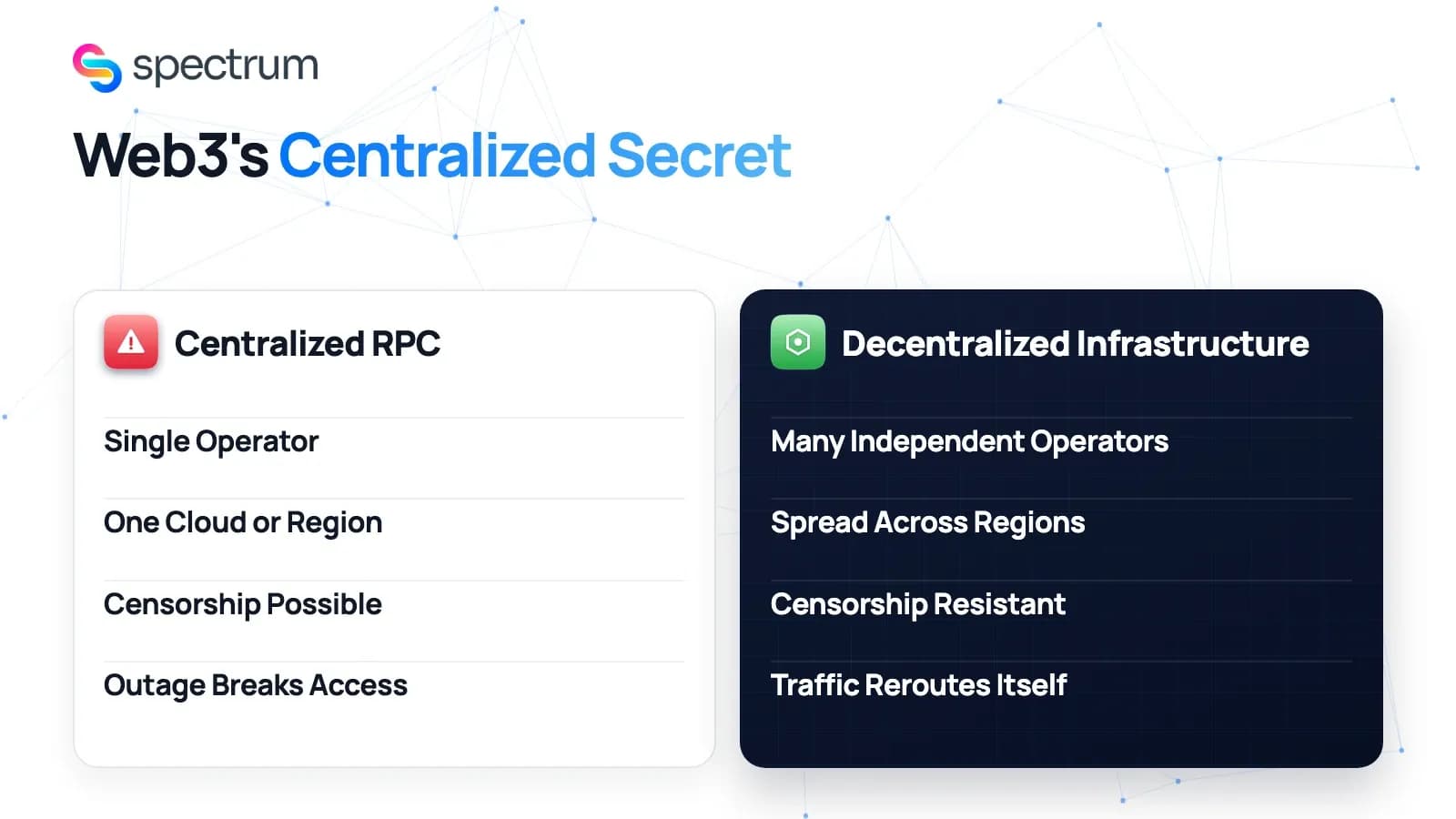
| Centralised RPC | Decentralised RPC | |
|---|---|---|
| Who runs it | One operator | Multiple independent operators |
| Strengths | Speed and simplicity, easy to integrate, scales quickly | Spreads trust and availability across operators and regions |
| Weakness | Concentrates operational risk | More complex to run |
| Fit with Web3 principles | Weaker | Aligned |
For applications that need to stay online and stay neutral, removing single points of failure at the RPC layer is a design requirement. You can get there with a decentralised network, or by spreading traffic across independent providers and regions and checking critical reads against more than one source. The KelpDAO incident shows why that second step matters.
Why Do Developers Need Decentralised Node Infrastructure?
Developers need decentralised node infrastructure because every decentralised application depends on nodes, and when access runs through one provider, that provider's failures become your application's failures.
Wallets rely on nodes to retrieve balances. Smart contracts depend on them to read and update state. APIs use them to fetch logs and events in real time. When node access sits behind a single provider or environment, your application inherits its constraints:
- Downtime at the infrastructure layer immediately becomes application downtime
- Rate limits set to protect shared resources cap your usage and slow growth
- Regional failures hit users globally when traffic cannot be rerouted
Over time, the node layer becomes a bottleneck instead of a foundation. Distributed node infrastructure improves uptime, reliability and geographic performance, and gives developers more control over operational risk.
Access to self managed or distributed node infrastructure also lets you scale without depending on a single provider. For teams that want direct access to node services across chains, Spectrum's node infrastructure shows how this works in practice.

For testing and development, Spectrum's testnet faucets also reduce friction for builders experimenting across chains.
Infrastructure decisions compound over time. Early convenience can become long term fragility.

Why Do Enterprises and Institutions Care About Infrastructure?
Institutions judge blockchain infrastructure on risk, governance and compliance, and a single provider is a concentration risk they are often required to avoid.
Their main concerns are:
- Operational resilience
- Service level expectations
- Geographic distribution
- Regulatory exposure
- Vendor concentration
When blockchain infrastructure is centralised, these risks compound. A single provider outage can breach internal risk thresholds, undermine service level commitments or create regulatory exposure.
Decentralised blockchain infrastructure lets institutions spread exposure across regions and operators. That reduces concentration risk and lines infrastructure choices up with established enterprise risk management. As institutional adoption of Web3 grows, infrastructure decisions move beyond technical optimisation and become a governance requirement.
Why Is Infrastructure the Missing Layer of Web3?
Without decentralised infrastructure, blockchains work like decentralised databases running on centralised servers. That is a structural point. If decentralisation exists only at the protocol layer, control doesn't disappear: it shifts down to the infrastructure layer.
In that case, claims of neutrality, censorship resistance and resilience depend on the policies and availability of a few providers. Decentralised infrastructure is the layer that completes the Web3 architecture.
How Does Spectrum Nodes Reduce Single Points of Failure?
We run Spectrum Nodes on our own hardware across several regions, so your access layer doesn't depend on a rented cloud provider. We build from first principles: we spread infrastructure deliberately instead of hiding complexity behind one cloud.
Our core design choices:
- Support for 200+ chains, so no single chain dependence
- Bare metal on our own racks and hardware in Tier III facilities, not shared cloud environments
- Nodes in the US, Europe and APAC (in Singapore, our bare metal servers sit in a rented rack)
- No cloud lock in: our infrastructure runs independently of any major cloud provider
- One accountable operator, SOC 2 Type II attested, with no breach on record
- Over a billion requests a day at 99.99% uptime
Spectrum is one operator. For your most critical reads, pair it with other independent sources and compare responses before you act.
For our wider infrastructure approach and service model, see the full overview. For background on why we built Spectrum and the problems it set out to solve, read Introducing Spectrum. Our technical documentation and architecture details are publicly available.
What Does the Future of Web3 Infrastructure Look Like?
Infrastructure will increasingly decide which chains last. Regulatory scrutiny of operational risk is growing, institutions are asking for resilience and transparency, and applications are scaling far beyond early adopters. In that setting, centralised infrastructure stops being a convenience and becomes a structural liability.
Decentralised blockchain infrastructure supports regulatory alignment through distributed risk, builds institutional confidence, allows global scale and preserves data sovereignty. The chains that survive will be the ones built on infrastructure that stays accessible and neutral under pressure, instead of depending on one company or one region.
FAQ
What is decentralised blockchain infrastructure? Decentralised blockchain infrastructure is the nodes, RPCs, validators, indexers and data services behind a blockchain, run by multiple independent operators across different regions. Spreading them out removes single points of failure.
Why is decentralised infrastructure important for Web3? It keeps applications resilient and neutral. Without it, decentralised applications depend on centralised services that can fail or restrict access, even while the blockchain keeps running.
What happens when RPC providers go down? Wallets and applications can become unusable even though the blockchain keeps running. Users can't send transactions or view balances until access returns or the app switches to another provider.
Is Web3 really decentralised if it runs on cloud servers? Only partly. Decentralisation exists at the protocol layer, but operational control stays centralised when the infrastructure depends on a few cloud providers.
Is Spectrum a reliable service? Spectrum Nodes serves over a billion requests a day at 99.99% uptime, on our own racks and hardware instead of rented cloud. We are SOC 2 Type II attested and have never had a breach.
How does Spectrum Nodes reduce single points of failure? We run our own bare metal in the US, Europe and APAC, independent of any major cloud provider, across 200+ chains. For the most critical reads, pair Spectrum with other independent providers and compare their responses.