
Hyperliquid Peering: What It Is and How It Works
Updated October 22, 2026 · Spectrum Nodes
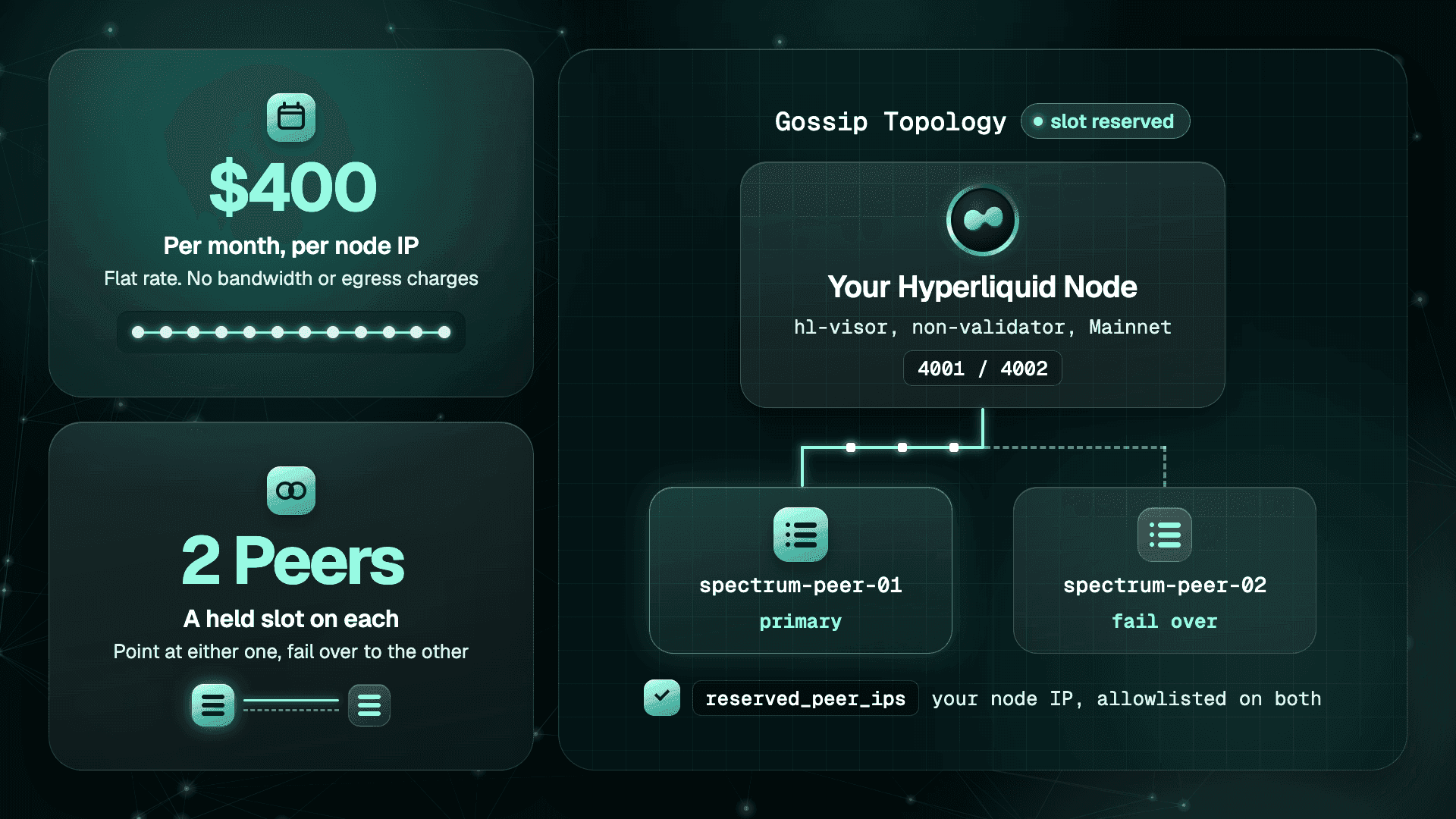
Short answer: Hyperliquid peering gives a self run, non validator Hyperliquid node a reserved gossip slot on a dedicated peer, set through Hyperliquid's reserved_peer_ips setting, so the node stops competing for oversubscribed public root peers. Spectrum Nodes reserves your node IP on two peers, commits to 99.9% uptime per calendar month and charges a flat $400 per month per node IP, with no bandwidth or egress fees.
What Is Hyperliquid Peering?
Hyperliquid peering is a service where a peer operator reserves a connection slot for your node's IP address using Hyperliquid's reserved_peer_ips setting. With that slot held, your node always has a peer that will accept it, however busy the chain gets.
Gossip is how Hyperliquid nodes pass data to each other: each node receives the block stream from a peer and applies it.
Why Does a Hyperliquid Node Need a Reliable Peer?
Because a non validator node inherits its peer's throughput and uptime. It does not produce blocks. It receives the block stream from a peer over Hyperliquid's gossip protocol and applies each block to stay at the tip of the chain. A slow peer means a slow node, and a dropped peer means the node stops advancing.
Why Do Hyperliquid Nodes Fall Behind on Public Root Peers?
Because the public root peers are shared and oversubscribed. Most self run nodes connect to the community root peers listed by Hyperliquid's gossipRootIps API. Every node operator shares them. Slots fill and addresses change, so a peer that accepted your node yesterday may reject it today.
When a node loses its peer, it falls behind the tip and has to resync. Anyone trading or building on that node sees stale order books, missing fills and gaps in stored data.
| Public root peers | Spectrum Hyperliquid Peering | |
|---|---|---|
| Slot for your node | Not guaranteed | Reserved on both peers |
| Peer type | Shared, oversubscribed | 2 dedicated Spectrum peers |
| Failover | Back to the public list | Second Spectrum peer |
| Uptime commitment | None | 99.9% per calendar month |
| Cost | Free | $400/month per node IP |
How Does Spectrum's Hyperliquid Peering Work?
Your node gets the same peers, configuration and priority as Spectrum's own Hyperliquid nodes. Spectrum Nodes runs its own Hyperliquid infrastructure on the peers it offers subscribers, on the same terms.
- Two reserved slots. Your node IP is reserved on two peers, so you fail over to the second without going back to the public list.
- Full stream. The gossip stream is the full stream Spectrum's own nodes consume.
- Measured uptime. The 99.9% commitment is measured each calendar month on gossip reachability to your IP from outside Spectrum's network. Scheduled maintenance is announced at least 48 hours ahead.
- Flat pricing. No usage, bandwidth or egress charges.
- Direct support. Subscribers get a shared Telegram or Slack Connect channel with the Spectrum team.
What Is the Best RPC Provider for Hyperliquid?
It depends on how much of the stack you want to run yourself. There are two paths, and Spectrum Nodes covers both:
- A provider runs everything. Spectrum Nodes offers dedicated Hyperliquid clusters where we operate the node and the data services on top of it. You get endpoints on bare metal infrastructure that Spectrum runs and monitors, without sharing capacity with other customers.
- You run your own node. You need a reliable upstream instead of RPC endpoints. Spectrum's Hyperliquid Peering reserves your node a gossip slot on two dedicated peers, the same peers our own infrastructure runs on.
That suits trading firms and builders who start on managed endpoints and later run their own nodes, or run both side by side.
If you only need HyperEVM RPC, note the public limits: Hyperliquid's public endpoint allows about 100 requests per minute per IP and has no WebSocket, per the Hyperliquid docs (checked October 21, 2026). HyperEVM is the EVM layer of the Hyperliquid chain. On HyperEVM, Spectrum Nodes also offers:
- RPC with a measured record: a 100% success rate in our RPC monitor from Sep 29 to Oct 14, 2026
- Cached data for heavy historical reads (see cached vs direct node access)
- Custom Contract Webhooks that push contract events to your endpoint instead of polling (see Spectrum Webhooks)
- Spectrum CLI commands for Hyperliquid funding rates
How Do You Set Up Hyperliquid Peering With Spectrum Nodes?
- Email Spectrum the public IP of each node and the region it runs in. You can also request access to Hyperliquid Peering.
- Spectrum adds each IP to
reserved_peer_ipson both peers and sends you two peer addresses, typically within one business day. - Add those addresses to
~/override_gossip_config.json:
   {
     "root_node_ips": [{ "Ip": "PEER_1" }, { "Ip": "PEER_2" }],
     "try_new_peers": false,
     "chain": "Mainnet",
     "reserved_peer_ips": []
   }
- Restart your visor and confirm the node keeps applying blocks.
What Are the Requirements?
- Ports 4001 and 4002 open to inbound connections. Hyperliquid gossips over both, and peers deprioritise nodes that don't accept them.
- A static public IP. Dynamic IPs and large NAT ranges can't be allowlisted.
- Non validator mode on Mainnet.
What Does Hyperliquid Peering Not Include?
Peering carries gossip only. It does not include RPC endpoints, data APIs, historical backfill, validator peering or management of your node. Both Spectrum peers run in a single region, so redundancy is across hosts, not data centres. If you want Spectrum to run the node and data services, use a dedicated cluster instead.
FAQ
What is Hyperliquid peering?
A reserved gossip slot for your self run Hyperliquid node on a dedicated peer, set through reserved_peer_ips. Your node always has a peer that accepts it, so it stays at the tip instead of competing for public root peers.
Why is my Hyperliquid node falling behind? Usually because it lost its peer. Public root peers are shared and oversubscribed, slots fill and addresses change, and a node without a peer stops advancing and has to resync.
How much does Hyperliquid peering cost? Spectrum Nodes charges a flat $400 per month per node IP, billed monthly, with no bandwidth or egress fees. You can cancel any time.
Does Hyperliquid peering include RPC access? No. Peering only provides gossip connectivity for a node you run yourself. For managed endpoints, Spectrum Nodes offers dedicated Hyperliquid clusters.
Can validator nodes use Spectrum's peering? No. The service covers non validator nodes on Mainnet. Setup takes about one business day from receiving your node IP.
What ports does Hyperliquid gossip use? Ports 4001 and 4002, both open to inbound connections.
References
- Hyperliquid docs, HyperEVM for developers: https://hyperliquid.gitbook.io/hyperliquid-docs/for-developers/hyperevm (checked October 21, 2026)
Talk to our team: https://calendly.com/spectrumnodes-sales/30min