
Cached vs Direct Blockchain Node Access: Which Should You Use?
Updated October 22, 2026 · Spectrum Nodes
Short answer: Cached RPC data serves reads from a stored copy, which is far faster for historical data. In Spectrum Nodes' July 2026 test, cached Ethereum archive endpoints returned eth_getBlockReceipts in a median 47 ms against 2.4 seconds on a standard archive node, about 51x faster. Direct node access wins when you need the latest state. Spectrum caches only finalized blocks and sends chain head reads to the node.
How Do Blockchain Nodes Answer Requests?
A node answers two kinds of request: reads and writes. Users and applications reach a node through RPC (remote procedure call) requests, a standard way to ask a server to run a method and return the result.
- Reading asks the chain for information: a wallet's ETH balance, a transaction's status, the latest block, a token balance. Nothing changes onchain.
- Writing submits a transaction: sending ETH, swapping tokens, staking, or calling a contract function that changes state.
Write requests always go to the chain. Read requests can be answered in more than one way, and that is where direct node access and cached or indexed data differ.
What Is Direct Node Access?
Direct node access means a node answers your read from its own copy of the chain. A blockchain node keeps a local, synced view of the chain. When you ask for a balance, a receipt or a block number, the node checks the state it has independently received, verified and stored, and returns the answer.
The request path is short: user → node → response.
What Is Cached or Indexed RPC Data?
Cached or indexed data is a read answered from a layer the provider built on top of its nodes. Many large RPC providers add these systems to improve speed and scale. For read heavy workloads, a request may be served from a cache, an indexed database or another preprocessed layer instead of a node every time.
An indexer is a system that extracts data from each new block and stores it in a searchable database. When a block arrives, the provider's node receives it, the indexer extracts the transactions, logs, token transfers and contract events, and the provider updates its database so future requests are answered faster. For most blockchain applications this is a good thing and adds no meaningful risk.
Why Is Cached Data Faster?
Because the answer is often already stored. Someone asks, "What is Malta's capital?" You could open a book, find Malta and read the answer, or you could already know it and reply at once: Valletta. Caching is the second option.
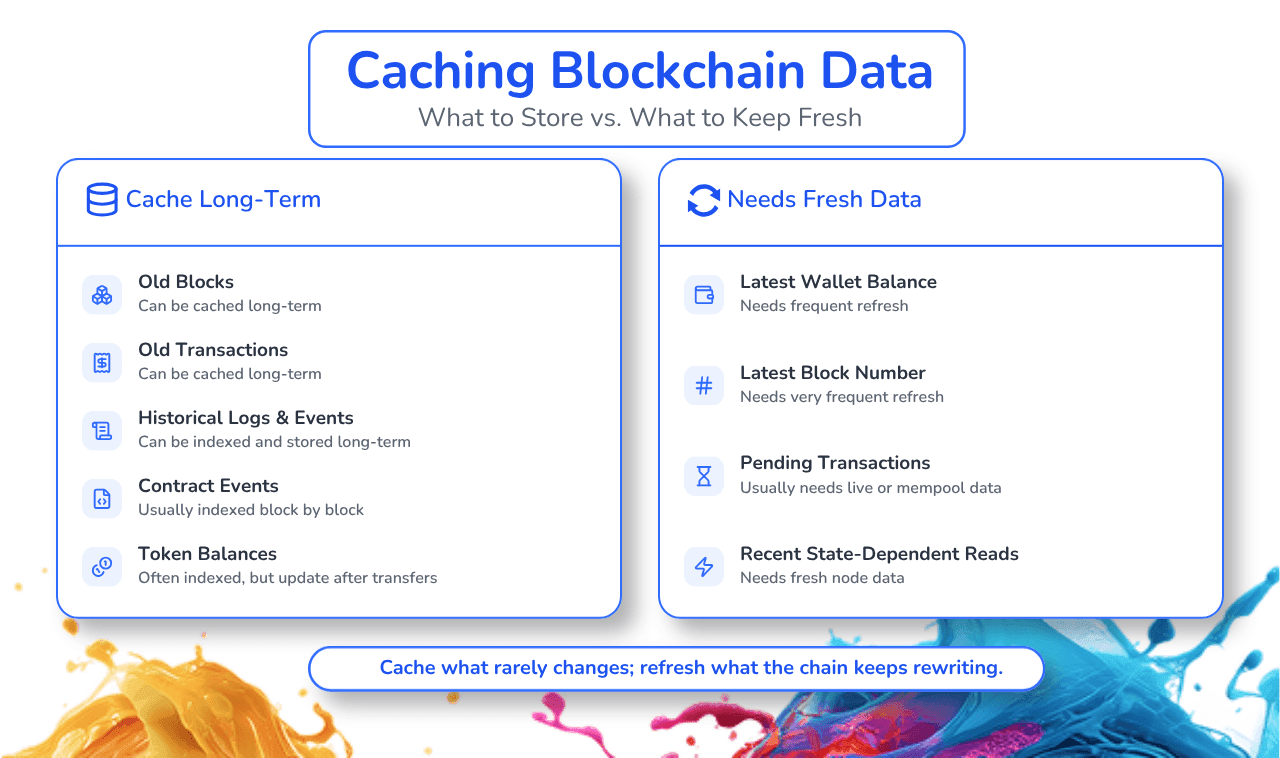
In blockchain terms, caching improves performance in three ways:
- The answer may already be stored. Popular data like the latest blocks, major token contracts and historical transactions is served instantly at scale.
- The data may be reorganised into structures that are easier to search than raw chain data.
- The node does less work, because the cache absorbs common read requests instead of passing every one through.
Cached data is, in most cases, correct and reliable. It is copied from blockchain nodes and, at professional providers, updated continuously. The blockchain stays the source of truth; the cache is a copy of that truth, optimised for speed.
Different data needs different update patterns:
- Every block: the indexer processes each new block on arrival.
- On demand: you ask for a balance, the provider fetches it and stores the result briefly in case the same request repeats.
- Every few seconds: fast changing data refreshes close to real time.
- Long term: old blocks, finalized transactions and past logs can be stored indefinitely, because once data is old and finalized enough, it does not change.
How Much Faster Is Cached Data? Our Ethereum Archive Benchmark
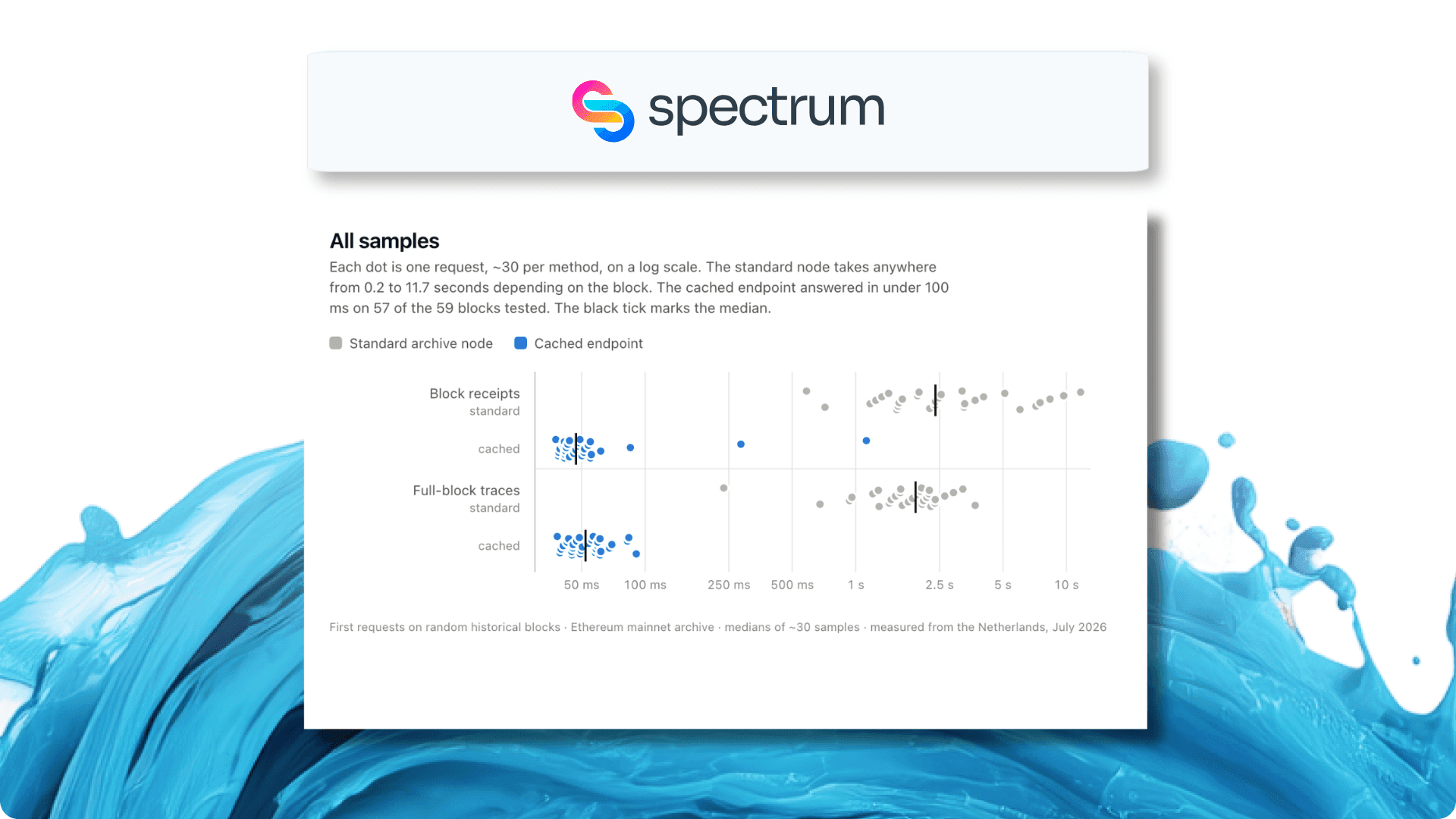
On Ethereum archive data, our cached endpoints answered heavy calls 37x to 51x faster than a standard archive node. An archive node keeps every historical state of the chain, not only recent blocks, which makes old data slow to compute.
Method. Benchmarks ran in July 2026 from the Netherlands (Central Europe). We compared Spectrum's cached Ethereum mainnet archive endpoints with a standard archive node running in the same infrastructure, using first time client requests against roughly 30 randomly selected historical blocks per method. Figures are medians.
| Method | What it returns | Standard archive node, median | Spectrum cached endpoint, median | Speedup |
|---|---|---|---|---|
eth_getBlockReceipts | Receipts (status, logs, gas) for every transaction in a block | 2.4 s | 47 ms | about 51x |
debug_traceBlockByNumber | A replay of every transaction in a block, with internal calls | 1.9 s | 52 ms | 37x |
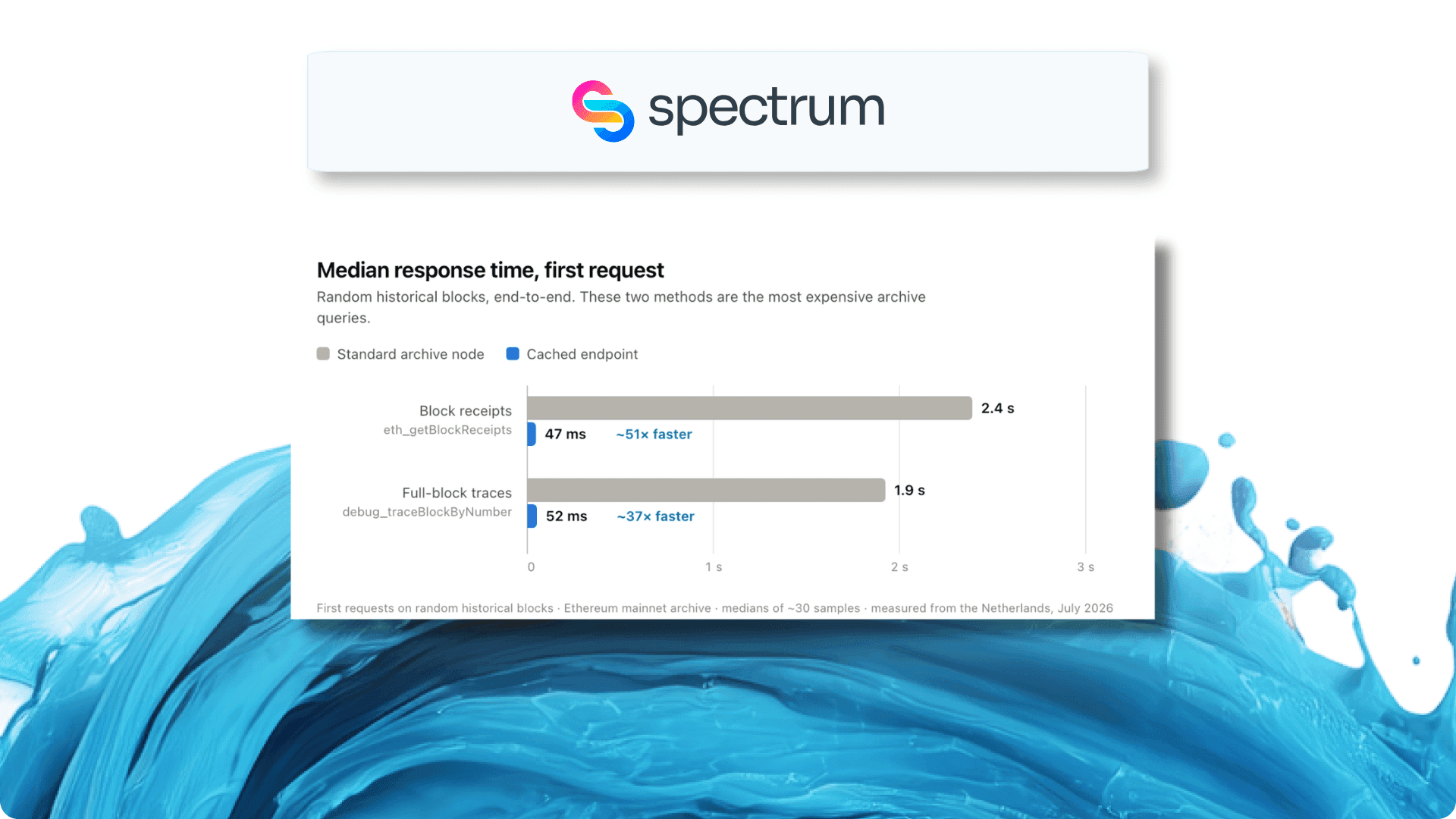
The full distribution matters as much as the median. The standard archive node took anywhere from 0.2 to 11.7 seconds depending on the block. Spectrum's cached endpoint clustered tightly in the tens of milliseconds, answering in under 100 ms on 57 of the 59 blocks tested. Only two cached responses went over 100 ms, while many standard node requests took seconds.
These were first time requests from the benchmark client, but the results were already in Spectrum's server side cache. They are cache hit measurements, not cold cache population times.
For indexers, real time analytics, tracing pipelines and MEV (maximal extractable value) infrastructure, lower latency and lower variance mean faster processing, steadier throughput and less engineering around unpredictable archive node response times.
How Does Spectrum's Caching Compare With Other Providers?
Against Alchemy, Spectrum's Boosted Nodes, our caching and routing layer in front of our own nodes, returned full block traces 3.2x to 8.6x faster at the median on BSC, Polygon and Base.
Block traces (debug_traceBlockByNumber) | Spectrum's Boosted Nodes, median | Alchemy, median | Faster | Answered first |
|---|---|---|---|---|
| BSC | 82 ms | 707 ms | 8.6x | 99% of requests |
| Polygon | 77 ms | 376 ms | 4.9x | 100% of requests |
| Base | 126 ms | 409 ms | 3.2x | 94% of requests |
Method. Spectrum's RPC monitor sent the same calls to both providers at the same instant from a test server in Finland, about 50,000 requests per chain and call type, from Sep 29 to Oct 14, 2026. Latency is the time to the last byte of the response. From a second server in Canada, Spectrum's Boosted Nodes still led on block traces: BSC 186 vs 295 ms, Polygon 180 vs 496 ms, Base 285 vs 620 ms. Alchemy was the only provider in this test. Chain by chain detail: Base RPC providers and Polygon RPC providers.
What Is the Tradeoff Between Speed and Freshness?
A cached answer can be correct a few seconds ago and wrong now. A balance might change while the cache still holds the old value.
For a transaction from two years ago, that lag is irrelevant and a cache is the right tool. For time sensitive work, seconds matter:
- Checking a balance before submitting a transaction
- Monitoring liquidation risk
- Tracking pending transactions
- Reacting to new contract events
- Reading state right after another transaction lands
Here the question becomes: is the data correct right now? Direct node access has the advantage, because the answer comes from the node's current synced view, not from a separate layer with its own update cycle.
What Are the Risks of Cached Blockchain Data?
Every layer between you and the node adds something to trust:
- Stale data. If chain state changes before the cache updates, you get an answer that trails the chain.
- Lower transparency. A direct node checks its state and answers. A cached answer may come from a database, an indexer, a regional replica or a mix, and you must trust that pipeline is correct, current and well maintained.
- Reorg handling. A reorg happens when the chain replaces a temporarily accepted block with a different one. Providers must detect it and correct any indexed data built on the discarded block. Until they do, cached results may reflect the old block.
- Edge cases. Queries that depend on very recent state, mempool visibility, pruning, archive availability or contract behaviour at a specific block can return different results from a node and from a processed data layer.
- Operational dependency. The cache is another system to maintain, monitor and secure, and it can fail on its own. The node may be healthy while the indexing pipeline is delayed; the API may respond fast while the answer lags the chain.
- Attacks. A direct RPC call is not immune to attack, but its trust boundary is simpler: you ask the node for the state it sees. A cached system adds components where errors or manipulation can occur. An attacker may skip the node and target the caching layer to serve stale, incomplete or wrong responses while the node stays healthy.
How Does Spectrum Nodes Cache Without Serving Stale Data?
By caching only finalized historical data and passing every chain head request straight to the node. Spectrum's caching layer is a fault tolerant RPC proxy with reorg aware permanent caching. Spectrum's Boosted Nodes put this caching and routing layer in front of our own nodes.
The cache holds one category of data: finalized historical blocks and everything derived from them, such as receipts, traces and block bodies. A finalized block is one the chain can no longer reorganise. This is the data that is both the most expensive for a node to produce and guaranteed never to change. Its receipts are fixed, and a trace of it gives the same result today, next month and in ten years. Caching it permanently carries no freshness risk.
Data that is not fully finalized is never served from the cache. Requests about the chain head (the latest block, a current balance, pending state) pass through to the node and are answered from its live, synced view. In our testing, the cached endpoint tracked new blocks in step with the direct endpoint at every poll. For live data, the cache is not in the request path at all, so there is no update cycle to lag behind.
Cached data is live on Arbitrum, Avalanche, Base, BSC, Ethereum, HyperEVM, Monad, Optimism and Polygon, with Robinhood Chain planned for early November 2026.
When Does Direct Node Access Matter Most?
Where freshness, transparency and institutional grade reliability are requirements:
- Transaction monitoring
- Latest balance and block tracking
- Recent contract state reads
- Validator operations
- DeFi infrastructure
- Security sensitive applications where users cannot afford a stale or wrong state
Direct access still has operational demands. Nodes must be synced, monitored, updated and scaled, and a badly run node is worse than a well run cache. When node infrastructure is run well, direct access gives you a cleaner path to the chain. If your nodes keep slipping behind the tip, see why blockchain nodes fall out of sync.
From a security view, speed is only part of the question. The rest is how much hidden infrastructure sits between you and the source of truth, and how exposed it is to downtime or attacks. Cache expiry logic, indexers, databases, regional replicas and reorg handling can each be engineered well, but each adds complexity you must trust. A simpler request path is easier to understand, audit and verify, and in security sensitive environments that simplicity has value.
Should You Use Cached Data or Direct Node Access?
Use cached data for historical reads, repeated reads, analytics and high volume workloads. Use direct node access when your app depends on the latest state. Caching and indexing make blockchain data faster to serve, easier to query and easier to scale. Direct access offers a shorter, more transparent path to the chain, with stronger freshness guarantees.
The choice sits between optimised data delivery on one side, and freshness, safety and less infrastructure dependency on the other. When timing, accuracy and trust minimisation matter most, direct node access stays the cleaner connection to the source of truth.
Both models have their place, so Spectrum Nodes supports both cached and direct node access, on archive or pruned nodes (a pruned node keeps recent state and drops old history to save storage). You choose the setup that matches your application, performance needs and trust assumptions.
Caching is standard practice across large RPC providers. If your protocol depends on the latest state, review your risk profile and check where your provider serves those reads from.
FAQ
Is cached RPC data accurate? In most cases, yes. It is copied from blockchain nodes and, at professional providers, updated continuously. The risk is lag: a cached balance or latest block can trail the chain by seconds.
Is cached blockchain data safe for DeFi apps? For historical reads, yes. For liquidation monitoring, balance checks before a transaction or reads right after a transaction lands, use direct node reads. Spectrum's cache serves only finalized blocks and sends chain head reads to the node.
How much faster is cached RPC data? In our July 2026 test on Ethereum archive data, median eth_getBlockReceipts fell from 2.4 seconds to 47 ms (about 51x) and debug_traceBlockByNumber from 1.9 seconds to 52 ms (37x). These were cache hits on randomly selected historical blocks.
Is there a low latency RPC for Ethereum archive queries? Cached archive endpoints answer heavy historical calls in tens of milliseconds. In our test, Spectrum's cached Ethereum archive endpoints answered in under 100 ms on 57 of 59 blocks tested, where a standard archive node took 0.2 to 11.7 seconds.
Which chains have Spectrum's cached data? Arbitrum, Avalanche, Base, BSC, Ethereum, HyperEVM, Monad, Optimism and Polygon. Robinhood Chain is planned for early November 2026.
Does Spectrum offer direct node access as well as cached data? Yes. Spectrum Nodes supports both cached and direct node access, on archive or pruned nodes, so you pick per application.