
How to Choose an RPC Provider for Circle's Arc
Facts checked September 16, 2026.
Arc, the stablecoin native layer 1 blockchain built by Circle, has its public mainnet set for September 16, 2026. Because Arc finalises transactions in under a second, the RPC node an app reads from can take longer to report a payment than Arc took to settle it. This guide covers what to check before choosing an Arc RPC provider.
Key Facts About Arc
- What Arc is: a stablecoin native layer 1 blockchain built by Circle and compatible with the Ethereum Virtual Machine (EVM).
- Public mainnet date: September 16, 2026, according to Circle.
- Gas token: USDC, so transaction fees on Arc are denominated in dollars.
- Finality: deterministic and under one second, using Malachite, a Tendermint BFT consensus engine.
- Block time: roughly 500 milliseconds, based on Uniswap's Arc deployment notes.
- USDC decimals: 18 on the native interface and 6 on the ERC20 interface at
0x3600000000000000000000000000000000000000, both reading the same balance. - Validators: permissioned, with 11 founding validators alongside Circle.
- RPC interface: standard Ethereum JSON RPC over HTTP and WebSocket.
What Is Circle's Arc?
Arc is an open layer 1 blockchain from Circle, the issuer of USDC, built for payments, foreign exchange, capital markets and tokenised assets. Developers can deploy contracts on Arc without approval, while block validation is limited to a permissioned set of institutions. Circle has set September 16, 2026 for Arc's public mainnet, after a private mainnet with more than 100 institutional and ecosystem builders.
Eleven institutions join Circle as Arc's founding validators: BlackRock, DTCC, Galaxy, Global Payments, ICE, Mastercard, MoneyGram, SBI Group, Standard Chartered, Sumitomo Corporation and Visa. BlackRock is expected to deploy its BUIDL fund on Arc, and DTCC is working with Circle to tokenise DTC custodied assets on Arc from the second half of 2027. Circle CEO Jeremy Allaire said the global financial system "deserves a blockchain network it can trust." Before mainnet, Arc's public testnet logged more than half a billion transactions across nearly 3 million wallets.
Why Arc Changes What You Need From an RPC Provider
Arc moves several jobs into the protocol. USDC pays for gas. Transactions are final on inclusion and can't be reorganised. Blocklist checks run inside the protocol, so a USDC transfer to or from a blocklisted address fails even with enough balance.
What the protocol doesn't handle is how an application reads Arc. Arc's compatibility guide tells teams porting EVM apps to focus their review on balance reads, value transfers and history indexing, and every one of those runs through an RPC endpoint. An endpoint that lags a few blocks or throttles eth_getLogs in a busy hour can leave a payments team reconciling by hand.
What to Check Before Choosing an Arc RPC Provider
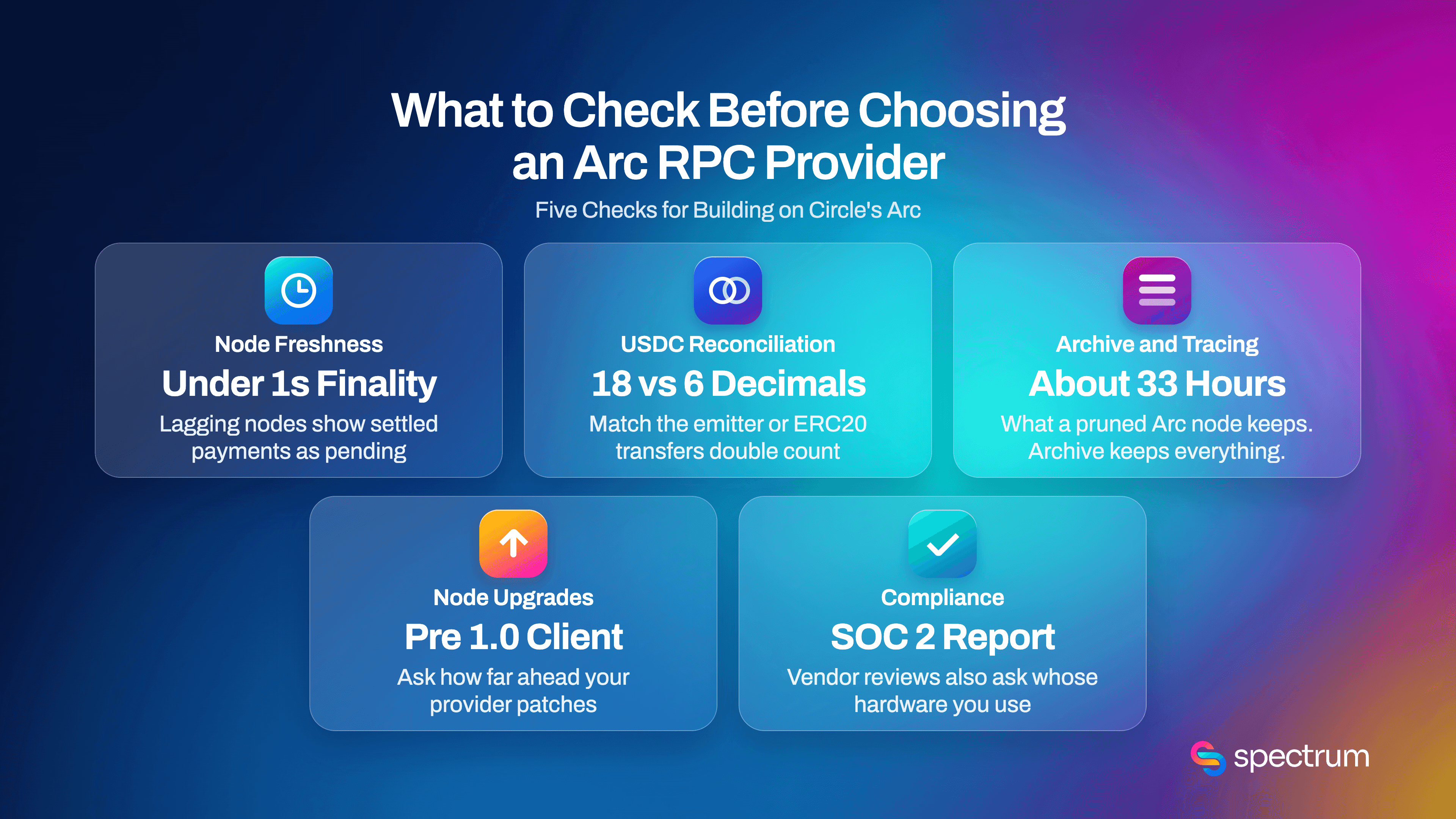
Arc speaks standard Ethereum JSON RPC, so connecting is simple. Running payments on that connection is the harder part. Put these five checks to any Arc RPC provider.
1. Node Freshness
Node freshness matters on Arc because Arc's documentation says transactions are final on inclusion and offchain systems can act after a single confirmation. With Arc blocks landing roughly every 500 milliseconds, an RPC node running two seconds behind the chain head is about four blocks stale, long enough for a checkout page to show a settled USDC payment as pending. Ask each provider how far behind the chain head its Arc nodes run under load.
2. Logs and Receipts for USDC Reconciliation
USDC reconciliation on Arc depends on reading logs and receipts correctly, because USDC on Arc has two interfaces over one balance. eth_getBalance returns the native balance in 18 decimals, while balanceOf on the USDC ERC20 contract at 0x3600000000000000000000000000000000000000 returns the same balance in 6 decimals. Every USDC send, transfer, mint and burn on Arc emits a Transfer log from a system emitter, Arc's implementation of EIP 7708, and a transfer through the ERC20 interface emits a second Transfer log from the token contract. An indexer that reads both logs without matching on the emitter address double counts every ERC20 interface transfer.
Blocklisted USDC transfers on Arc can revert and still land in a block, consuming gas, so an application should check receipt.status before marking a payment as paid. Local EVM simulators such as Foundry's anvil can't reproduce this behaviour, so it only shows up when testing against a live Arc RPC endpoint.
3. Archive Nodes and Tracing
Archive nodes matter on Arc because a pruned Arc node keeps only about a day and a half of history. According to the Arc node documentation, the full pruning preset keeps the last 237,600 blocks for most data, which at roughly 500 milliseconds per block works out to about 33 hours. Balances and events older than that, such as the figures a month end close needs, have to come from an archive node. Tracing through the debug and trace namespaces matters too, for working out why an Arc payment reverted.
4. Node Upgrades on a Pre 1.0 Client
Upgrade handling matters on Arc because Arc's node software is still pre 1.0. The Arc node documentation already marks one transport for deprecation in v0.8.0 and removal in v0.9.0. An RPC provider that falls behind on required Arc releases risks nodes that stop syncing while applications keep sending requests. Ask each provider how far ahead of a release it patches its Arc nodes and whether customers hear about upgrades in advance.
5. SOC 2 and Infrastructure Ownership
Compliance evidence matters on Arc because Arc is built for institutions, and Arc's validators are regulated institutions with compliance obligations of their own. Teams selling into banks or asset managers on Arc should expect vendor risk reviews to ask for a SOC 2 report and for exactly whose hardware serves their RPC requests.
What Spectrum Nodes Offers
Spectrum Nodes is an RPC and blockchain API provider serving more than a billion requests a day across 200+ networks under a 99.999% uptime SLA.
Uptime and infrastructure. Spectrum Nodes routes requests through load balanced clusters with automatic failover if a node becomes unavailable, running on its own bare metal hardware rather than rented cloud capacity across Europe, North America and Asia. When widespread cloud outages hit in October 2025, Spectrum Nodes reported all of its nodes fully operational.
Log pricing. Spectrum's published rate card for Ethereum charges eth_getLogs the same 50 credits as eth_blockNumber, so a log heavy reconciliation job costs no more per call than a standard read. Spectrum Nodes plans can be paid in USDC, with automatic credit top ups from a USDC balance.
Upgrades. The Spectrum Nodes DevOps team patches nodes ahead of each network upgrade and lists upcoming upgrades in the Upgrade Calendar inside the dashboard. When Robinhood Chain launched in July 2026, Spectrum Nodes had endpoints live the next day.
Compliance. Spectrum Nodes is AICPA SOC 2 Type 1 attested across the Security, Availability and Confidentiality criteria, its SOC 2 Type 2 audit is in progress, and it has never had a breach.
Which Spectrum Nodes Setup Fits Which Workload
Shared plans. Load balanced endpoints from Free to Enterprise, with caps from 25 requests per second on Free up to 350 on Enterprise, where limits can be raised case by case. Custom plans remove the caps, with unlimited endpoints and throughput. Suited to wallets and consumer payment apps.
Dedicated nodes. Offered as part of Spectrum's enterprise services, alongside monitoring dashboards and usage analytics. Suited to payment processors and high volume indexers that don't want to share capacity.
Spectrum Engineering. Custom APIs built on blockchain data, including indexed datasets, streams, webhooks and private deployments, built and operated on Spectrum's own infrastructure. Suited to institutions that would rather not build and maintain their own indexing pipeline.
Frequently Asked Questions About Arc RPC
How many decimals does USDC use on Arc?
USDC on Arc uses 18 decimals on the native interface, which covers gas, native sends and eth_getBalance, and 6 decimals on the ERC20 interface at 0x3600000000000000000000000000000000000000. Both interfaces read the same underlying balance, so raw values from one should never be compared with the other without converting.
Why does one USDC transfer on Arc emit two Transfer logs?
A USDC transfer made through Arc's ERC20 interface emits one Transfer log from Arc's system emitter, which implements EIP 7708, and a second Transfer log from the USDC token contract. Indexers should match on the emitter address to avoid double counting.
Can Arc transactions be reorganised?
No. Arc uses deterministic finality through Malachite BFT consensus, so a transaction is final once it is included in a block and can't be reversed or reorganised.
How much history does a pruned Arc node keep?
An Arc node on the full pruning preset keeps the last 237,600 blocks for most data, according to the Arc node documentation. At roughly 500 milliseconds per block, that is about a day and a half of history, so older balances and events need an archive node.
Do blocklisted USDC transfers on Arc still cost gas?
They can. Arc's EVM differences reference says a transfer to or from a blocklisted address reverts while the transaction is still included in a block and gas is consumed, so applications should check receipt.status instead of treating inclusion as success.
Can you test Arc behaviour on a local EVM like anvil?
Not fully. Arc's documentation says local simulators such as Foundry's anvil run a standard EVM, so Arc specific features like EIP 7708 Transfer events and USDC blocklist enforcement only appear when testing against an Arc RPC endpoint.
Who are Arc's founding validators?
Arc's 11 founding validators alongside Circle are BlackRock, DTCC, Galaxy, Global Payments, ICE, Mastercard, MoneyGram, SBI Group, Standard Chartered, Sumitomo Corporation and Visa.
What should you look for in an Arc RPC provider?
Look for Arc nodes that stay close to the chain head, reliable eth_getLogs and receipt access for USDC reconciliation, archive nodes with tracing, a clear process for patching Arc's pre 1.0 node software, and a SOC 2 report.
What is Spectrum Nodes?
Spectrum Nodes is an RPC and blockchain API provider serving more than a billion requests a day across 200+ networks under a 99.999% uptime SLA, running on its own bare metal hardware. Spectrum Nodes is AICPA SOC 2 Type 1 attested, with its SOC 2 Type 2 audit in progress.
Choosing an Arc RPC Provider
Arc settles a payment in under a second. Whether an application sees that settlement in time depends on the RPC endpoint it reads from. Put these five checks to every provider on the shortlist, Spectrum Nodes included.
Talk to the Spectrum Team About Arc
Sources
- Circle: Founding Validator Cohort and Arc Integrations
- Arc Docs: Stablecoin Native Model
- Arc Docs: EVM Differences
- Arc Docs: Consensus Layer
- Arc: Compatibility Guide for Existing EVM Apps
- Arc Node Documentation: Running an Arc Node
- Uniswap: Arc Deployment Notes
- The Defiant: Circle Targets Sept. 16 for Arc Public Mainnet Launch
- Spectrum Nodes Pricing
- Spectrum Nodes October 2025 Outage Statement