
Best RPC Provider in 2026: A Production Focused Comparison of Blockchain RPC Infrastructure
When engineers search for the best RPC provider, the conversation usually starts with pricing. How many requests per month are included? What is the free tier? How much does a million calls cost?
That is a sensible starting point, but it rarely tells you how the service will behave once you are in production.
In production, your RPC provider stops being just an endpoint you plug into, as effectively, it becomes a dependency that directly affects how your application behaves under load. If traffic spikes, rate limits determine whether requests go through or return 429 errors. If you query historical data frequently, archive pricing determines whether your costs stay predictable, while if you rely on trace or debug calls, multipliers can increase usage far faster than you expect. And if your workload runs continuously, credit-based throttling can quietly cap performance even when your total request count looks reasonable.
In other words, the best RPC provider is not the one with the most features on a pricing page. It is the one whose rate limits, unit model, and architecture behave predictably when your application is under real load.
This article compares the leading blockchain RPC services in 2026, including Alchemy, Infura, QuickNode, Spectrum, Chainstack, GetBlock, and Ankr. But instead of repeating surface-level feature comparisons, we will focus on how these providers behave under real load. Furthermore, we will break down unit accounting models, archive multipliers, trace weighting, throughput ceilings, and the architectural trade-offs between shared and dedicated infrastructure, because these are the factors that ultimately determine cost predictability and performance under real load.
If you are building serious Web3 infrastructure, this is the comparison that matters.
What “Best RPC Provider” Actually Means in Production
The phrase “best RPC provider” sounds straightforward, but in practice, it depends entirely on what you are building. A lightweight wallet serving occasional balance checks places very different demands on infrastructure than an indexer issuing large eth_getLogs queries. A monitoring pipeline that relies on trace methods behaves differently from a trading engine that spikes during market volatility, and a continuously executing AI agent stresses infrastructure in ways that low-volume applications never will.
On the surface, most providers expose the same JSON RPC interface. Beneath that surface, however, they differ significantly in how they measure usage, apply multipliers, and enforce rate limits, and it is those differences that ultimately determine performance, cost, and stability.
At this point, we should also note that providers account for usage in fundamentally different ways. Some use Compute Units, where each method carries a specific weight. Others rely on API Credits, often applying higher multipliers to advanced or trace calls. Some use flat Request Unit models where each call counts the same, while others enforce throughput limits based on credits per second rather than raw requests per second. In weighted systems, a single heavy method can consume the same capacity as dozens of lightweight reads.
Obviously, these differences are not minor billing details. They directly shape cost predictability, scaling behaviour and how your system performs under pressure, and therefore, to compare providers meaningfully, you have to look beyond feature lists and understand the infrastructure mechanics underneath.
The Infrastructure Layers That Shape Behaviour
RPC infrastructure is not a single product category. It is a stack. The way that stack is designed determines how your system behaves under load, how costs scale, and how predictable performance remains during volatility. To compare providers meaningfully, we need to look at four infrastructure layers that define how capacity is allocated, enforced, and delivered.
Transport and Protocol Support
At a surface level, most providers look similar. They offer HTTPS endpoints where your application sends blockchain queries and receives JSON responses. Many also support WebSockets, which keep a persistent connection open so your system can subscribe to updates like new blocks or contract events without repeatedly polling. Some extend further into gRPC for high-throughput streaming or specialised datasets. On paper, this appears to be a simple protocol variety, but in practice, it shapes how entire systems are designed.
The protocols may be standardised, but the way providers implement and scale them is not. For example, QuickNode presents itself not only as an RPC endpoint, but as a broader multi-chain infrastructure layer offering RPC, REST and gRPC access. Chainstack and GetBlock promote Yellowstone-style streaming for certain chains, while Ankr highlights RPC, REST, and gRPC support across paid plans. These distinctions are not marketing footnotes. They signal how each provider expects developers to consume data and scale workloads.
For teams building event-driven systems or subscription-heavy applications, protocol support is a foundational decision. It influences how state changes are captured, how latency propagates through downstream services, how bandwidth is consumed, and how costs accumulate under sustained load. The surface similarity of JSON RPC endpoints masks meaningful architectural differences that only become visible once systems move beyond light request patterns into continuous or streaming workflows.
Full Nodes Versus Archive Nodes
Archive access is often treated as a simple checkbox feature, but in practice, it has real architectural and pricing consequences. A full node may prune older state depending on the chain’s rules, while an archive node retains the complete historical state. Storing and serving that historical state increases storage and operational overhead, and providers reflect those costs differently in their pricing models.
Some providers make this distinction explicit. Chainstack prices standard requests at 1 Request Unit, while archive requests cost 2 Request Units. GetBlock applies a 2x archive modifier within its Compute Unit formula when queries are served from archive endpoints. By contrast, Spectrum’s dedicated RPC model does not apply per-call archive multipliers. Instead, archive usage is governed by the provisioned infrastructure tier, which changes how teams model sustained historical workloads. Additionally, Infura documentation currently indicates that archive requests consume credits at the same rate as non-archive calls, although this policy may change over time.
For systems that perform frequent historical queries, these differences materially affect cost modeling. A provider that appears economical when querying the current state may become significantly more expensive once historical state access, replay-style debugging, or sustained large range log retrieval becomes routine. The relevant question is not simply whether the archive is supported, but how archive usage is accounted for under sustained load.
Trace and Debug Weighting
Trace and debug methods are significantly more resource-intensive than standard reads, and most providers reflect that reality through weighted pricing models. QuickNode categorises Trace and Debug as advanced APIs with higher multipliers, and certain replay-style calls fall into even heavier tiers. GetBlock documentation shows methods such as debug_traceTransaction consuming substantially more Compute Units than basic calls. On the other hand, Infura restricts trace functionality to paying customers, while Alchemy includes Debug and Trace APIs within its broader platform ecosystem.
Spectrum does not publicly expose separate trace multipliers in its pricing documentation. Instead, trace and debug methods consume from the overall Compute Unit allocation according to documented per-method credit costs. This shifts cost planning toward sizing total workload capacity rather than modeling explicit per-method trace surcharges. One should keep in mind that the distinction becomes more relevant when the trace is continuous, such as in monitoring, analytics, compliance replay, or automation pipelines.
If trace usage is occasional, weighting differences may have a limited impact. When trace becomes continuous, however, multiplier-based accounting can materially alter both cost predictability and throughput stability.
Unit Systems and Throughput Ceilings
This is the layer where most surface-level comparisons break down. While pricing pages may look similar, the underlying accounting models are not. Alchemy publishes per method Compute Unit costs. Infura operates on a credit system with daily quotas and credits per second throughput limits, while QuickNode uses API Credits with chain-level and Advanced API and Large Call multipliers. Chainstack measures usage in Request Units, distinguishing between 1 RU full node calls and 2 RU archive calls. GetBlock calculates Compute Units using a formula combining chain, method, and archive multipliers. Ankr publishes API credit costs per request across categories, with equivalent per-request pricing.
Throughput enforcement is equally variable. Credits per second is not the same as requests per second. A short burst of heavy methods can exhaust a credits per second ceiling even when the total request volume appears moderate. For a practical look at how these limits behave under stress, see what happens when an RPC goes down. Understanding these mechanics fundamentally changes how providers should be compared.
Comparing the Leading RPC Providers in 2026
With that framework in place, we can evaluate each major provider more meaningfully. Below is a structured summary of how the main platforms differ across critical dimensions.
| Provider | Unit System | Archive Pricing Behaviour | Trace and Debug Weighting | Throughput Model | Dedicated Option |
|---|---|---|---|---|---|
| Alchemy | Compute Units | Archive broadly available, no explicit archive multiplier published | Method weighted via CU table | Monthly CU allowance plus CU per second and RPS limits | Enterprise tier |
| Infura | Credits | Currently, the same credit cost as standard calls | Paid feature, credit weighted | Daily credit quota plus credits per second | Enterprise tier |
| QuickNode | API Credits | Chain dependent, not exposed as a simple archive multiplier | Advanced APIs and Large Calls have multipliers | API Credits plus RPS ceilings | Enterprise tier |
| Chainstack | Request Units | 2 RU archive multiplier | Not publicly exposed as method multipliers | RU per month plus RPS limits | Unlimited tier and dedicated options |
| GetBlock | Compute Units | 2x archive modifier | Method multiplier within the CU formula | CU per month plus RPS limits | Yes, dedicated nodes are available |
| Ankr | API Credits | Category-based, not explicitly archive tiered in pricing table | Node API versus Advanced API differentiation | API Credits plus RPS limits | Enterprise tier |
| Spectrum | Compute Units | No explicit archive multiplier published, governed by CU allocation and plan tier | No publicly exposed trace-specific multipliers | CU per month plus explicit RPS limits | Dedicated tier available under Custom |
Now, let us consider each provider in context.
Alchemy: Pros and Cons

Alchemy uses a Compute Unit model with published per-method weights, which provides transparency and makes modeling possible at a granular level, and archive and trace functionality sit within the same CU framework. However, heavy methods such as eth_getLogs consume significantly more units than basic reads, meaning cost predictability depends heavily on request composition. One should note that because limits apply to both Compute Units and requests per second, heavy trace or log workloads can hit ceilings faster than expected, which makes usage forecasting important.
Infura: Pros and Cons
Infura operates on a credit-based system with daily quotas and credits per second throughput limits, offering a clear quota structure and currently pricing archive calls the same as non-archive requests. However, credit consumption varies by method, and WebSocket events also burn credits. Because enforcement is credit per second rather than request per second, bursts of heavy calls can trigger throttling even when total request volume appears moderate.
QuickNode: Pros and Cons
QuickNode measures usage in API Credits with chain tier multipliers and higher weights for advanced APIs such as Trace and Debug, giving clear categorisation of heavier workloads. At the same time, replay-style calls fall into heavier classes, and archive behaviour depends on node type. Under sustained trace or log-intensive workloads, predictability depends on modeling both chain and method multipliers carefully.
Chainstack: Pros and Cons

Chainstack uses a Request Unit model where standard calls cost 1 RU and archive calls cost 2 RU, creating a simple and explicit archive distinction. Throughput is enforced via requests per second limits, and dedicated or geo-balanced options are available. However, archive effectively doubles per request cost, and sustained load scales linearly with total request volume and archive proportion.
GetBlock: Pros and Cons
GetBlock calculates Compute Units using chain, method, and archive multipliers, making its accounting model explicit and predictable for those willing to model it. Dedicated nodes remove CU and requests per second caps. On shared plans, however, archive typically applies a 2× modifier, and trace or debug methods carry higher weights, so sustained heavy workloads require careful modeling of interacting multipliers.
Ankr: Pros and Cons

Ankr uses API Credits and publishes pricing per 1,000 requests across broad categories, offering visible rate limits and clear list pricing, and archive and trace are available on paid plans. Credit consumption still varies by method and tier, and throughput is enforced via both request and credit limits, meaning heavy calls can accelerate effective throttling under sustained workloads.
Spectrum Nodes: Pros and Cons
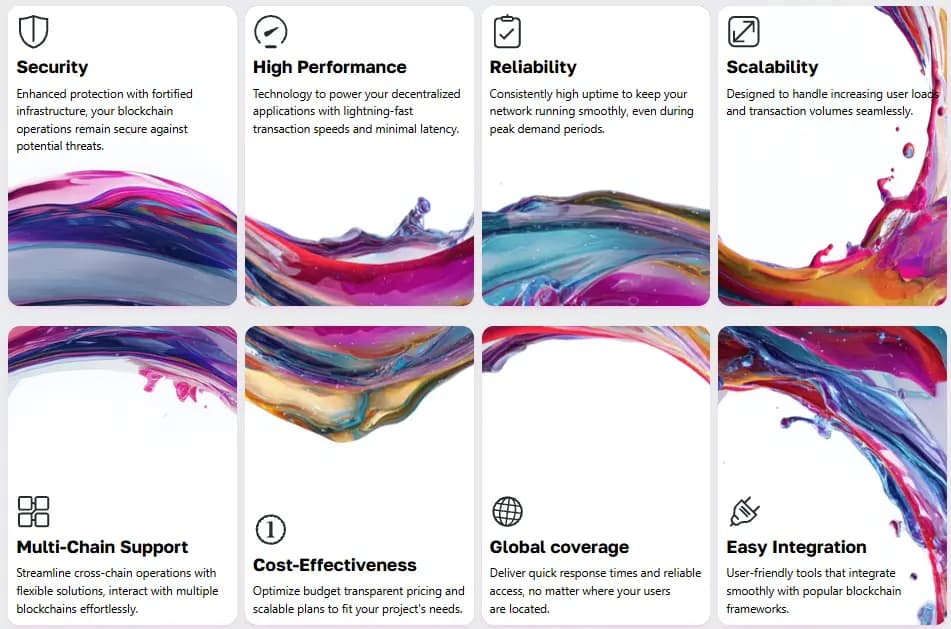
Spectrum combines a Compute Unit model with explicit requests per second ceilings, giving clear visibility into both capacity and throughput. It does not apply separate trace or archive multipliers, so those workloads consume from the allocated CU pool rather than being amplified per method. Additionally, paid tiers run on private infrastructure, with dedicated options at higher levels, aligning cost and performance with sustained workload sizing rather than method-level amplification.
The trade-off is that teams must size plans around sustained demand rather than optimising around individual method weights. For production systems, however, this structure can simplify forecasting and reduce multiplier driven volatility.
Which RPC Provider Is Best for You?
Pricing models only matter once they meet real traffic patterns.
A lightweight wallet performing balance checks and transaction lookups will operate efficiently across most leading blockchain RPC providers. Under predictable, low-intensity workloads, differences between unit systems rarely dominate performance or cost. Shared infrastructure from providers such as Alchemy, Infura, or QuickNode is typically sufficient.
The picture changes drastically as workloads become heavier or less predictable. An analytics engine issuing frequent eth_getLogs queries, a trading engine reacting to volatility spikes, or a monitoring pipeline running continuous trace calls introduces sustained concurrency and higher computational pressure. Under shared multi-tenant models, performance boundaries are influenced not only by your request volume, but by how capacity is pooled and enforced.
Therefore, at that point, the decision is less about marginal differences in per-method pricing and more about architectural alignment. Shared infrastructure is optimised for efficiency across many tenants, while on the other hand, Dedicated RPC architecture provisions infrastructure separately from shared plans and defines throughput boundaries through plan-based requests per second limits.
Providers such as SpectrumNodes position their infrastructure around sustained production workloads where stable throughput and transparent rate limits are important. Therefore, if your system depends on predictable behaviour under continuous execution rather than occasional bursts, capacity isolation becomes a structural advantage rather than a premium feature.
In practical terms, the best RPC provider is not universal. It depends on whether your dominant characteristic is light reads, burst-driven traffic, sustained log processing, or continuous automated execution. For serious production infrastructure, architectural predictability often outweighs surface-level pricing comparisons.
If you are evaluating production-grade RPC infrastructure, it is worth reviewing network coverage and implementation details directly. Additionally, we encourage you to explore the supported blockchain networks at SpectrumNodes Networks and examine architectural specifics in the developer documentation.
Final Thoughts
The best RPC provider in 2026 is not defined by brand familiarity or free tier allowances, but by how well its infrastructure model aligns with real workload behaviour. Shared environments are optimised for accessibility and developer convenience, while dedicated architecture is designed for sustained execution and automation-heavy systems where transparent rate limits and capacity planning are important.
If your application is transitioning from development into production and begins encountering latency variability or 429 errors during burst activity, the constraint may not simply be scale, but it may be architectural alignment. Evaluating whether your workload requires isolated capacity rather than pooled throttling is often the turning point in achieving stable performance.
For teams building serious Web3 infrastructure and automation-driven systems, you can explore a dedicated RPC architecture aligned with sustained execution at SpectrumNodes.
Frequently Asked Questions (FAQs)
What is an RPC provider?
An RPC provider offers managed access to blockchain nodes so applications can interact with blockchains without operating their own node infrastructure.
How do I choose the best RPC provider?
Define your method mix, archive needs, trace requirements, and peak concurrency. Map those characteristics to each provider’s unit system and throughput model.
What causes 429 errors?
429 errors occur when rate limits are exceeded. Limits may be defined as requests per second, compute units per second, or credits per second, depending on the architecture.
Can I use multiple RPC providers?
Yes. Many production systems use multiple providers for redundancy or workload separation.