
RPC Infrastructure for AI Agents: Challenges, Bottlenecks & Case Study
RPC blockchain infrastructure is fundamental for various crypto related technologies, but it is especially important for most AI agents, even if it rarely gets attention. As days pass, more and more agents are being deployed across trading, monitoring, and automation workflows, and their performance is increasingly dependent on how quickly and reliably these AI agents can interact with the blockchain.
All of these interactions happen through Remote Procedure Calls (RPC). It is only because of RPCs that agents can read state, monitor activity, and submit transactions therefore, if that connection is slow or unstable, the agent may still run, but it will act on outdated data or fail at the worst possible moment.
Considering their importance, today, let’s discuss the vital role of RPCs for blockchain AI agents.
What Is RPC in Blockchain?
In simple terms, RPC is the interface applications use to communicate with blockchain nodes. Instead of interacting with the chain directly, an application sends a request to an RPC endpoint, and the node returns a response. To give a real world example, consider that on networks like Ethereum, this is handled through JSON RPC methods. These methods allow applications to fetch balances, query contract state, estimate gas, and broadcast transactions.
Although an endpoint may look simple from the outside, behind it sits real infrastructure. Routing layers, node clusters, caching, and failover systems all affect how that endpoint behaves. That is why 2 RPC providers can feel completely different under load. For a deeper look at how requests are handled in practice, see how Spectrum handles requests.
What Are AI Agents in Crypto?
AI agents in crypto are systems that observe inputs, make decisions, and execute actions without constant human input. In practice, they may be better understood as automated operators than assistants.
For example, a trading bot reacting to price differences, a liquidation watcher monitoring positions, or a system rebalancing treasury allocations all fall into this category. Sure, there are various differences between different AI agents; some use machine learning, others rely on structured logic, but at their core, they all share one requirement. They need continuous access to the blockchain state.
At this stage, it is worth noting that this access is not, and should not be occasional, but it is very important for it to be constant, as agents check conditions, reassess, and act repeatedly. This is exactly why infrastructure is important and should never be a secondary concern, since it shapes how the agent behaves under real conditions.
How AI Agents Use RPC Blockchain Infrastructure
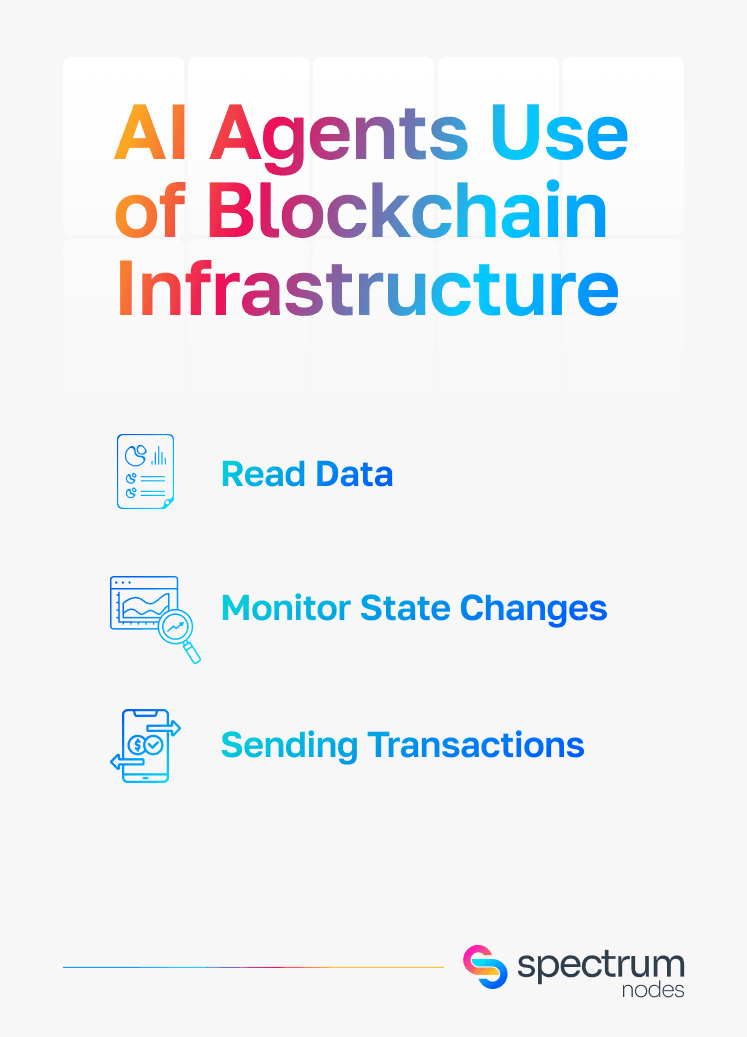
AI agents rely on RPC blockchain infrastructure in 3 core ways.
First of all, they read data, which basically includes balances, contract storage, logs, and transaction history. Very often, these reads happen at high frequencies, especially when the agent tracks multiple markets. Effectively, this means the agent is not relying on a single request, but on a continuous stream of calls where even small delays or inconsistencies can compound and affect decision quality.
The second core way AI agents rely on RPC infrastructure is by monitoring state changes. Agents constantly check for new blocks and look for changes in smart contracts, and therefore they are sending repeated requests every second. If responses slow down or vary in speed, the agent can easily fall behind or miss important updates.
The final core way is by sending transactions, and this is where timing really matters. Once a decision is made, the agent needs to submit the transaction immediately, because even a short delay can change the price, reorder the transaction, or make the trade invalid altogether.
Even small inefficiencies compound here. When an agent is making large numbers of requests, sending them one by one adds unnecessary overhead. So much so that for example tools like Geth, Ethereum’s Go based node client, support batching multiple RPC requests into a single call, helping agents process data faster and act more efficiently.
In relation to this, we recently put together a piece that breaks down what actually matters when it comes to high performance RPC infrastructure.
The Hidden Problem: RPC Bottlenecks for AI Agents
Most teams focus on refining strategy, but far fewer stress test their infrastructure, even though it has a direct impact on how well an AI agent actually performs.
Latency usually is the first, very real bottleneck issue that becomes apparent, as if responses arrive slowly, the agent would essentially be working with stale data. One should also note that this does not always show up in testing, but it becomes obvious in production.
Rate limits are another constraint. Shared RPC services often cap requests per second or total usage, which works well under normal conditions. The issue would only become apparent when activity spikes as the agent may start hitting those limits, forcing it to slow down, drop requests, or miss critical updates at exactly the wrong time.
Finally, failed requests create a different kind of problem. Timeouts and inconsistent responses do not always stop the system, but they make it unreliable. Of course, the agent may always simply retry the request, but by the time it succeeds, the data can be outdated or the opportunity would have already gone.
These issues rarely show up as clear failures. More often, performance just starts to drift. Execution quality drops, but nothing obviously breaks, which is why many teams notice the problem late. For a closer look at how this plays out, see what happens when an RPC goes down.
Why Standard RPC Infrastructure Breaks at Scale
Standard RPC infrastructure is usually shared, and for the most part that works for wallets and basic applications, but it becomes a limitation for automated systems.
Shared environments introduce contention, as multiple users rely on the same resources, and performance becomes unpredictable during peak activity. This is very similar to what you usually see in cloud environments when workloads compete for compute capacity, a challenge often discussed in platforms like AWS.
Additionally, scaling adds another layer of complexity. Systems that perform well under average load often struggle when traffic spikes, and AI agents tend to generate exactly this kind of bursty activity rather than steady usage. This makes consistency difficult to maintain, as latency can increase and requests may start to fail under pressure. Spectrum approaches this by focusing on maintaining stable latency and throughput as demand grows, even during spikes.
Case Study: Running AI Agents on Spectrum Nodes
For the sake of the argument, let's consider a trading agent operating across decentralised exchanges. The agent monitors liquidity, compares prices, and executes trades when conditions are met, and in a testing environment, it performs exactly as expected.
On the other hand, in production, the problems become clear. It usually starts with data arriving slightly too slowly, which means the agent is already working with stale information by the time it evaluates a trade. From there, request performance becomes inconsistent, with some calls slowing down during periods of high activity, making it harder for the agent to build an accurate view of the current state.
By the time the agent is ready to act, transaction submission becomes the final bottleneck. Even if the decision is correct, delays or failed requests can mean the transaction arrives too late, gets reordered, or simply does not execute as expected.
To fix this, usually the team at this stage decides to move to dedicated RPC endpoints and expands across supported blockchain networks, as this removes dependency on shared infrastructure and allows the agent to operate more reliably across chains. The result is more consistent data, predictable request behaviour, and more reliable execution.
Why Dedicated RPC Matters for AI and Automated Systems
Dedicated RPC infrastructure improves consistency in ways that matter for automation. First of all, latency becomes much more predictable, and even if the chain itself introduces delays, the communication layer is no longer a major variable.
Secondly, throughput increases, which effectively means that agents can continue operating during peak activity without hitting any request limits, and this is critical when workloads spike. At the same time, reliability also improves because the system is no longer competing with unrelated traffic, reducing the risk of congestion and inconsistent behaviour. For automated systems, this kind of consistency is often more valuable than raw peak speed.
How to Choose a Blockchain RPC Provider
Choosing a blockchain RPC provider requires focusing on how the system behaves under real conditions. It is of utmost importance that performance should be measured under load, and not just in ideal scenarios. Furthermore, fundamentally consistency matters more than occasional speed.
Choosing a blockchain RPC provider comes down to how the system behaves under real conditions, not just how it looks on paper. Uptime and fault handling are critical, and therefore it is important to understand how the provider deals with failures, whether through failover mechanisms or active monitoring. At the same time, scalability needs to match your workload, especially since AI agents tend to generate burst traffic rather than steady usage, which can expose weaknesses during spikes.
Network support also plays a role. Many applications now operate across multiple chains, so broad coverage helps reduce complexity and avoids the need to switch providers as you scale. Finally, pricing should reflect how you actually use the service, since request limits and throughput caps can quickly become constraints if they are not aligned with your workload.
If you are evaluating options, you can explore the Spectrum Nodes platform.
Conclusion
AI agents depend on infrastructure more than most systems, because their ability to act in real time is directly limited by how quickly they can interact with the chain. This is where RPC blockchain infrastructure becomes critical, as it is the layer that connects decision making to execution, and when it performs well, agents behave as expected. When it does not, even strong strategies begin to struggle.
Moving to dedicated RPC reduces much of this uncertainty by improving consistency, throughput, and reliability. Furthermore, for teams running automated systems, this is often the difference between something that works in testing and something that holds up in production.
If you are building or scaling AI agents, we invite you to speak with our team to explore your setup in more detail.
Frequently Asked Questions (FAQs)
What is RPC in blockchain?
RPC is the interface applications use to communicate with blockchain nodes. It allows them to request data and submit transactions.
What is an AI agent in crypto?
An AI agent is a system that observes data, makes decisions, and executes actions automatically based on changing conditions.
How do AI agents use blockchain?
They use RPC to read data, monitor events, and submit transactions. Without this connection, they cannot operate effectively.
Why does RPC latency matter for trading bots?
Latency affects how quickly a bot can react to market conditions. Delays can lead to missed or less favourable execution.
What is a blockchain RPC provider?
It is a service that gives developers access to blockchain nodes through RPC endpoints, removing the need to run infrastructure themselves.
How do you choose the best RPC provider for blockchain apps?
Focus on performance, uptime, scalability, network support, and pricing. Consistency under load is especially important.
What causes RPC rate limits in blockchain?
Rate limits are set to manage infrastructure usage and prevent overload. They become a constraint when applications generate high volumes of requests.