
Dedicated RPC Endpoints for Autonomous Onchain Systems
A dedicated RPC endpoint is often the difference between an AI agent that performs reliably and one that silently degrades under load. These systems are no longer experimental scripts running in isolation. They now handle capital allocation, liquidation monitoring, arbitrage execution, governance automation, and cross-chain coordination. Additionally, unlike traditional decentralised applications, they do not wait for user interaction, as they operate continuously and respond to state changes as they occur.
This shift changes what infrastructure actually means. The RPC layer is no longer just a way to fetch blockchain data, but now has become a part of the system that makes decisions. When an autonomous agent relies on constant reads, event driven triggers, and always on execution, even small delays or rate limits can change how it behaves.
Latency spikes, RPC rate limits, and unpredictable throughput are not simple minor inconveniences for AI agents, but they introduce systemic execution risk. For teams building autonomous on-chain systems, the distinction between shared RPC access and a dedicated RPC endpoint determines whether automation behaves predictably under sustained load.
AI Agents Are Not Traditional dApps
Most decentralised applications depend on user actions. Someone connects a wallet, signs a transaction, and then leaves. Activity rises and falls based on how people use the app, but AI agents behave very differently. AI agents run persistent loops, subscribe to contract events, and trigger logic based on state transitions. For example, a trading bot may simulate opportunities every block, while a liquidation engine may monitor multiple lending markets simultaneously. Furthermore, it is also worth mentioning that a multi-agent coordination system may operate across several networks, reacting to signals in real time.
This workload pattern creates steady infrastructure pressure rather than temporary bursts. When infrastructure degrades, agents do not pause politely. They retry calls, re-fetch state, and escalate concurrency. Under shared infrastructure models, these retries can compound instability.
If you have experienced infrastructure degradation during periods of market volatility, the mechanics are often explained in what happens when an RPC goes down. Automation leaves no room to hide infrastructure weakness. If performance drops, the agent will react to it in real time.
What Is a Dedicated RPC Endpoint?
To truly evaluate infrastructure properly, we need to first understand and make the difference between shared and dedicated models.
First of all, in a shared RPC environment, infrastructure resources are pooled across multiple tenants, basically meaning that users concurrently query the same cluster. In turn, this forces providers to implement ceilings to maintain the overall stability of their systems. These ceilings typically take the form of RPC rate limits, compute unit quotas, or credit based throughput controls.
On the other hand, a dedicated RPC endpoint isolates infrastructure resources for a specific workload so that throughput is no longer influenced by unrelated traffic. Instead of sharing cluster level ceilings with other tenants, concurrency limits are defined at the project level, which makes performance behaviour more predictable and easier to measure.
In some contexts, teams refer to isolated access as using a private RPC endpoint. In practice, “private” often means authenticated, project scoped access rather than a public shared node, while “dedicated” infrastructure goes further by reserving capacity for a specific workload. By isolating resources at that level, cross-tenant interference is reduced and performance boundaries become clearer. For automation heavy systems, that determinism is not optional, but becomes part of the architecture itself.
Spectrum reflects this distinction in its platform design. Across its standard plans, the platform provides private endpoints within its high performance RPC infrastructure, giving teams authenticated, project scoped access rather than exposure to public shared congestion. For workloads that require stronger throughput guarantees or sustained high concurrency, dedicated infrastructure is available through custom deployments. This separation allows builders to start with controlled private access during development and transition to dedicated capacity as their automation matures.
Dedicated deployments are available across multiple supported blockchain networks, allowing teams running AI agents or trading bots to apply the same infrastructure model consistently across chains. In practice, a dedicated RPC endpoint aligns infrastructure behaviour with automation requirements rather than human paced traffic patterns.
Dedicated RPC vs Shared RPC: What Builders Need to Know
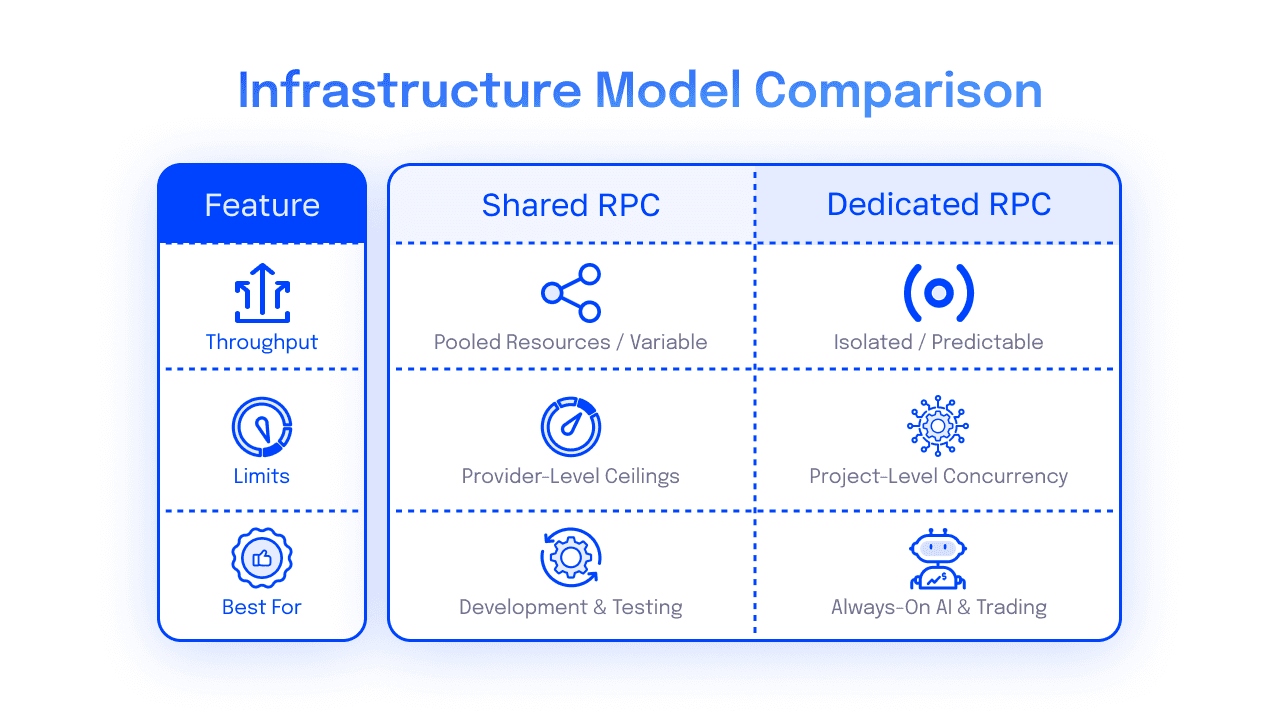
The discussion of dedicated RPC vs shared RPC is often reduced to pricing. In practice, the difference is architectural.
Shared RPC models are designed for broad accessibility. Multiple users query the same infrastructure concurrently, which makes them well suited for development, testing, and lighter workloads. Under sustained automation load, however, shared environments introduce structural constraints. Noisy neighbor RPC effects occur when one tenant’s burst traffic increases latency for others. Even if your own request rate remains stable, performance can fluctuate because capacity is shared.
To protect cluster stability, providers enforce throttling mechanisms such as RPC rate limits, request per second ceilings, and compute or credit based quotas. When these boundaries are reached, developers commonly see “429 Too Many Requests” responses or other rate limit errors. Automated retry logic can then increase call density, which adds further pressure to the shared environment, especially during market volatility.
For deeper context on sustained throughput, see why high performance RPC matters.
A dedicated RPC endpoint removes cross-tenant interference by isolating capacity for a specific workload. Instead of competing within a shared cluster, performance boundaries are defined at the deployment level. This stabilises latency under continuous concurrency and reduces unpredictable throttling.
Why AI Agents Hit RPC Rate Limits Faster
AI agents reach infrastructure ceilings more quickly because of their structural workload patterns.
Consider a trading bot operating on a single network. Each decision loop may include state reads, simulation calls, pre condition checks, transaction submission, and post execution verification. If this loop runs every block, the request rate escalates rapidly. Furthermore, when multiple agents operate concurrently, concurrency multiplies. High frequency blockchain reads combined with event driven smart contracts produce steady throughput pressure rather than isolated bursts.
Common rate limit indicators include:
- 429 Too Many Requests
- compute units per second exceeded
- credits per second exceeded
- eth_getLogs block range limit
The eth_getLogs block range limit shows up most clearly during reconnects. If an agent misses events while the connection is down, it will often try to backfill logs across a large block range. That kind of wide query can hit provider limits quickly.
Spectrum’s request processing approach is detailed in how Spectrum handles requests blog post. Understanding these mechanics allows automation engineers to design systems around sustained concurrency rather than reactive retries. If you are building autonomous systems that depend on predictable throughput, dedicated infrastructure truly matters.
Compute Units, Credit Models, and Hidden Throughput Ceilings
Many RPC providers measure usage through compute units or credit systems. It simplifies billing and reporting, but it does not tell the full story about how a workload behaves once concurrency increases.
On paper, two projects might show similar credit usage, but in production, they can stress infrastructure in very different ways. A continuously running automation system that issues parallel requests for example, can reach limits faster than a user driven application, even if monthly usage looks comparable.
For AI agents, consistency is what really matters. The question is whether capacity remains available when the system needs it, not just how much has been consumed over time. Engineers care about whether performance stays stable under load so they can plan around clear limits instead of constantly reacting to throttling events.
If you are interested in reading further, Spectrum outlines its scaling model and throughput isolation in how Spectrum scales infrastructure. By isolating allocation at the deployment level, a dedicated RPC endpoint makes those performance boundaries easier to define and reason about.
WebSockets, Real Time Data, and Reconnect Risk
Autonomous systems often depend on WebSocket subscriptions to stay in sync with chain activity. Polling every few seconds is inefficient, so most production agents listen for events instead. So, what is the trade of? Well, the trade off appears when the connection drops. When that happens, the agent needs to reconnect and figure out what it missed, and catching up usually means querying logs across a range of blocks. If the requested range is too wide, the node may reject the request because of block range limits.
The tendency is that this will probably surface during volatile periods. Multiple agents reconnecting at the same time can place sudden pressure on shared infrastructure, especially if each one attempts to backfill aggressively.
At this point we should also note that designing around this requires practical safeguards. Retry behaviour needs limits. Backfill windows should be constrained. Engineers also need to know whether they are querying a full node or an archive node. A full node keeps recent state, while an archive node preserves historical state, which matters for deeper verification or replay logic.
Designing Infrastructure for Autonomous Onchain Systems
Infrastructure planning for AI agents should begin before deployment. Automation infrastructure must account for sustained concurrency, multi agent coordination, and multi-chain execution.
A robust architecture typically includes:
- A dedicated RPC endpoint per chain
- Clearly defined concurrency ceilings
- Continuous monitoring of latency and error codes
- Backpressure controls to prevent runaway retries
- Isolation across networks to avoid cross chain congestion spillover
The same ideas that shape decentralised systems still apply here. When infrastructure depends on a single chokepoint, instability spreads quickly. Designing for isolation and distribution reduces the risk that one spike or bottleneck cascades across your entire stack.
If you want a deeper look at how these principles apply at the network level, see decentralised blockchain infrastructure.
Dedicated infrastructure is not an upgrade layer for autonomous systems. It is a fundamental part of the design itself.
Why Spectrum RPC Is Built for AI Agents
Spectrum RPC supports both private and dedicated deployments, allowing teams to match infrastructure to workload intensity. For automation heavy systems, dedicated RPC endpoints isolate capacity and define clear throughput boundaries, which helps stabilise latency under continuous execution.
Because Spectrum operates across multiple networks, AI agents can apply the same infrastructure model across chains without redesigning their stack. The separation between shared access and dedicated deployments is visible at the control layer, making performance trade offs explicit rather than hidden.
Cost planning matters as automation scales. Spectrum’s transparent pricing shows request rates, compute units, and infrastructure tiers in concrete terms, so teams can understand how their workload maps to capacity before hitting limits in production.
The distinction between shared and dedicated infrastructure is not theoretical inside Spectrum. It is implemented directly in the control layer.
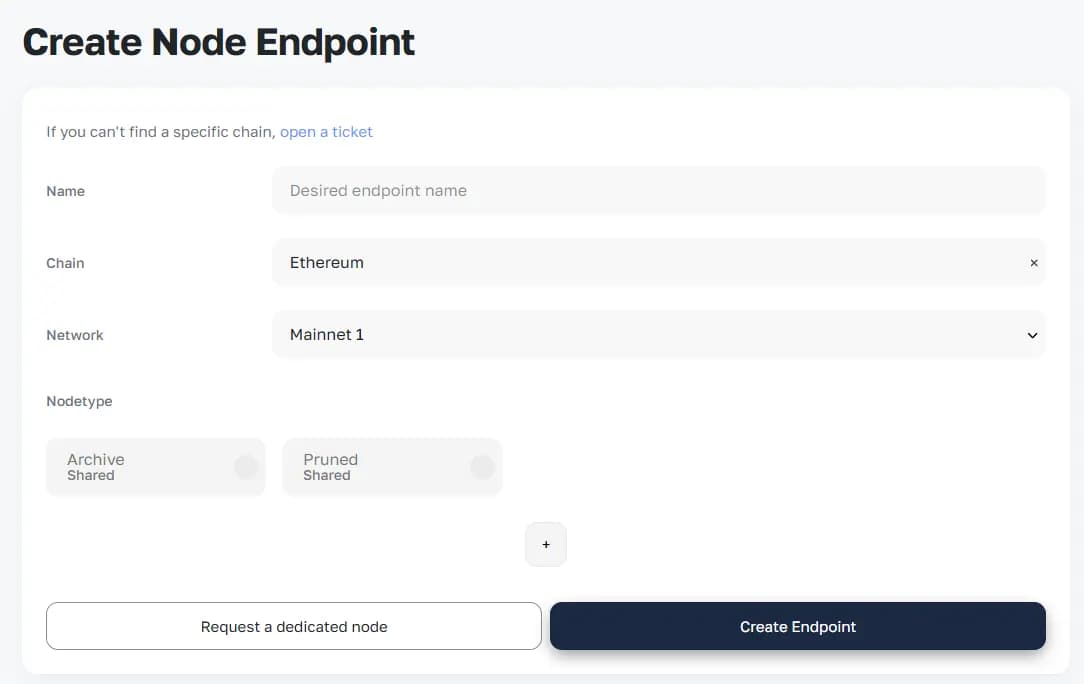
When creating a node endpoint, builders explicitly select the chain, network, and node type. For example, they can choose between pruned nodes for current state access or archive nodes for full historical state queries. Furthermore, shared nodes support concurrent development access and lightweight workloads, while dedicated deployments are provisioned for isolation and predictable performance under sustained concurrency.
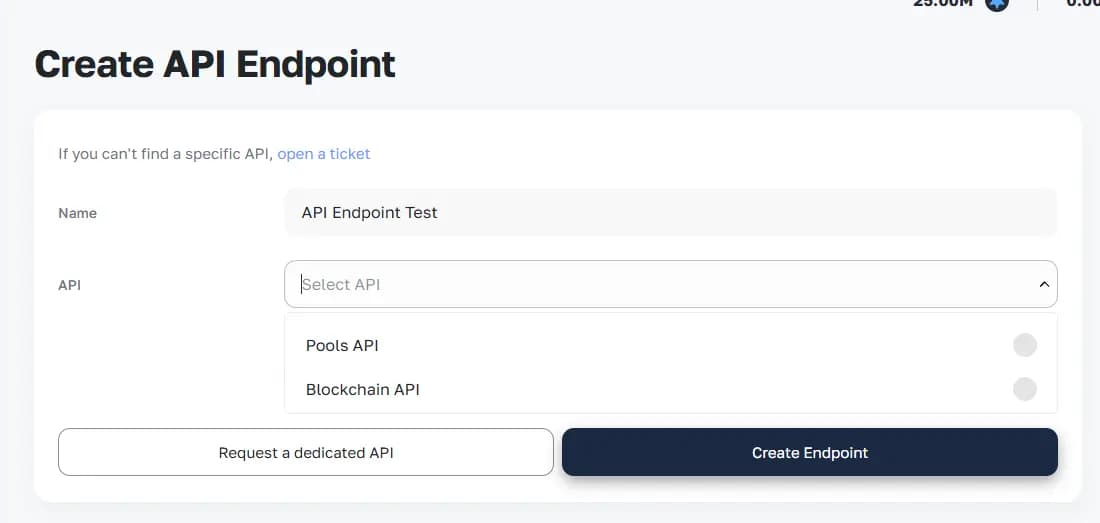
Spectrum separates node endpoints from API endpoints so teams can clearly distinguish between raw chain access and structured data services. The Blockchain API provides direct node level queries, while the Pools API exposes aggregated liquidity data without requiring manual reconstruction. For AI agents that combine low level state reads with higher level data feeds, this separation keeps architecture explicit and easier to reason about.
The deployment model mirrors the architectural principles described earlier in this article. Shared environments support general purpose access. Dedicated RPC endpoints support automation heavy systems that require deterministic performance boundaries.
In practice, this allows teams building trading bots, event driven automation systems, or multi agent coordination engines to isolate throughput per chain, define network boundaries explicitly, and scale infrastructure alongside workload growth without introducing noisy neighbor interference.
Infrastructure is not abstracted away. It is structured.
Dedicated RPC Endpoints for Deterministic Automation
Autonomous systems expose infrastructure limits quickly. When execution runs continuously, small latency shifts and shared throttling stop being background noise and start shaping behaviour. A dedicated RPC endpoint brings those variables under control by isolating capacity and setting clear performance boundaries.
If you are running AI agents, trading bots, or other always on automation, it is worth testing how your infrastructure behaves under sustained load. You can explore Spectrum RPC or speak with our team to evaluate what predictable throughput would look like for your workload.