
Introduction to Mezo
The beauty of Bitcoin is in its simplicity, not only from a technical standpoint, but also from a narrative perspective. Although the potential for various other narratives does exist for Bitcoin’s base layer, over the years the one narrative that has stood above the rest is that of being digital gold. You buy it, you hold it, and wait for it to appreciate over time due to its fundamental properties, and if you ever need liquidity, you sell it.
Therefore, it is reasonable that this narrative significantly shaped how many use Bitcoin. Fundamentally, it works, but in practice it also comes with a clear limitation. Your capital stays locked unless you are willing to give up your position.
Precisely because of this, in recent years a number of projects started to explore how Bitcoin can be used more actively, either by building on top of it or by creating systems around it, so much so that this shift has even picked up its own label, often referred to as BTCfi.
Mezo is one of the newer additions to this space, and its mission is simple. You keep your Bitcoin, while at the same time allows you to use its value when needed. How is this possible?
Instead of forcing a choice between holding and spending, Mezo introduces a different approach. Using its platform, you can borrow against your Bitcoin, earn from it, and move capital within a system that remains anchored to BTC. So how does that actually work? Let’s have a look!
What Is Mezo?

Mezo may be best described as a Bitcoin based financial system rather than a typical crypto project, as it is designed to give Bitcoin more utility without changing its role as the underlying asset. At the centre of the system is a simple idea. You deposit Bitcoin as collateral, and in return, you gain access to liquidity through a stablecoin called MUSD. In turn, this allows you to use the value tied to your Bitcoin while still holding it within the system.
Essentially, the core premise of the project is presented as a way to “live off Bitcoin” rather than exit it.
The Problem Mezo Is Trying to Solve
Evidently, over the course of the years, Bitcoin proved itself as a great store of value, but it has always been limited when it comes to flexibility. If you need liquidity, selling is the default option. In practice, this means that it immediately removes your exposure, which matters if you believe in Bitcoin over the long term. Furthermore, in some cases depending on the jurisdiction where you live, it can also introduce tax implications. At the same time, Bitcoin has not developed a deep native financial layer. Compared to other ecosystems, there are fewer options for borrowing, lending, or generating yield without relying on custodial services or moving assets elsewhere, and Mezo tries to solve both problems at once. It allows you to unlock liquidity without selling your Bitcoin, while keeping everything structured around BTC as the core asset.

How Mezo Works
The process behind Mezo is easier to follow once you see it as a cycle rather than a set of steps.
First of all, you begin by depositing Bitcoin into the protocol, where it is locked as collateral, while at the same time allowing you to maintain full custody of your keys. After doing so, you would now have the opportunity to borrow MUSD, which is Mezo’s native stablecoin. The protocol allows you to borrow up to around 90% of your collateral value, with fixed borrowing rates typically between 1 and 5%, and it is this that gives you access to liquidity without needing to sell your Bitcoin.
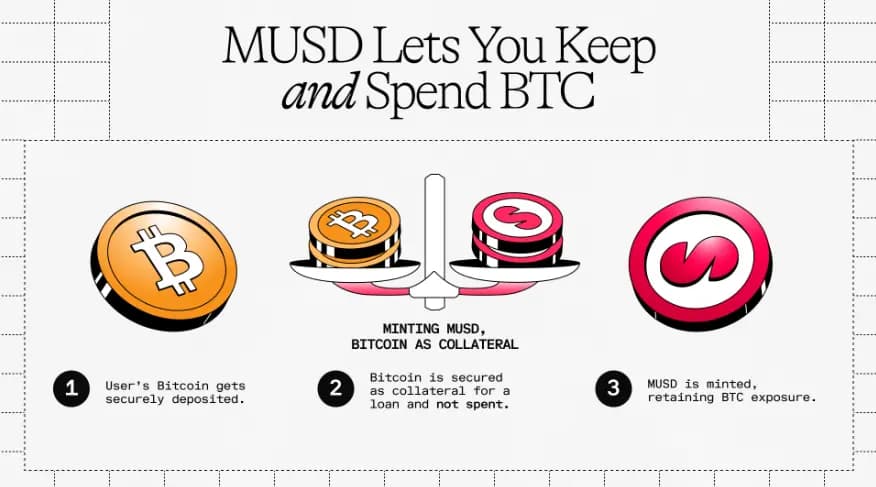
Once you have MUSD, you can use it freely within the ecosystem. You might spend it, move it, or deploy it elsewhere depending on your goals, and then, when you are ready, you repay the loan, and your Bitcoin becomes fully available again.
Understanding MUSD and the Lending Model
MUSD is the core mechanism that makes the system work. It is a stablecoin that aims to track the value of the US dollar, but instead of being backed by fiat, it is backed by Bitcoin collateral. Each position in the system is a collateralised debt position, and to keep everything stable, it is important to note that Mezo requires over collateralisation. In simpler terms, this means your Bitcoin must always be worth more than the amount you borrow.
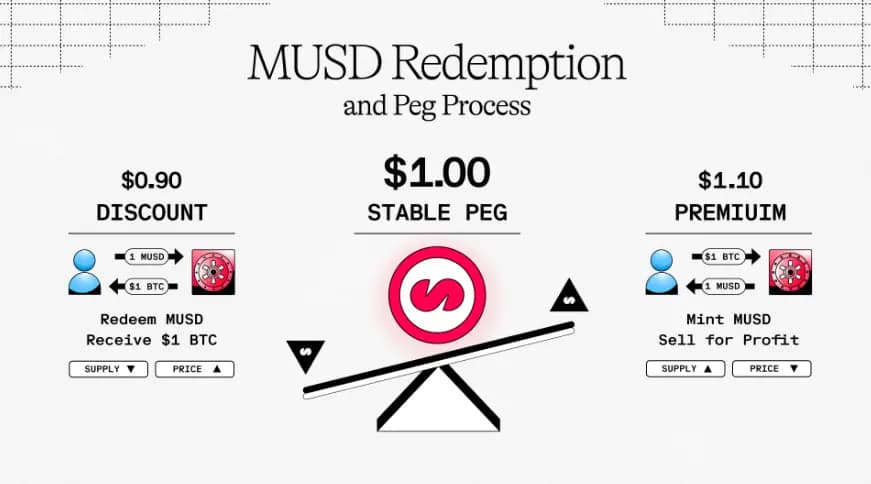
2 thresholds are particularly important to mention. First of all, if your collateral ratio drops below roughly 110%, your position can be liquidated, while at a broader level, the protocol aims to maintain overall backing above 150%, which affects how new loans can be opened.
Therefore, the natural question to ask at this stage is what happens if you want to borrow but the protocol’s overall collateral falls below 150%? If that happens, in order to protect the overall protocol, you would only be allowed to borrow if you secure 150% collateral from your end instead of the usual 110%.
The peg itself is supported through minting and redemption. If MUSD moves away from one dollar, users have incentives to create or repay positions in ways that push it back towards its target.
The Mezo Earn System Explained
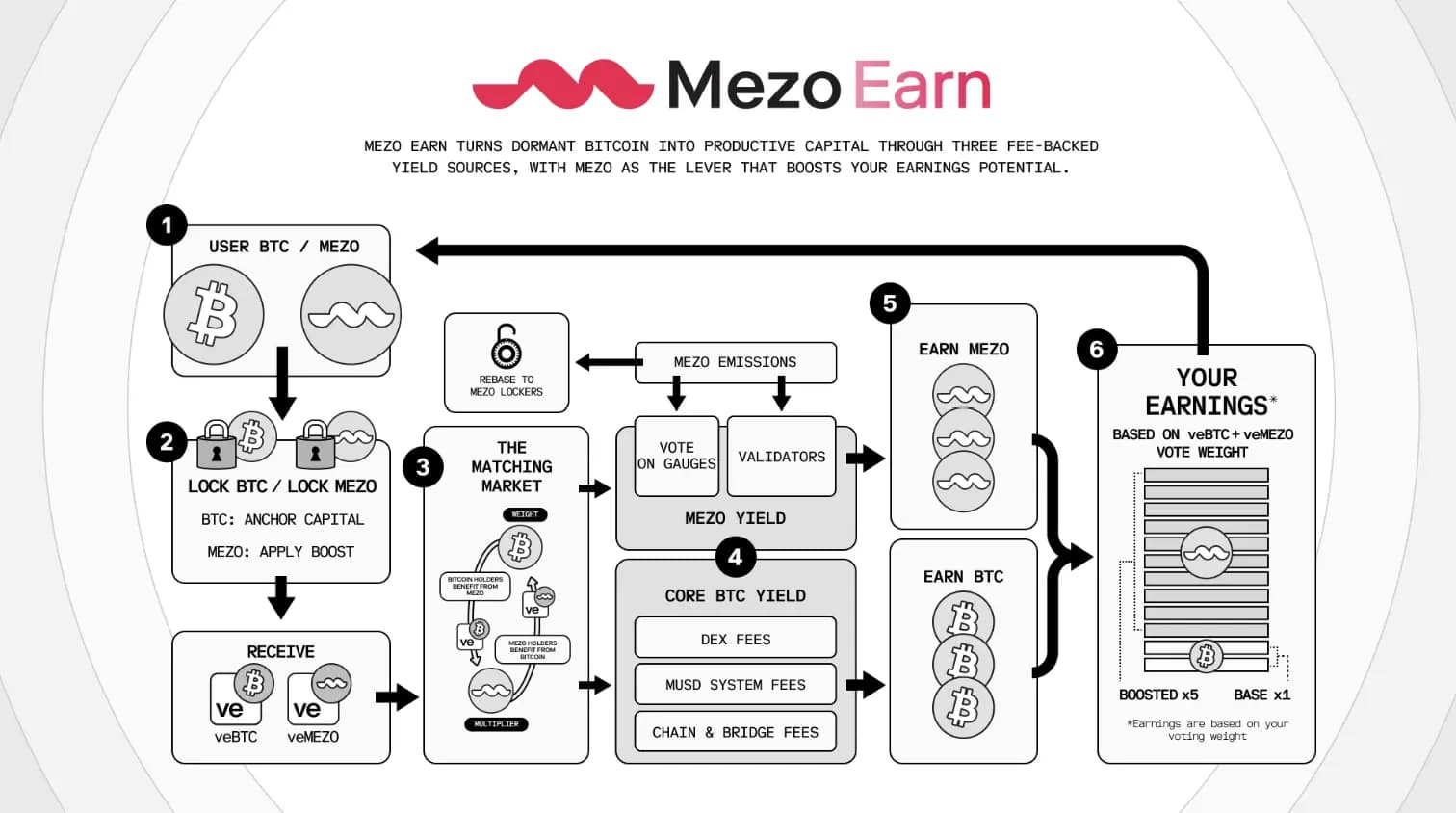
Borrowing is only one part of the system, as Mezo also introduces a layer that lets users take part in how value is distributed across the protocol. This is where veBTC and veMEZO come in. When you lock Bitcoin, you receive a veBTC position, which gives you voting powers and access to a share of protocol fees. On the other hand, locking MEZO creates a veMEZO position, which although does not vote on its own, will grant you the ability to boost the influence of veBTC by up to five times.
This structure matters more than it might seem at first glance, as it keeps Bitcoin at the centre of governance while using MEZO as a way to coordinate incentives rather than replace BTC’s role.
How Yield Works on Mezo
A common question is where the yield actually comes from. In many systems, yield is driven by token emissions, which can lead to dilution over time, but Mezo takes a different approach. Yield is tied to real activity within the protocol and is generated via 3 primary sources. First of all, when users trade crypto assets using Mezo’s decentralised exchange, a swap fee is charged. Secondly, yield is generated when users borrow MUSD because of the interest, origination fees and refinancing fees while, bridging and on-chain transaction fees also help to generate yield.
The result is a system where rewards depend on usage. If borrowing and activity increase, fees increase, while if activity slows, yield reflects that change, effectively creating a more direct link between what the system does and what it pays out.
What Makes Mezo Different
What truly sets Mezo apart from the rest is the projects design choices when you look at the project as a whole, instead of a set of individual products. Bitcoin is not just one asset among many, but it serves as the foundation of the whole system. Governance is anchored in BTC through veBTC, with MEZO acting as a multiplier rather than an independent control layer. Furthermore, the model also leans towards self custody, even though it introduces additional layers such as collateral management and bridging.
All of these choices point towards a system built for long term participation rather than short term activity, potentially positioning Mezo as a reliable long term partner.
Technical Architecture
Under the hood, Mezo combines elements from different ecosystems to support this model. It is built on a Cosmos SDK base and uses a modified Evmos client with CometBFT consensus, while remaining compatible with the Ethereum Virtual Machine. Furthermore, the design decision to use BTC as its gas token for transactions make the project even more unique as this keeps usage tied back to BTC rather than introducing a separate token for fees.
Finally, there is also an important detail in how Bitcoin enters the system. Native BTC deposits are bridged internally before being used as collateral, which adds a layer that users should be aware of even if it stays mostly in the background.
If you are interested in reading more about how reliability at the infrastructure level plays a big role in making systems like this usable, we encourage you to read our recent articles “What Happens When an RPC Goes Down?” and “Why High Performance RPC Matters”.
Mezo Tokenomics
Mezo officially launched on the 1st of April 2026, marking the point where its model moved from theory into a live system, and of course, at the centre of that design is the MEZO token. Therefore, let's have a look at MEZO’s supply architecture and vesting parameters to better understand the economical structure of the token.
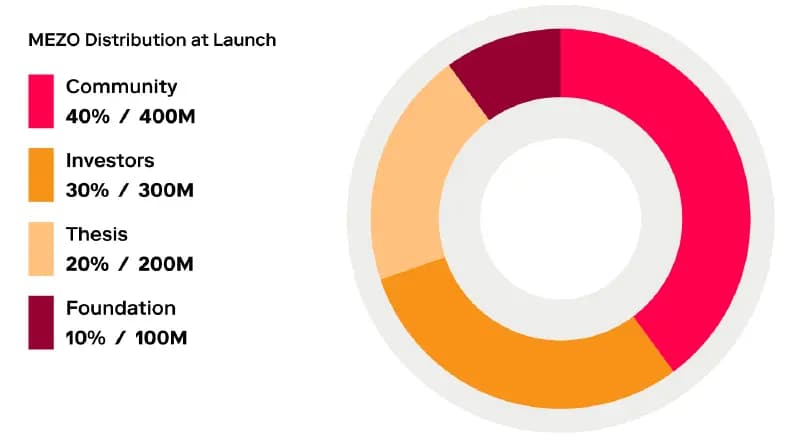
From a supply perspective, MEZO launched with a total supply of 1 billion tokens and at genesis, the allocation was split between the community, investors, Thesis (the main company behind Mezo) and the foundation.
Furthermore, the chart below shows how MEZO tokens are released over time across different stakeholder groups, gradually increasing circulating supply.
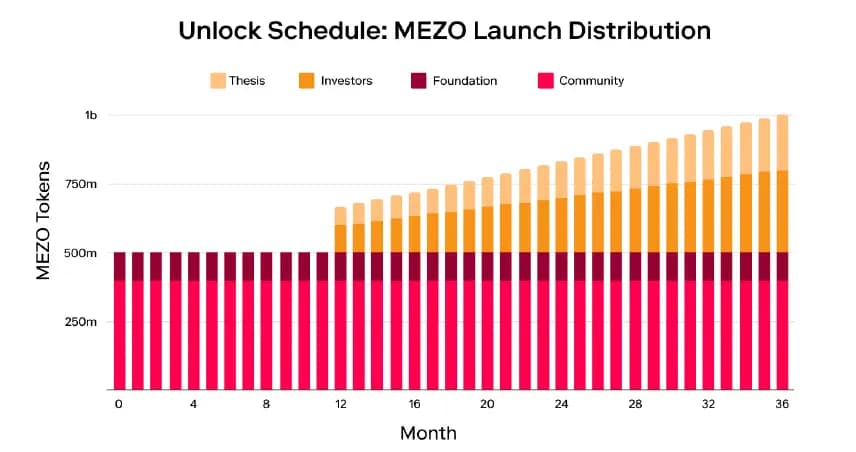
With regards to the emission model MEZO’s emissions start relatively high, with an annualised rate of around 25% during the initial phase, and gradually decrease over time until reaching a long term level of around 2%.
What stands out is how MEZO is tied directly to activity. The protocol generates value through borrowing, trading, and transactions, and MEZO is used to route that value between participants. In that sense, it functions less like a standalone asset and more like a mechanism that reflects how much the system is actually being used.
Use Cases of the Mezo Protocol
Now that we have a better understanding of how the system fits together, the use cases become more practical and easy to understand. A long term Bitcoin holder might use Mezo to access liquidity without selling, whether to cover expenses or make new investments. Others may borrow MUSD and use it within the broader crypto ecosystem, depending on their strategy and risk tolerance.
Furthermore, it is fair to assume that as more tools are built on top of the protocol, these use cases are likely to expand, as the system is still evolving, and therefore, its full range of applications is not fixed yet.
Risks and Considerations
Mezo is still in its early stages, and as any other early stage crypto project it comes with trade offs. First of all, one has to acknowledge that there is smart contract risk, which applies to any on-chain system. Also, there is also price risk. If Bitcoin drops, positions that are not managed carefully can be liquidated. Additionally, considering that the network itself is also evolving, the validator model is not yet a fully mature proof-of-stake system, and governance continues to develop over time.
That said, we should point out that none of these risks are unique to Mezo and are very common risks for projects which have recently launched, but they are important to understand before using the system.
Final Thoughts
Mezo introduces a different way of thinking about Bitcoin. Instead of choosing between holding and using it, the system tries to combine both. It turns Bitcoin into something that can be actively used while still remaining at the centre of your exposure.
At the same time, it is not a finished system, as its long-term success will depend on how it performs as more users and developers interact with it. For now, it offers a clear example of how Bitcoin based finance might evolve beyond simple holding. If you want to keep up with emerging blockchain infrastructure, you can follow Spectrum Nodes on X.
Frequently Asked Questions (FAQs)
What is Mezo in simple terms?
Mezo is a system that lets you use Bitcoin as collateral to borrow a stablecoin instead of selling your BTC.
What is MUSD?
MUSD is a stablecoin backed by Bitcoin collateral within the Mezo protocol.
How does Mezo generate yield?
Yield comes from protocol activity such as loan interest, swap fees, and network related fees.
Do you lose your Bitcoin when using Mezo?
No. Your Bitcoin is locked as collateral and can be unlocked once the loan is repaid.
What are the main risks?
Price volatility, liquidation risk, smart contract risk, and the fact that the system is still developing.
Is Mezo suitable for beginners?
The concept is straightforward, but users should understand collateral and liquidation before using it in practice.