
Spectrum Nodes vs Infura: A Practical Infura Alternative
Updated October 22, 2026 · Spectrum Nodes
Short answer: Spectrum Nodes is a practical Infura alternative for teams that run on many chains and need infrastructure they can audit. Spectrum Nodes serves over a billion requests a day across 200+ chains at 99.999% uptime, is SOC 2 Type II attested and runs on its own hardware. Infura, part of MetaMask Developer Services, covers 40+ networks with Ethereum tooling such as its Gas API and ERC 4337 bundler methods.
The right choice depends on your workload. A wallet, explorer, analytics pipeline, trading system, DeFi app or AI agent each stresses RPC infrastructure in a different way. An RPC (remote procedure call) endpoint is the URL your app sends blockchain reads and transactions to, so how it behaves under load decides how your product feels.
Spectrum Nodes vs Infura at a Glance
Infura is the stronger fit for Ethereum focused teams that want MetaMask aligned tooling. Spectrum Nodes is the stronger fit for multichain teams that care about endpoint behaviour, compliance evidence and who owns the hardware.
| Spectrum Nodes | Infura | |
|---|---|---|
| Chains | 200+, including testnets and devnets | 40+ networks (Infura pricing page, Oct 22, 2026) |
| Products | RPC and WebSocket endpoints, unified API across 24 chains, webhooks, CLI | JSON RPC, WebSockets, archive data, Gas API, trace and debug, ERC 4337 bundler methods, limited IPFS |
| Usage model | Monthly credits plus a requests per second (RPS) ceiling per plan | Daily credit quotas. Traffic stops at the daily limit (MetaMask docs, Oct 21, 2026) |
| SOC 2 | SOC 2 Type II attested | No Infura specific report published (Consensys security page, Oct 21, 2026) |
| Uptime | 99.999% across over a billion requests a day | 99.9% minimum on the Ethereum Standard API (rfp.wiki, third party) |
| Hardware | Own racks and hardware in Tier III data centers | Not stated on its pricing or security pages |
| Published latency | No Spectrum vs Infura test yet | No Infura benchmark. 104.93 ms p50 on light reads in Alchemy's Base test (Aug 8 to 13, 2026, vendor run) |
Infura's strengths are JSON RPC, WebSockets, archive data, the Gas API, trace and debug tooling, bundler methods, dashboard analytics, access controls and MetaMask alignment. Spectrum Nodes leads on chain reach, managed RPC and WebSocket endpoints, private endpoints, sponsored node access, regional URLs, failover, load balancing, endpoint controls, team workspaces and visible RPS planning.
What Is Infura?
Infura is one of the best known blockchain infrastructure providers for Ethereum teams, and is now part of MetaMask Developer Services.
Beyond endpoints, Infura provides JSON RPC, WebSockets, archive data, a Gas API, trace and debug access, bundler methods, dashboard analytics and limited IPFS access. JSON RPC is the standard request format EVM chains use for reads and transactions. Debug and trace access and failover to partner nodes sit on paid or higher tiers (Infura plans, checked Oct 21, 2026).
Infura fits best when a team wants surrounding developer services as well as an RPC.
What Is Spectrum Nodes?

Spectrum Nodes is a developer platform for blockchain data. It runs managed RPC and WebSocket endpoints across 200+ chains, a unified API across 24 chains, signed webhooks and a CLI. It also offers dedicated private endpoints, sponsored node access for foundations and cross chain GraphQL APIs.
What sets it apart:
- Own hardware. We run our own racks and hardware, not rented cloud, in Tier III data centers across the US and Europe, plus a full bare metal deployment in a rented rack in Singapore.
- Scale. Over a billion requests a day at 99.999% uptime.
- Security. SOC 2 Type II attested, and we have never had a breach.
- Operations. Regional endpoints, load balancing, automatic failover, endpoint access controls, team workspaces and shared usage visibility.
- Support. Direct engineering access 24/7 via Slack.
Why Is Spectrum Nodes a Practical Infura Alternative?
Spectrum Nodes is a practical Infura alternative when you judge providers on endpoint behaviour and chain reach more than on Ethereum specific tooling.
Take a team that already runs its own analytics stack, indexing setup, contract workflow or monitoring. What it needs from a provider is stable endpoints, private access, WebSockets, regional routing, RPS headroom and clear production controls. Those are Spectrum's strong points.
Spectrum Nodes does not replace every Infura use case. It matters most when endpoint behaviour outweighs platform breadth. For more on the design, read why high performance RPC matters and how Spectrum handles requests.
Ethereum Tooling or a Multichain Platform: Which Do You Need?
Pick Infura if your work centres on Ethereum tooling. Pick Spectrum Nodes if your work spans many chains and you want more control over your endpoints.
Infura makes sense for a team that wants RPC plus the Gas API, archive access, trace and debug workflows, bundler support, account controls and a MetaMask ecosystem fit.
Spectrum Nodes puts its weight on the infrastructure layer and on cross chain data: RPC and WebSocket endpoints, private endpoints, regional access, load balancing, failover, endpoint controls and capacity visibility, with the unified API, webhooks and CLI on top.
A longer product menu helps only if those products solve the problem you have.
How Many Chains Do Spectrum Nodes and Infura Support?
Infura supports 40+ networks. Spectrum Nodes supports 200+ chains, including testnets and devnets. Chain count alone should not decide it, because a listed chain can still lack the methods, transports or data depth your app needs.
Before choosing a multichain RPC provider, check:
- The mainnets and testnets you need
- WebSocket support
- Archive access and tracing
- Beta status
- Private endpoint availability
- Gaps in supported methods
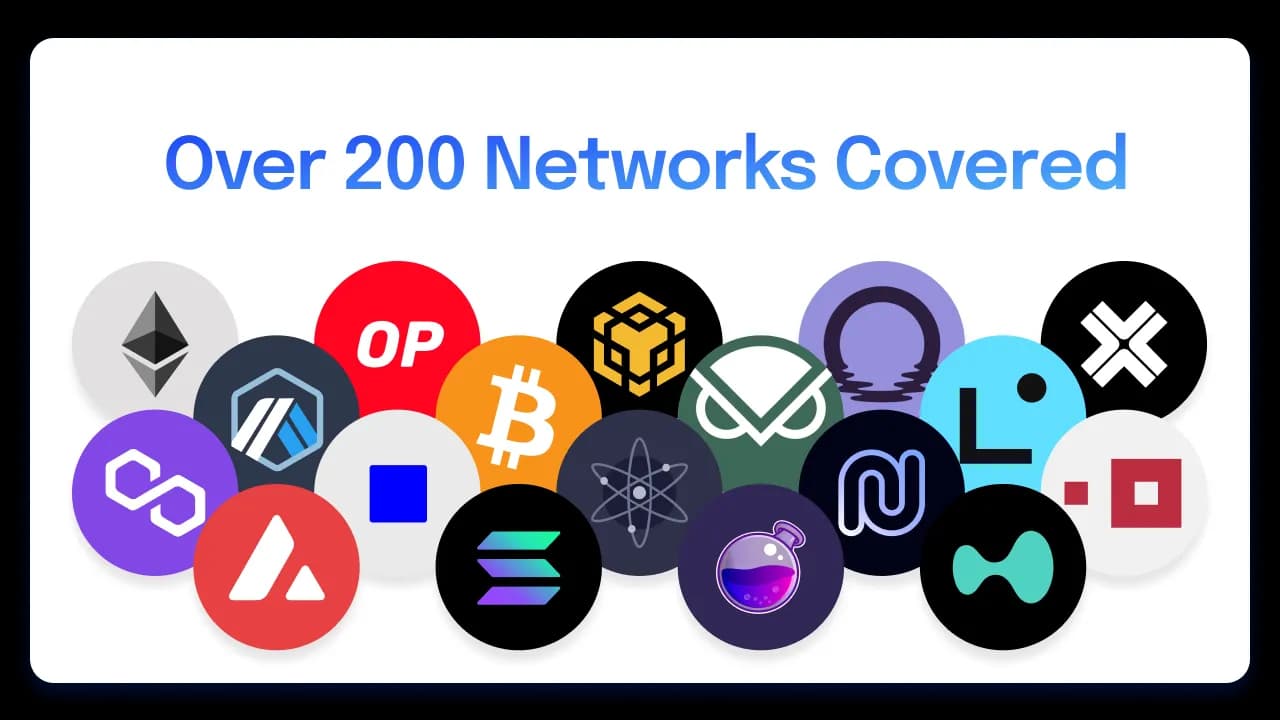
Infura's supported endpoints page helps with this review. Spectrum's supported networks page lists its chain coverage, and posts such as new networks added in 2026 track changes.
How Do WebSockets, Archive Data and Tracing Compare?
Both providers offer WebSockets, archive data and tracing, so the test is how each behaves on your chains, methods, plan and traffic.
A WebSocket is a persistent connection that pushes new data to your app without a new request each time. An archive node keeps the full history of chain state, so you can read balances at any past block. Tracing (the debug and trace methods) replays transactions step by step.
Infura documents its WebSockets and archive data clearly. On Spectrum Nodes you create endpoints in the dashboard by picking the chain, the network and a pruned or archive node type, and you get RPC and WebSocket URLs per region. Spectrum's chain pages list pruned node, archive node, tracing and plan availability.
If you poll nodes to watch addresses, Spectrum Webhooks send signed HTTPS POSTs instead, so you can stop polling.
Test the exact workload before you choose: connection stability, block range queries, archive calls, tracing, method costs and traffic spikes.
How Do Pricing and Capacity Planning Differ?
Infura bills credits against a daily quota. Spectrum Nodes bills monthly credits with an RPS ceiling per plan.
Infura's request cost depends on computational complexity, so two apps with the same request count can use credits very differently. Its plans run on daily quotas, such as 15M credits a day on Developer and 75M on Team (MetaMask docs, Oct 21, 2026). At the daily limit traffic stops and WebSocket connections are cut, so plan your failover before you reach it.
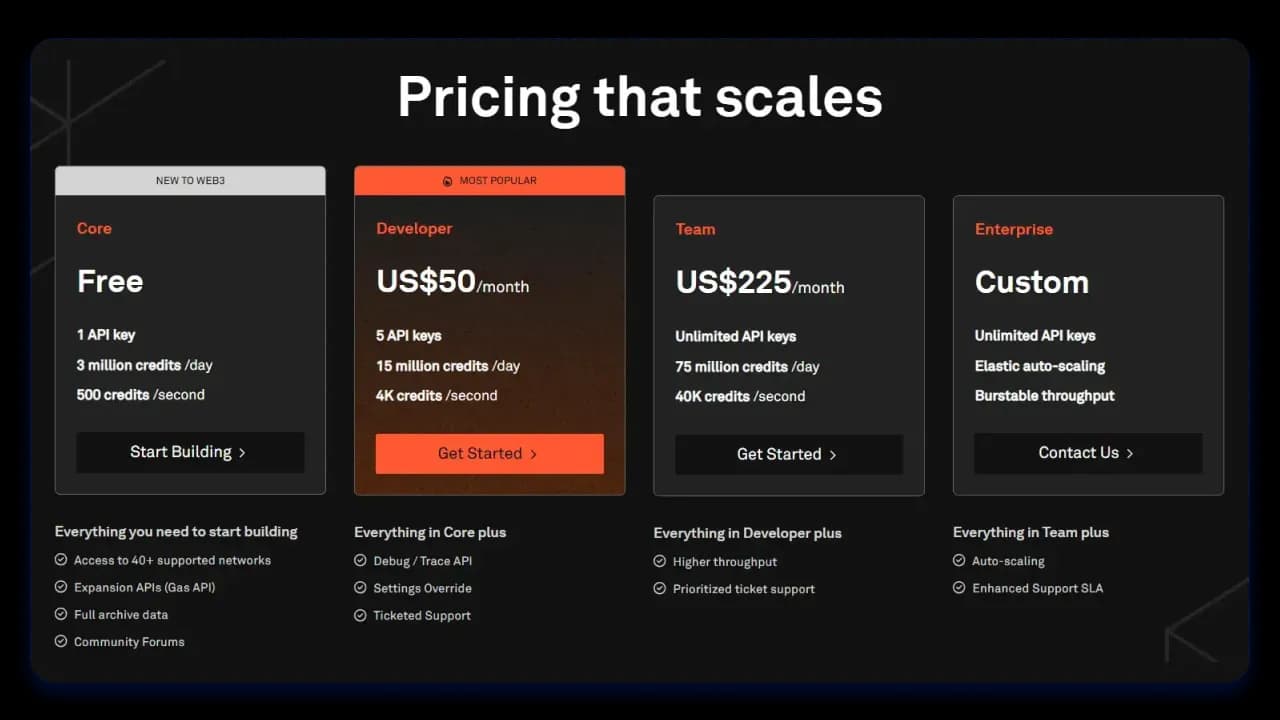
The Spectrum Nodes pricing page shows monthly credit volumes and RPS ceilings by plan, which helps you plan both total usage and burst capacity.
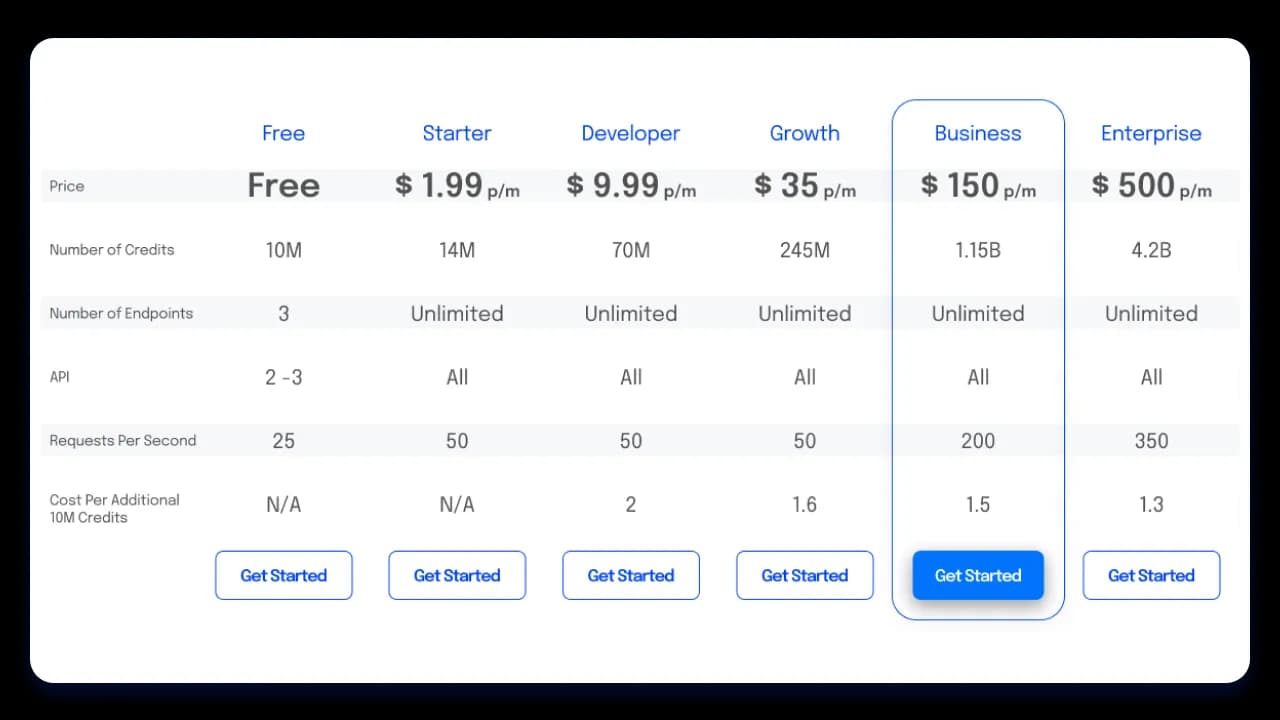
Don't compare monthly prices alone. Compare expected RPS, heavy methods, archive calls, WebSocket use, add on credits, support needs and chain selection. A balance reading app has a very different cost profile from an analytics system that pulls logs and historical state.
How Do Security and Compliance Compare?
Spectrum Nodes is SOC 2 Type II attested. Infura has no Infura specific SOC 2 report in public. Its parent Consensys is ISO 27001:2022 certified, lists SOC 2 Type 2 for Consensys Staking and Type 1 for MetaMask, and says it is "in the process of implementing SOC2 for some of our services" (Consensys security page, Oct 21, 2026).
SOC 2 Type II is an independent audit of how a company's security controls worked over a period of time. Vendor risk reviews often ask for it.
Access controls matter just as much in production, because they affect reliability, billing, security and incident response:
- Infura: API key security, JWT support, allowlists, origin and user agent restrictions, method controls and address controls.
- Spectrum Nodes: CORS restrictions, IP allowlisting, team management, role assignment, shared endpoint access, shared credit pools, usage visibility and support tickets. CORS (cross origin resource sharing) rules decide which websites can call your endpoint from a browser. See the Spectrum Nodes docs for current details.
We have never had a breach.
When Is Infura the Better Fit?
Infura is the better fit if your team needs:
- Mature Ethereum focused developer tooling
- MetaMask and Consensys ecosystem alignment
- The Infura Gas API
- ERC 4337 bundler support
- Trace and debug tooling, and archive data on supported chains
- API key and JWT based governance
- A broader developer platform built around Ethereum
If your stack is Ethereum heavy and that tooling matters, Infura is a good option.
When Is Spectrum Nodes the Better Fit?
Spectrum Nodes is the better fit if you need an Infura alternative built for multichain production work:
- RPC across 200+ chains, plus a unified API, webhooks and a CLI
- Private RPC endpoints and dedicated node options
- Region specific RPC and WebSocket URLs
- Sponsored node options for foundations
- Visible RPS ceilings by plan
- CORS and IP allowlisting, team workspaces and shared usage visibility
- Cross chain GraphQL APIs and DeFi pool APIs
- SOC 2 Type II attestation for vendor reviews
- Direct engineering access 24/7 via Slack
Can Spectrum Nodes Run Custom Node Clients?
Yes. Spectrum Nodes supports custom client deployments for block builders, HFT systems, MEV strategies and security forensics:
- Modified node clients (custom Geth, Nethermind, Besu and Reth builds)
- Custom tracers for transaction simulation and forensic analysis (debug_traceTransaction for MEV detection, reorg analysis and vulnerability scanning)
- Optimised networking (direct to leader routing, proximity to validators and sequencers)
- Low latency tuning (kernel parameters, CPU pinning, custom mempool configs for sub ms propagation)
We work directly with engineering teams on bespoke setups when microseconds matter. Our software engineers, DevOps engineers and 24/7 response teams can work inside your team to integrate with your existing systems and SOPs. We handle kernel tuning, CPU pinning and sync monitoring while you keep familiar RPC endpoints and focus on application logic.
To discuss your requirements, get in touch through this form or explore our case studies.
Final Verdict: Spectrum Nodes vs Infura
The choice comes down to workload.
Infura suits teams that want a broad Ethereum aligned platform with a Gas API, account abstraction support, tracing, archive access and MetaMask alignment.
Spectrum Nodes suits teams that want multichain reach, private and regional endpoints, visible RPS planning, failover, endpoint level control and a SOC 2 Type II attested operator on its own hardware.
Compare your chains, methods, request volume, RPS, WebSocket use, archive needs, failover, security controls and support requirements first. For more providers side by side, read the best RPC provider comparison. To discuss a production setup, contact Spectrum Nodes.
FAQ
Is Spectrum Nodes an Infura alternative? Yes. Spectrum Nodes is an Infura alternative for teams that need RPC across 200+ chains, WebSocket and private endpoints, regional access and a SOC 2 Type II attested operator. Teams that depend on Infura's Gas API or bundler methods should check those workflows first.
Spectrum vs Infura: which is more reliable? Spectrum Nodes serves over a billion requests a day at 99.999% uptime on its own hardware and has never had a breach. Third party site rfp.wiki lists Infura's marketed minimum at 99.9% on the Ethereum Standard API. Infura's daily quotas also stop traffic when a plan reaches its limit.
Does Infura have a SOC 2 Type II report? Not one that names Infura, as of Oct 21, 2026. Consensys lists SOC 2 Type 2 for Consensys Staking and Type 1 for MetaMask and MetaMask Institutional, and holds ISO 27001:2022. Spectrum Nodes is SOC 2 Type II attested.
What happens when you hit your Infura daily credit limit? Traffic stops until the daily quota resets and WebSocket connections are cut, per MetaMask's docs (Oct 21, 2026). Plan a failover endpoint or a larger plan before you reach it.
Is Spectrum Nodes better for multichain RPC? Spectrum Nodes supports 200+ chains against Infura's 40+ networks, and adds a unified API across 24 chains. Still check exact support for the chains, methods, WebSockets, archive data and tracing you need.
Which provider is better for high volume RPC workloads? It depends on request volume, method mix, RPS, WebSocket use, archive calls, chain selection and support. Spectrum's visible RPS ceilings help with capacity planning, while Infura's credit model needs method level analysis and a plan for the daily limit.