
Alchemy vs Infura vs Ankr: Which RPC Provider Is Faster in 2027?
Updated October 26, 2026 · Spectrum Nodes
Short answer: Spectrum Nodes is the fastest of the four providers we tested. On October 23, 2026, with network distance removed (median of 20 to 30 requests), Spectrum answered Arbitrum eth_getLogs in 10 ms against 12 ms on Alchemy, 28 ms on Ankr and 40 ms on Infura, and led every chain head call on BSC and Arbitrum. Alchemy ranks second, Ankr third, Infura fourth.
| # | Provider | Best for | Our test, Oct 23, 2026 (median, network distance removed) | Security evidence | Free tier | Entry plan |
|---|---|---|---|---|---|---|
| 1 | Spectrum Nodes | Apps that wait on chain head reads, logs and traces | Fastest of the four on all 8 calls. eth_getLogs 10 ms | SOC 2 Type II attested, no breach | 10M credits, 25 RPS | Starter, $1.99 a month |
| 2 | Alchemy | Enhanced APIs next to RPC | 2 to 3 ms behind Spectrum. eth_getLogs 12 ms | SOC 2 Type II | 30M compute units, 15 RPS | Pay as you go, $0.525 per 1M compute units |
| 3 | Ankr | One flat price per EVM request | BSC eth_getBlockByNumber 68 ms. eth_getLogs 28 ms | SOC 2 Type II via its operator, Asphere | Public endpoints | Pay as you go from a $10 deposit |
| 4 | Infura | Teams inside the MetaMask toolchain | Slowest on all 4 calls it ran. eth_getLogs 40 ms | No Infura specific SOC 2 report | Daily credit quota | Developer, $50 a month |
Competitor prices checked October 26, 2026. Spectrum prices from spectrumnodes.com/pricing, October 22, 2026. Infura was not in the BSC test, and Ankr was not in the Arbitrum chain head test.
How Did We Rank These Providers?
We scored all four on five criteria, in this order:
- Measured speed: our October 23, 2026 test covered all four on BSC and Arbitrum. A separate block trace test covered Spectrum's Boosted Nodes and Alchemy.
- Security evidence: a public SOC 2 Type II claim, the breach record and who owns the hardware.
- Beyond RPC: APIs, webhooks, a caching layer, tracing and archive data.
- Launch and support speed: how fast new chains go live and how you reach an engineer.
- Price of entry: the free tier and first paid plan, dated.
Spectrum Nodes publishes this ranking. We scored ourselves on the same five criteria and list the evidence for each score, so you can check it.
Alchemy is second on speed and tooling. Ankr is third on its SOC 2 Type II claim and flat pricing. Infura is fourth: slowest on every call we timed it on, and no SOC 2 report names it.
Which Provider Answered Fastest in Our BSC and Arbitrum Test?
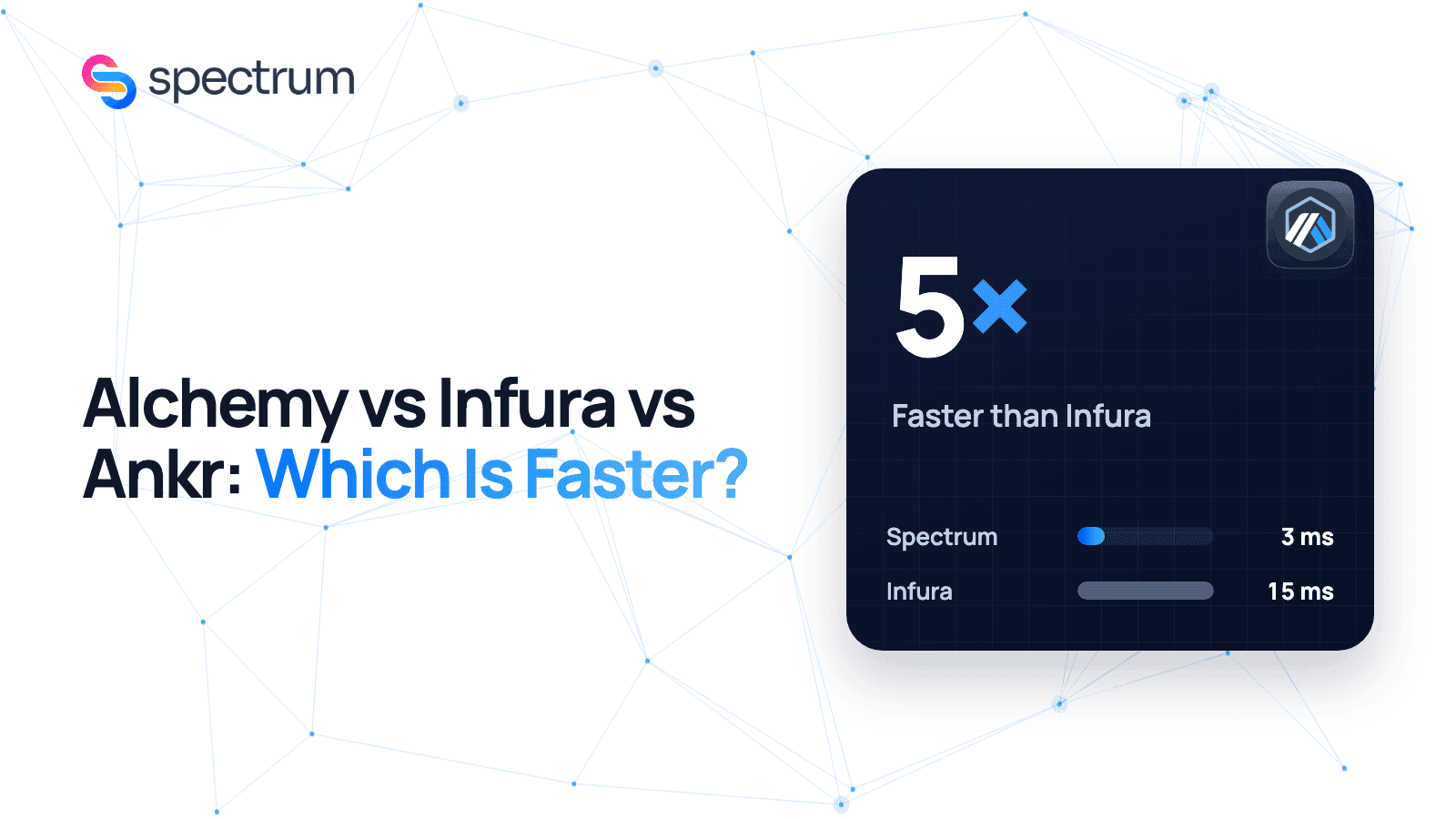
Spectrum, on every call. Ankr took 68 ms to Spectrum's 5 ms on BSC eth_getBlockByNumber, 13.6× slower. Infura took 15 ms to Spectrum's 3 ms on Arbitrum eth_call, 5× slower. Alchemy stayed close, 2 to 3 ms behind on each call.
We ran this test on October 23, 2026. Each figure is the median of 20 to 30 requests, with network distance removed: each provider's TCP connect time was subtracted from every request, so the number left is the time the provider took to answer.
BSC chain head calls, median ms, network distance removed
| Call | Spectrum | Alchemy | Ankr |
|---|---|---|---|
eth_blockNumber | 3 | 6 | 4 |
eth_getBlockByNumber (latest) | 5 | 7 | 68 |
eth_call (latest) | 4 | 7 | 14 |
eth_getBalance (latest) | 5 | 7 | 6 |
Arbitrum One chain head and log calls, median ms, network distance removed
| Call | Spectrum | Alchemy | Infura | Ankr |
|---|---|---|---|---|
eth_blockNumber | 3 | 5 | 8 | Not in this test |
eth_call (latest) | 3 | 6 | 15 | Not in this test |
eth_getBalance (latest) | 3 | 6 | 15 | Not in this test |
eth_getLogs (10 past blocks) | 10 | 12 | 40 | 28 |
eth_getLogs returns the events a contract emitted over a block range, which is how indexers and dashboards read contract history. On that call, Infura took four times as long as Spectrum and Ankr 2.8 times as long.
The Alchemy gap is small per request and grows with volume: 10,000 sequential reads at 3 ms extra each is 30 more seconds per job.
How Much Faster Are Spectrum's Boosted Nodes on Block Traces?
3.2× to 8.6× faster than Alchemy at the median, on BSC, Polygon and Base. This test used a different method, so its numbers get their own table. Infura and Ankr were not in it.
A block trace (debug_traceBlockByNumber) replays every transaction in a block and returns what each one did. Indexers and explorers call it on every block. Spectrum's Boosted Nodes are our caching and routing layer in front of our own nodes.
| Spectrum's Boosted Nodes vs Alchemy | Median | Slowest 5% (p95) | Faster at median | Answered first |
|---|---|---|---|---|
| BSC block traces | 82 vs 707 ms | 237 vs 2,182 ms | 8.6× | 99% of requests |
| Polygon block traces | 77 vs 376 ms | 222 vs 932 ms | 4.9× | 100% of requests |
| Base block traces | 126 vs 409 ms | 399 vs 2,120 ms | 3.2× | 94% of requests |
Polygon block receipts (eth_getBlockReceipts) | 45 vs 59 ms | 22% | 77% of requests |
The test ran September 29 to October 14, 2026, with about 50,000 same instant requests per chain and call type from a server in Finland. From a second server in Canada the lead was smaller: BSC 186 vs 295 ms, Polygon 180 vs 496 ms, Base 285 vs 620 ms.
How Do Security, Uptime, Pricing and Support Compare?
Spectrum, Alchemy and Ankr all claim SOC 2 Type II, and no SOC 2 report names Infura. Spectrum runs at 99.99% uptime. Ankr's Enterprise SLA is 99.9%, and Alchemy and Infura print no uptime percentage on their pricing pages.
| Spectrum Nodes | Alchemy | Ankr | Infura | |
|---|---|---|---|---|
| SOC 2 | Type II attested | Type II | Type II held by operator Asphere, audited by A-LIGN, report under NDA | No Infura specific report. Parent Consensys holds ISO 27001:2022 |
| Hardware | Own racks in Tier III data centers in Malta, the Netherlands, and Canada, plus bare metal in Singapore | Third party cloud providers | Not stated | Not stated |
| Uptime | 99.99% across over a billion requests a day | Signed SLAs on Enterprise, no figure published | 99.9% SLA on Enterprise | Committed SLAs on Enterprise, no figure published |
| Pricing unit | Monthly credits plus an RPS ceiling | Compute units, weighted per method | Flat 200 credits per EVM request | Daily credits, weighted per method |
| Entry paid plan | $1.99 a month, 14M credits, 50 RPS | $0.525 per 1M compute units, from 300 RPS | $10 deposit, $0.10 per 1M credits | $50 a month, 15M credits a day |
| Support | Direct engineering access 24/7 via Slack | 48 hour target on Free, 24 hours on Pay as you go | Discord on free plans, priority portal on paid | Community on Core, tickets on Developer |
Checked October 26, 2026. Ankr's 99.9% SLA and its SOC 2 operator detail are Ankr's own claims, read in October 2026.
1. Spectrum Nodes
Best for: indexers, explorers, trading systems and backends whose product waits on RPC answers.
Spectrum was the fastest of the four providers on all eight calls in our October 23, 2026 test. In the separate block trace test, Spectrum's Boosted Nodes returned BSC traces in 82 ms against 707 ms on Alchemy.
Spectrum Nodes is a developer platform: RPC across 200+ chains, a unified API, signed webhooks and the Spectrum CLI on one account. We have never had a breach, we serve over a billion requests a day, and we run our own hardware in Tier III data centers in Malta, the Netherlands, and Canada, plus a bare metal deployment in Singapore. Spectrum's Boosted Nodes are live on Arbitrum, Avalanche, Base, BSC, Ethereum, HyperEVM, Monad, Optimism and Polygon. Robinhood Chain support went live the day after that chain launched.
Plans (October 22, 2026): Free, 10M credits at 25 RPS. Starter $1.99 a month, 14M at 50 RPS. Developer $9.99, 70M. Growth $35, 245M. Business $150, 1.15B. Enterprise $500, 4.2B at 350 RPS. See our pricing page.
Worth knowing: our block trace test covers Alchemy only. Time your own chains too.
2. Alchemy
Best for: teams that want enhanced APIs, webhooks and gas sponsorship from their RPC vendor.
Alchemy came second on six of the eight calls in our October 23, 2026 test. In our separate block trace test, it took 707 ms median on BSC against 82 ms on Spectrum's Boosted Nodes.
Alchemy's own live benchmark of light reads such as eth_getBalance put it at 6.17 ms p50 over the 24 hours to October 26, 2026, ahead of QuickNode. Alchemy runs that test, and Spectrum is not in it. Enterprise plans start at 1,000 RPS with signed SLAs.
Worth knowing: debug_traceBlockByNumber costs 40 compute units and eth_getLogs 60, against 10 for eth_blockNumber (Alchemy docs, October 26, 2026). For the two way view, read Spectrum Nodes vs Alchemy.
3. Ankr
Best for: teams that want one flat price per EVM request and a $10 start.
On BSC, Ankr was 1 ms behind Spectrum on eth_blockNumber and eth_getBalance, and far behind on eth_getBlockByNumber (68 vs 5 ms) and eth_call (14 vs 4 ms). On Arbitrum eth_getLogs it took 28 ms to Spectrum's 10.
- Free: public endpoints at about 1,800 requests a minute, or 200M credits a month on Freemium
- Pay as you go: $0.10 per 1M credits, 200 credits per EVM request, so about $20 per 1M requests
Ankr's trust page says its infrastructure operator, Asphere / W3 Technologies, holds SOC 2 Type II, with ISO 27001 in progress. In December 2022 a former team member used a malicious code package to compromise a private key and mint aBNBc tokens, per Ankr's after action report. The report does not say the RPC service was affected.
Worth knowing: at a flat 200 credits, a block trace costs what a balance read costs.
4. Infura
Best for: Ethereum teams already inside the MetaMask developer toolchain.
On Arbitrum, Infura was the slowest provider on all four calls: 15 ms on eth_call and eth_getBalance against Spectrum's 3, and 40 ms on eth_getLogs against 10. Alchemy's own Base test (vendor run, August 8 to 13, 2026) also put Infura last of four, at 104.93 ms p50.
- Core: free, with a daily credit quota
- Developer: $50 a month, 15M credits a day
- Team: $225 a month, 75M credits a day
Worth knowing: past the daily cap, Infura blocks traffic and cuts WebSocket connections until the 00:00 UTC reset (MetaMask docs, October 2026). More in Spectrum Nodes vs Infura.
How Do You Choose Between Spectrum, Alchemy, Infura and Ankr?
Time the call your product makes most, on your chain, from your region, and read the slow tail as well as the median.
- You read the chain head all day: a few ms per call adds up. Watch Ankr's BSC
eth_getBlockByNumberand Infura's Arbitrumeth_call. - You index logs or trace blocks: time
eth_getLogsanddebug_traceBlockByNumberand check p95, the time within which 95% of requests finish. - You pass vendor reviews: ask for the SOC 2 Type II report, the company it covers and who owns the hardware.
On Arbitrum? See the full Arbitrum RPC provider ranking.
How Did We Test?
Two tests, measuring different things, so their numbers never share a table.
Chain head and logs: Spectrum, Alchemy, Infura and Ankr
- Date: October 23, 2026
- Chains: BSC (Spectrum, Alchemy, Ankr). Arbitrum One (Spectrum, Alchemy, Infura on chain head calls, all four on
eth_getLogs) - Method: identical requests, one at a time, in a fresh random order, over kept alive HTTPS
- Network distance removed: each provider's TCP connect time subtracted from every request
- Each figure: the median of 20 to 30 requests, with answers checked to match across providers
Block traces: Spectrum's Boosted Nodes vs Alchemy
- Window: September 29 to October 14, 2026
- Method: the same call sent to both at the same instant, about 50,000 requests per chain and call type
- Location: a server in Finland, plus a second server in Canada
- Latency: from sending the request to the last byte of the response
Verdict: Which RPC Provider Is Faster in 2027?
Spectrum Nodes. It was the fastest of the four providers we tested on every chain head and log call. In a separate test, Spectrum's Boosted Nodes traced blocks 3.2× to 8.6× faster than Alchemy at the median. With SOC 2 Type II, our own hardware and 24/7 engineering access on top, it is our pick overall.
- Alchemy: best for teams that want the widest tool set around RPC and can accept a 2 to 3 ms gap on light calls
- Ankr: best for flat per request pricing and a low cost start
- Infura: best for Ethereum teams tied to MetaMask tooling who can plan around daily quotas
FAQ
Which RPC provider is the fastest in 2027? Spectrum Nodes, of the providers we tested. On October 23, 2026, with network distance removed, Spectrum was fastest on all eight BSC and Arbitrum calls we timed against Alchemy, Infura and Ankr. QuickNode, Chainstack and Dwellir were not in that test.
Is Alchemy faster than Infura?
In our Arbitrum test on October 23, 2026, yes. Alchemy answered eth_call in 6 ms and eth_getLogs in 12 ms, against 15 ms and 40 ms on Infura (median of 20 to 30 requests, network distance removed). Spectrum beat both, at 3 ms and 10 ms.
Is Ankr faster than Alchemy?
On two BSC calls in our October 23, 2026 test, slightly: eth_blockNumber 4 vs 6 ms and eth_getBalance 6 vs 7 ms. Alchemy was much faster on eth_getBlockByNumber (7 vs 68 ms), eth_call (7 vs 14 ms) and Arbitrum eth_getLogs (12 vs 28 ms). Spectrum beat both on every call.
Which RPC provider is fastest for eth_getLogs on Arbitrum? Spectrum Nodes, of the four we tested. Over 10 past blocks on October 23, 2026, Spectrum answered in 10 ms, Alchemy in 12, Ankr in 28 and Infura in 40 (median of 20 to 30 requests, network distance removed).
Is Spectrum faster than Alchemy for block traces?
Yes. From September 29 to October 14, 2026, Spectrum's Boosted Nodes returned debug_traceBlockByNumber in 82 vs 707 ms on BSC, 77 vs 376 ms on Polygon and 126 vs 409 ms on Base at the median.
Do Infura and Ankr have SOC 2 Type II? Ankr says its infrastructure operator, Asphere, holds SOC 2 Type II, with the report under NDA. No SOC 2 report names Infura; its parent Consensys lists reports for Consensys Staking and MetaMask. Spectrum Nodes is SOC 2 Type II attested.
References
- https://www.alchemy.com/pricing (checked October 26, 2026)
- https://www.alchemy.com/docs/reference/compute-unit-costs (checked October 26, 2026)
- https://www.alchemy.com/security (checked October 26, 2026)
- https://www.alchemy.com/benchmarks (vendor run, checked October 26, 2026)
- https://www.infura.io/pricing (checked October 26, 2026)
- https://docs.metamask.io/services/how-to/avoid-rate-limiting (checked October 2026)
- https://consensys.io/security (checked October 2026)
- https://www.ankr.com/docs/rpc-service/service-plans/ (checked October 26, 2026)
- https://www.ankr.com/docs/trust/overview/ (checked October 2026)
- https://www.ankr.com/blog/after-action-report-our-findings-from-abnbc-token-exploit/ (checked October 2026)
- https://spectrumnodes.com/pricing (checked October 22, 2026)