
What Is Chainlink Runtime Environment (CRE)?
Updated October 22, 2026 · Spectrum Nodes
Short answer: Chainlink Runtime Environment (CRE) is a runtime for decentralised services that runs application logic off the blockchain while staying connected to onchain contracts. It is built on upgraded decentralised oracle networks (DONs), which now work as execution clusters. CRE workflows react to events, fetch and verify outside data, run computation and return results onchain. Per Chainlink's Q3 2026 review, CRE connects institutions to Swift's ledger.
Smart contracts do exactly what they are told. They execute deterministically, settle value reliably and remove the need to trust intermediaries. That precision made them the foundation of decentralised apps.
Most systems need more than deterministic execution. Smart contracts need to react to outside events, coordinate across chains and handle workflows that unfold over time rather than inside a single transaction. As apps matured, developers filled the gap by stitching offchain services, bots and scripts around their contracts.
That approach does not scale cleanly. CRE adds a structured execution layer so decentralised apps can behave like complete systems instead of isolated contracts.
What Is Chainlink Runtime Environment?
Chainlink Runtime Environment is a runtime for decentralised services: an environment where app logic runs securely offchain while staying tightly connected to onchain contracts.
With CRE you build long running, composable services that combine onchain logic with offchain execution. Instead of forcing all logic into smart contracts, you define workflows that:
- React to events
- Fetch and verify external data
- Perform computation
- Return results onchain in a coordinated way
CRE runs on upgraded decentralised oracle networks. A decentralised oracle network (DON) is a group of independent Chainlink nodes that deliver data or run computation together. DONs no longer only deliver data feeds. They also act as execution clusters that run offchain logic in a decentralised, fault tolerant way.
The result supports complex app behaviour without trusted servers or bespoke infrastructure. CRE extends smart contracts by handling the execution patterns they were never designed to manage on their own.
Why Does CRE Exist?
CRE exists because teams started running critical logic offchain on scripts, bots and centralised services, which created security risks, operational fragility and coordination problems.
Chainlink's oracles first focused on bringing external data onchain. As apps grew more complex, they also needed secure offchain execution, often across multiple chains and outside systems.
Demand also grew for workflows that span blockchains, traditional systems and offline processes. Coordinating all of that securely with smart contracts alone proved impractical at production scale.
CRE is the next step in Chainlink's evolution beyond price feeds. It formalises offchain execution into a decentralised runtime that keeps trust minimisation while coordinating across chains and systems, and it addresses smart contract limits directly at the infrastructure level.
What Are the Core Components of CRE?
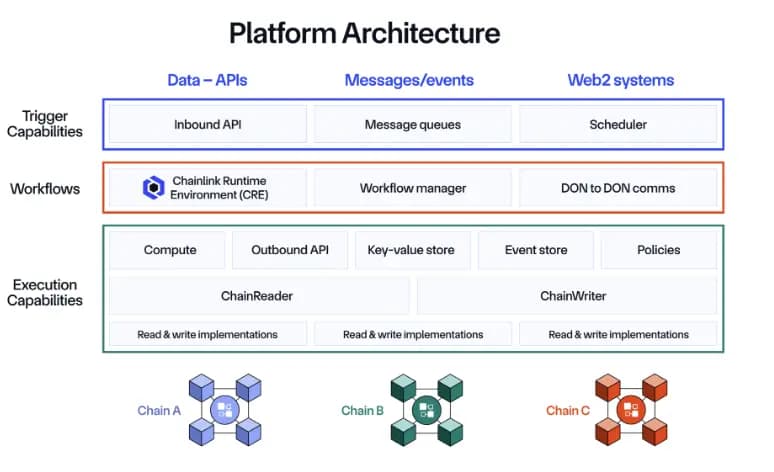
CRE has four core components that together form a general purpose execution layer alongside smart contracts:
- Decentralised services. Independent node operators execute logic collectively, so no single trusted party runs it. Execution stays resilient and fault tolerant even offchain
- DONs as execution clusters. Beyond delivering data, DONs coordinate workflow execution, manage state transitions and interact with onchain contracts in a structured, verifiable way
- Secure offchain computation. Logic that is too expensive, too slow or impractical to run onchain runs offchain and settles onchain once complete. Complexity moves out of smart contracts while execution guarantees stay strong
- Native multichain support. CRE works across multiple blockchains, in line with Chainlink's cross chain strategy and interoperability tooling, so workflows coordinate actions across chains without trusted intermediaries
For technical details on how these components interact, see Chainlink's documentation.
What Can You Build With CRE?
CRE fits any workflow that needs offchain steps with verifiable onchain outcomes.
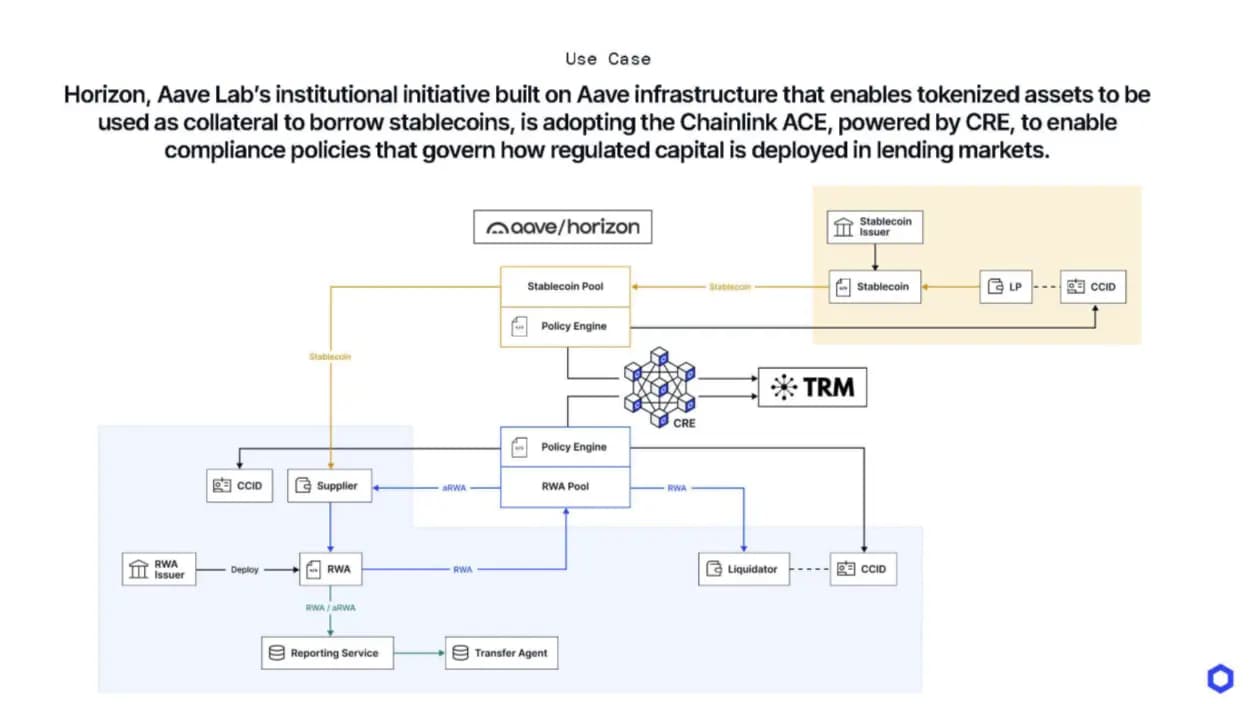
- Real world assets and compliance. Coordinate data verification, regulatory checks and settlement logic across multiple systems before committing results onchain. Sensitive validation steps happen offchain, with clear auditability and deterministic outcomes onchain
- DeFi. Run automated risk management, dynamic parameter updates or multi step strategies that are impractical to run fully onchain, without introducing central points of failure
- Cross chain asset management. Coordinate actions across chains through workflows executed collectively and verified across DONs, instead of centralised relayers or brittle scripts
- Institutional automation. Orchestrate workflows across onchain contracts, internal systems and regulatory processes. Chainlink's Q3 2026 review reports CRE connecting institutions to Swift's ledger
- AI agents. Agents observe conditions, decide offchain and act onchain under clearly defined rules. Their actions run through decentralised execution, so outcomes are verifiable and resistant to single points of failure. For more, see AI agents in blockchain
What Infrastructure Does CRE Depend On?
Offchain workflows still depend on dependable node operation, predictable performance and continuous availability. This matters most when execution logic depends on external calls, time sensitive actions or coordinated workflows.
This is the layer where infrastructure providers like Spectrum Nodes work, because execution reliability, observability and uptime directly shape app behaviour. We run our own hardware in Tier III data centers in Malta, the Netherlands, and Canada, plus a bare metal deployment in Singapore, are SOC 2 Type II attested, and serve over a billion requests a day at 99.99% uptime.
For a deeper look at how infrastructure reliability affects decentralised apps, read what happens when RPC infrastructure fails. For Chainlink's cross chain transfer protocol, see what changed in CCIP 2.0.
Why Does CRE Matter for the Crypto Stack?
CRE shifts Chainlink's role from mainly a data provider to a decentralised coordination and execution layer that connects smart contracts with offchain systems.
That lets you design apps that behave like modern distributed systems while keeping the security guarantees and trust minimisation of decentralisation, without bringing back trusted intermediaries.
It also raises the bar for infrastructure. Execution layers only deliver value when they are reliable in practice. As apps move critical logic offchain, the quality of execution environments and node infrastructure becomes a first order concern instead of an implementation detail.
CRE expands what decentralised apps can achieve by aligning execution, coordination and infrastructure into one model.
What Does CRE Mean for Builders?
CRE reflects where decentralised infrastructure is heading: apps that need more coordination, execution and flexibility than smart contracts alone provide, supported by decentralised execution layers designed for production scale.
As more application logic moves offchain, execution reliability becomes a first order concern. For builders and infra teams, understanding how offchain execution behaves under load is now part of the job. If this is relevant to what you are building, a useful next step is how RPC reliability affects decentralised apps.
Follow Spectrum's blog for deep dives into node infrastructure, reliability and blockchain performance.
FAQ
What is Chainlink Runtime Environment (CRE)? CRE is Chainlink's runtime for decentralised services. It runs app logic offchain on decentralised oracle networks while staying connected to onchain contracts, then returns results onchain.
How does Chainlink CRE work? Developers define workflows that react to events, fetch and verify outside data, run computation and write results onchain. Upgraded decentralised oracle networks run those workflows as execution clusters operated by independent node operators.
Does CRE replace smart contracts? No. CRE extends smart contracts by handling offchain execution, long running workflows and cross chain coordination. Final outcomes still settle onchain.
What is a decentralised oracle network (DON)? A DON is a group of independent Chainlink nodes that work together. In CRE, DONs act as execution clusters that run offchain logic in a decentralised, fault tolerant way.
What can you build with Chainlink CRE? CRE supports real world asset and compliance workflows, DeFi risk automation, cross chain asset management, institutional automation and AI agents that act onchain under defined rules. Per Chainlink's Q3 2026 review, CRE connects institutions to Swift's ledger.
What infrastructure does Chainlink CRE depend on? CRE workflows depend on reliable node operation, predictable performance and continuous availability. Workflows with external calls or time sensitive actions are the most exposed when infrastructure fails.