
Spectrum Nodes vs Chainstack: Which RPC Provider Should You Choose?
Spectrum Nodes and Chainstack are two of the most credible blockchain infrastructure providers within the industry. Therefore, choosing between these providers depends on what your team actually needs from its RPC setup.
If you need broad multi-chain RPC access, regional RPC and WebSocket endpoints, private endpoint control, and infrastructure built around bare metal operation, Spectrum Nodes is likely the better starting point.
On the other hand, if you need a more segmented platform, Chainstack should probably be considered. Its product set includes Global Node, Trader Node, Dedicated Node, Unlimited Node, Self Hosted options, Warp transactions, and Yellowstone gRPC Geyser.
In this article, we will not discuss who the best universal winner is, as a conclusion from that standpoint would likely offer no real actionable information. Rather, we will focus our efforts on matching the provider to the workload.
If you are interested in having a wider view of the market, read our Best RPC Provider Comparison.
Quick Verdict
If your team wants broad multi-chain access, regional endpoint choice, private endpoints, WebSockets, access controls, cross-chain APIs, and an infrastructure model centered on bare metal operation, then Spectrum Nodes is the natural choice.
For teams building wallets, dashboards, automation systems, analytics products, trading support tools, or applications that need access across many networks, Spectrum nodes are a strong Chainstack alternative.
On the other hand, Chainstack should be considered if your team is interested in more specialised infrastructure products on one platform. Chainstack is relevant for trading-focused RPC, Solana streaming, transaction propagation tools, self-hosted options, and public benchmarking.
In short, Spectrum Nodes leans towards broad RPC access, regional control, and private endpoint flexibility while Chainstack leans towards product segmentation, specialist workflows, and visible benchmarking tools.
Platform Overview
At a high level, Spectrum Nodes is focused on broad RPC access, regional endpoints, private endpoint control, and cross-chain APIs. In contrast, Chainstack is more segmented, with separate products for shared RPC, trading workflows, dedicated nodes, unlimited usage, Solana streaming, and transaction propagation.
That difference matters because most teams are not just buying “RPC”. They are choosing how much control, isolation, tooling, and cost predictability they need around their infrastructure.
RPC Infrastructure and Architecture
Production RPC infrastructure is about more than having an endpoint. Teams need to know how requests are routed, how failover works, whether endpoints are shared or private, how stale data risk is handled, and whether infrastructure sits close enough to the application or users.
Spectrum Nodes makes its strongest case for bare-metal infrastructure, geo-distributed endpoints, regional RPC and WebSocket URLs, load balancing, and failover. Regional endpoint choice can matter for latency-sensitive products, wallets, dashboards, automation systems, and infrastructure teams seeking greater control over connectivity.
If you are interested in reading further, we encourage you to consider the following articles:
- How Spectrum Handles Requests
- Why High Performance RPC Matters
- The Importance of Decentralised Blockchain Infrastructure.
On the other hand, Chainstack takes a more productised approach to RPC infrastructure. Global Node is its geo-balanced shared RPC option, Trader Node is positioned for regional low-latency trading workflows, and Dedicated Node is designed for isolated customer infrastructure. Furthermore, it supports various execution client options, including Reth, the Rust-based Ethereum client, which may be attractive for teams seeking faster Ethereum RPC performance. Still, client choice should not be treated as a speed decision alone. Fundamentally, buyers should ask which client is being used, whether Geth is also available, how failover works, and what happens if a client-specific issue affects availability.
Network Coverage and Chain Support
Spectrum Nodes claims support for 200+ networks, which gives it a stronger headline breadth. Therefore, this makes it a great starting point for teams seeking a multi-chain RPC provider, especially when the roadmap spans multiple ecosystems.
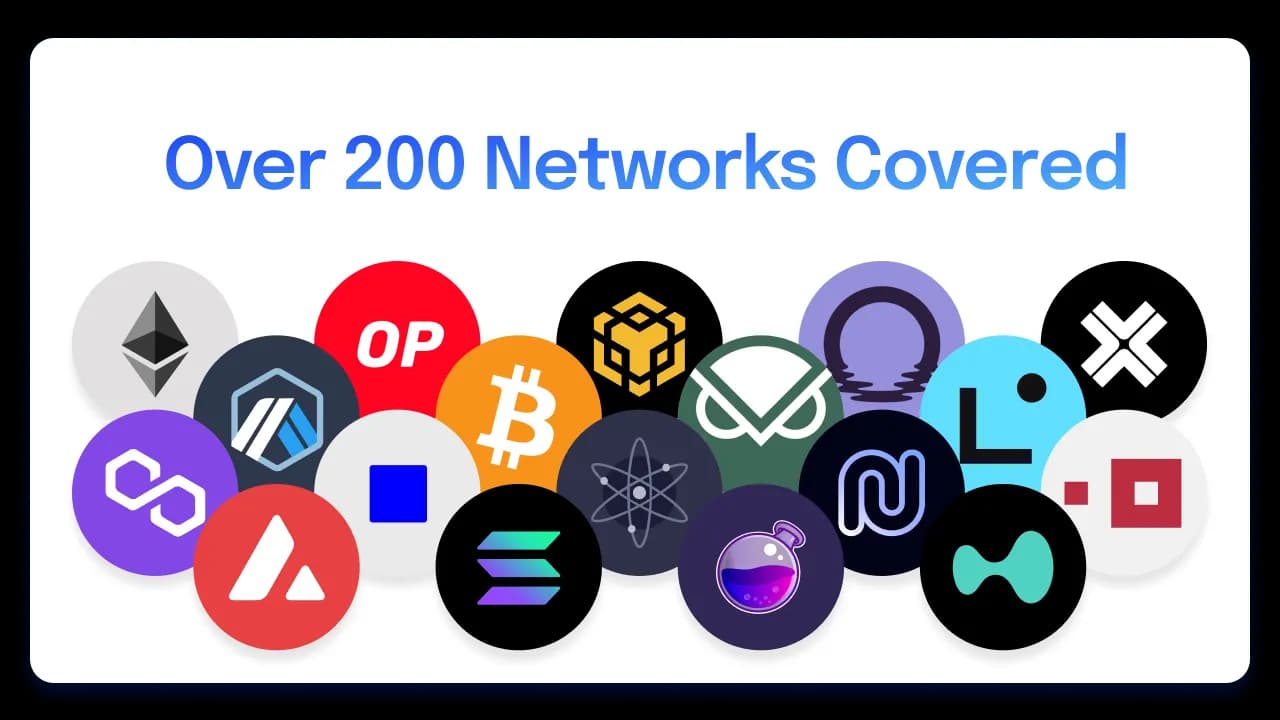
In contrast, Chainstack supports 70+ mainnet and testnet protocols. The available chains are fewer than those offered by Spectrum Nodes, it is still broad enough for many production teams, especially when the chosen chain and required product mode are supported.
| Chain | Support | Elastic Mainnet Support | Elastic Testnet Support | Testnet Networks |
|---|---|---|---|---|
| Apechain | Dedicated | - | - | - |
| Aptos | Elastic, Dedicated | Full, Archive | Full | Testnet |
| Arbitrum | Elastic, Dedicated | Full, Archive | Full, Archive | Arbitrum Sepolia Testnet |
| Astar | Dedicated | - | - | - |
| Avalanche | Elastic, Dedicated | Full, Archive | Full, Archive | Fuji Testnet |
| B^2 | Dedicated | - | - | - |
| Base | Elastic, Dedicated | Full, Archive | Full, Archive | Sepolia Testnet |
| Berachain | Elastic, Dedicated | Full, Archive | - | - |
| Bitcoin | Elastic, Dedicated | Full | Full | Signet, Testnet |
| Bitlayer | Dedicated | - | - | - |
| Blast | Elastic | Full, Archive | - | - |
| BNB Smart Chain | Elastic, Dedicated | Full, Archive | Full, Archive | Testnet |
WebSockets, Archive Access, and Tracing
Considering that no two applications are the same, for some basic RPC access is more than enough. For others, simply having the basic RPC infrastructure would be a critical mistake given the nature and requirements of their application.
For example, a product that needs real-time updates, WebSockets are fundamental, while archive access may matter when you need historical state queries. Tracing matters for analytics, debugging, monitoring, transaction inspection, and advanced EVM workloads.
Spectrum Nodes has a network catalogue structured around pruned nodes, archive nodes, tracing, and plan availability, which helps with early filtering. Chainstack documents HTTPS and WSS endpoints, archive access, debug and trace support where available, and selected protocol-specific interfaces.
Both providers can support advanced RPC workloads; therefore, the decision depends on chain, method requirements, WebSocket usage, archive depth, tracing needs, and cost impact.
If you are planning or researching RPC resilience, we recommend you read What Happens When an RPC Goes Down.
Data APIs and Developer Tooling
Both providers go beyond basic RPC, but they extend in different directions.
Spectrum Nodes offers a General Blockchain API and a Pools API. This supports a cross-chain data angle, including blockchain reads and DeFi-related data use cases.
In contrast, Chainstack offers Advanced APIs, Marketplace add-ons, platform API access, Yellowstone gRPC Geyser for Solana real-time streaming, Warp transactions, and Compare tools. Chainstack Yellowstone gRPC Geyser is a clear Solana-specific highlight.
Spectrum Nodes is stronger where the buyer wants RPC, cross-chain API abstraction, and DeFi-related data access. On the other hand, Chainstack is an alternative for buyers who want specialist add-ons, transaction propagation tools, Solana streaming, and benchmarking tools.
Pricing and Cost Predictability
A common pricing mistake is comparing prices from different providers in isolation, for example, by comparing only the monthly figures. This is important as RPC pricing depends on monthly request volume, peak RPS, method mix, archive usage, tracing usage, WebSocket usage, regions, dedicated infrastructure, add-ons, and overage rules.
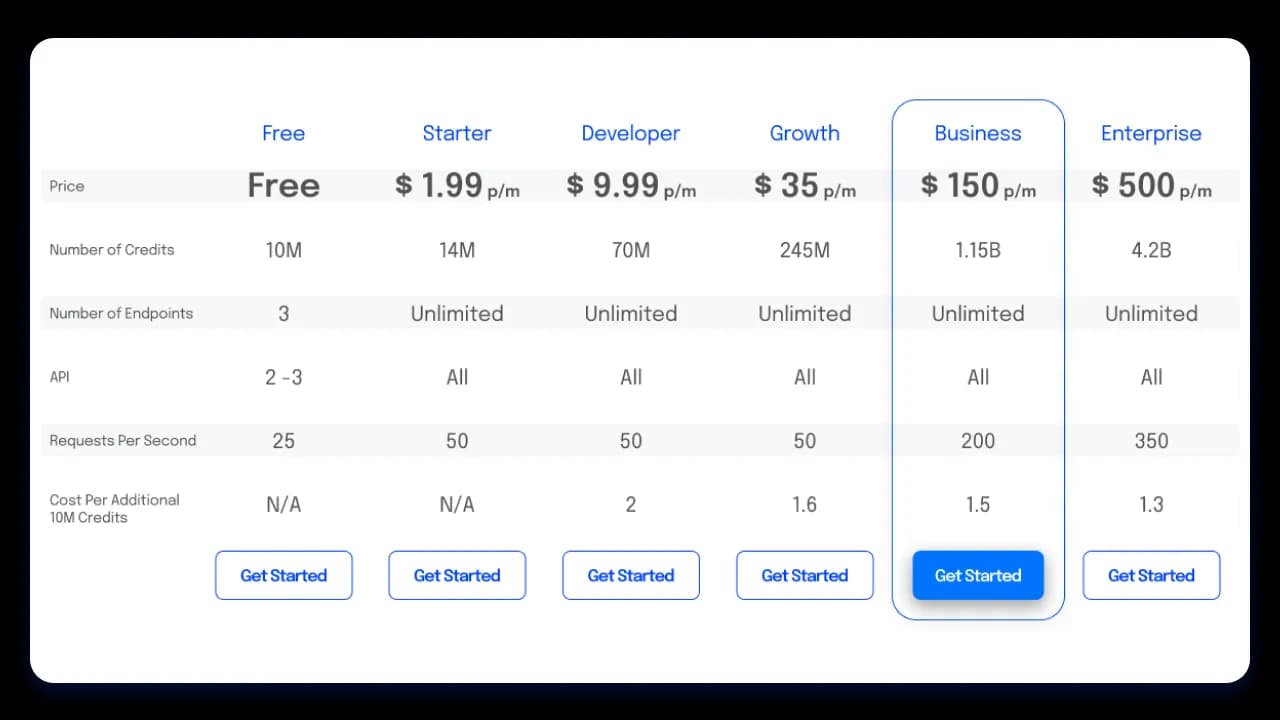
Spectrum Nodes pricing shows monthly credits and RPS ceilings by plan, helping buyers understand usage limits and plan fit at a glance.
Chainstack pricing uses request units for request-based services, but standard full-node requests, archive requests, debug calls, trace calls, and add-ons may affect cost differently. Furthermore, Chainstack offers Unlimited Node, dedicated compute, storage,, and Warp transaction pricing.
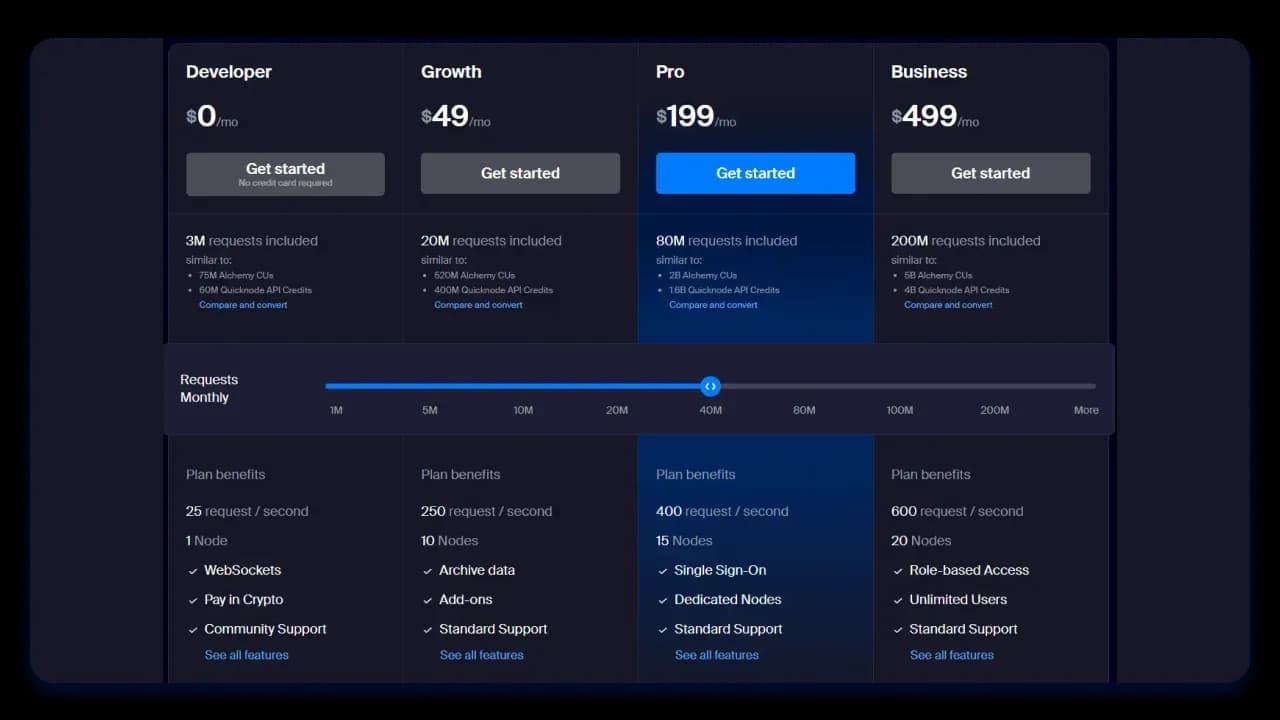
The right pricing comparison requires a real workload model. Before making a decision, one should consider the expected number of calls, peak RPS, archive and tracing usage, WebSocket needs, region requirements, and dedicated infrastructure needs.
Security, Access Controls, and Enterprise Readiness
Security is not only about certifications. For RPC infrastructure, buyers should also look at endpoint restrictions, access rules, authentication, team permissions, private infrastructure, auditability, support response time, and contractual uptime.
Spectrum Nodes provides practical controls such as CORS restrictions, IP whitelisting, team controls, shared endpoint access, shared credit pool, and usage visibility. For more context, we highly suggest you read Spectrum under the hood.
On the other hand, Chainstack has strong public enterprise security and access documentation. Enterprise buyers should request current security reports, SLA terms, support terms, private networking, and per-chain capability sheets from both providers.
Performance, Reliability, and Benchmarking
Although both providers make performance and reliability claims, those claims only matter when the testing context is clear.
Before choosing a Web3 RPC provider, ask which region was tested, which chain was tested, which method was used, whether latency is average or percentile-based, how the endpoint behaves during traffic spikes, how failover works, how stale data is detected, and uptime whether a contractual SLA backs uptime SLA.
Spectrum Nodes has an architecture-led performance argument grounded in bare-metal infrastructure, regional endpoints, load balancing, and failover. Chainstack provides public benchmarking and endpoint testing surfaces, which makes its performance positioning more visible.
The practical answer is to test both providers against your own production workload. Generic performance claims are useful for shortlisting, but they are definitely not enough for final selection.
Practical Decision Framework
In conclusion to this direct comparison, we believe that one should choose Spectrum Nodes if your priority is broad multi-chain access, regional RPC and WebSocket endpoints, private RPC endpoint control, cross-chain APIs, and infrastructure independence.
Chainstack should be seriously considered if your priority is trading-focused RPC, Solana real-time streaming, transaction propagation, self-hosted options, public benchmarking tools, or a highly segmented product stack.
Obviously, this is not a universal ranking, but it is simply a starting point for evaluation. If Spectrum Nodes looks like the better fit for your project, you can contact Spectrum Nodes to discuss setting up a private endpoint.
Final Verdict
Spectrum Nodes and Chainstack are both very credible RPC infrastructure providers, but they suit different teams.
Spectrum Nodes is a better starting point for broad multi-chain RPC access, regional endpoints, private endpoint control, WebSockets, bare metal infrastructure, and cross-chain APIs.
Chainstack is a good starting point for specialist infrastructure options, trading workflows, Solana streaming, transaction propagation, self-hosted models and public benchmarking surfaces.
What is truly fundamental is that before choosing, one should test the exact chains, regions, methods, archive needs, tracing needs, WebSocket requirements, failover expectations, support terms, and total cost under realistic traffic.
Frequently Asked Questions (FAQs)
Is Spectrum Nodes a good alternative to Chainstack?
Yes. Spectrum Nodes is a good Chainstack alternative for teams that need multi-chain RPC access, regional endpoints, private endpoint control, WebSockets, and cross-chain APIs. Chainstack may be a better fit for Trader Node, Unlimited Node, Warp transactions or Yellowstone gRPC Geyser.
Which provider supports more blockchain networks?
Spectrum Nodes support for 200+ networks. Chainstack supports 70+ mainnet and testnet protocol networks. Before choosing, compare the exact chain, RPC type, WebSocket support, archive access, tracing, and plan availability.
Which provider is better for WebSocket RPC?
Both providers support WebSocket RPC. Spectrum Nodes offers regional RPC and WebSocket endpoints. Chainstack documents WSS endpoints. The better option depends on your chain, region, subscription needs, and traffic profile.
Do you offer custom client deployments?
Yes. Spectrum Nodes supports custom client deployments for block builders, HFT systems, MEV strategies, and security forensics. This includes:
- Modified node clients (custom Geth, Nethermind, Besu, Reth builds)
- Custom tracers for transaction simulation and forensic analysis (debug_traceTransaction for MEV detection, reorg analysis, vulnerability scanning)
- Optimized networking (direct-to-leader routing, proximity to validators/sequencers)
- Low-latency tuning (kernel params, CPU pinning, custom mempool configs for sub-ms propagation)
Unlike standard RPC endpoints, we work directly with engineering teams on bespoke setups when microseconds matter. To discuss your requirements, get in touch with us through this form. You can also explore relevant case studies.
How do Spectrum Nodes services work with our existing systems?
Get in touch with us for technical support. Whether you need standard RPC or custom client deployments, we provide software engineers, DevOps engineers, and 24/7 response teams who can be deployed within your team to integrate immediately. We help integrate everything as part of your SOPs, handling the DevOps complexity (kernel tuning, CPU pinning, sync monitoring) so your team can focus on application logic while maintaining familiar RPC endpoints. To discuss your requirements, get in touch with us through this form. You can also explore relevant case studies.