Webhooks
Spectrum Webhooks push real-time blockchain activity to an HTTPS endpoint, Slack channel, or Telegram chat. Watch addresses for transfers and transactions, or watch smart contracts for specific emitted events without running your own polling infrastructure.
How it works
- Create a webhook. Choose Address Activity or Contract Events, select a chain, configure its filters, and choose a destination.
- Spectrum watches the chain in real time. Each block is checked for matching address activity or matching contract logs.
- Matching events are delivered. Events from one block are bundled into one delivery to your HTTPS endpoint, Slack channel, or Telegram chat.
- Your destination processes the event. HTTPS receivers verify the signature and process the JSON; Slack and Telegram receive a readable summary.
On-chain activity  ──►  Spectrum listener  ──►  HTTPS / Slack / Telegram
 (address or event)          (real-time)              (your destination)
Supported webhook types
Address Activity
Address Activity (ADDRESS_ACTIVITY) watches addresses and delivers the native, token, and NFT activity they take part in. Each matched entry has a transfer category:
| Category | What it matches |
|---|---|
external | Native-asset transfer from a top-level transaction, such as an ETH send. |
internal | Native-asset transfer from a contract-internal CALL or CREATE. |
erc20 | ERC-20 token transfer; delivered with category: "token". |
erc721 | ERC-721 NFT transfer. |
erc1155 | ERC-1155 multi-token transfer. |
A webhook receives every category by default, or you can select categories when you create it. See Activity Categories for the exact delivered fields.
Contract Events
Contract Events (CONTRACT_EVENT) watches logs emitted by one selected smart contract. Configure events in three ways:
| Event selection | Result |
|---|---|
| ABI fragment | Matches the event signature and delivers decoded, named arguments. |
Raw topic0 hash | Matches the signature and delivers raw topics and data without decoded arguments. |
| All events | Matches every log emitted by the selected contract, including anonymous events. |
ABI fragments and raw hashes can be combined. See Contract Events for indexed filters, decoding rules, and payload examples.
Why use webhooks
- Real-time. Events arrive as blocks are produced, no polling loops, no
eth_getLogscron jobs. - Decoded. Address activity arrives with token metadata and human-readable amounts; contract logs selected by ABI arrive with named arguments.
- Reliable. Deliveries are retried with backoff, dead-lettered if your endpoint stays down, and are at-least-once, you never silently miss an event.
- Flexible destinations. Send signed JSON to HTTPS, or readable notifications to Slack and Telegram.
- Reorg-aware. If a delivered block is later orphaned, Spectrum sends a follow-up so you can roll back derived state.
Managing webhooks
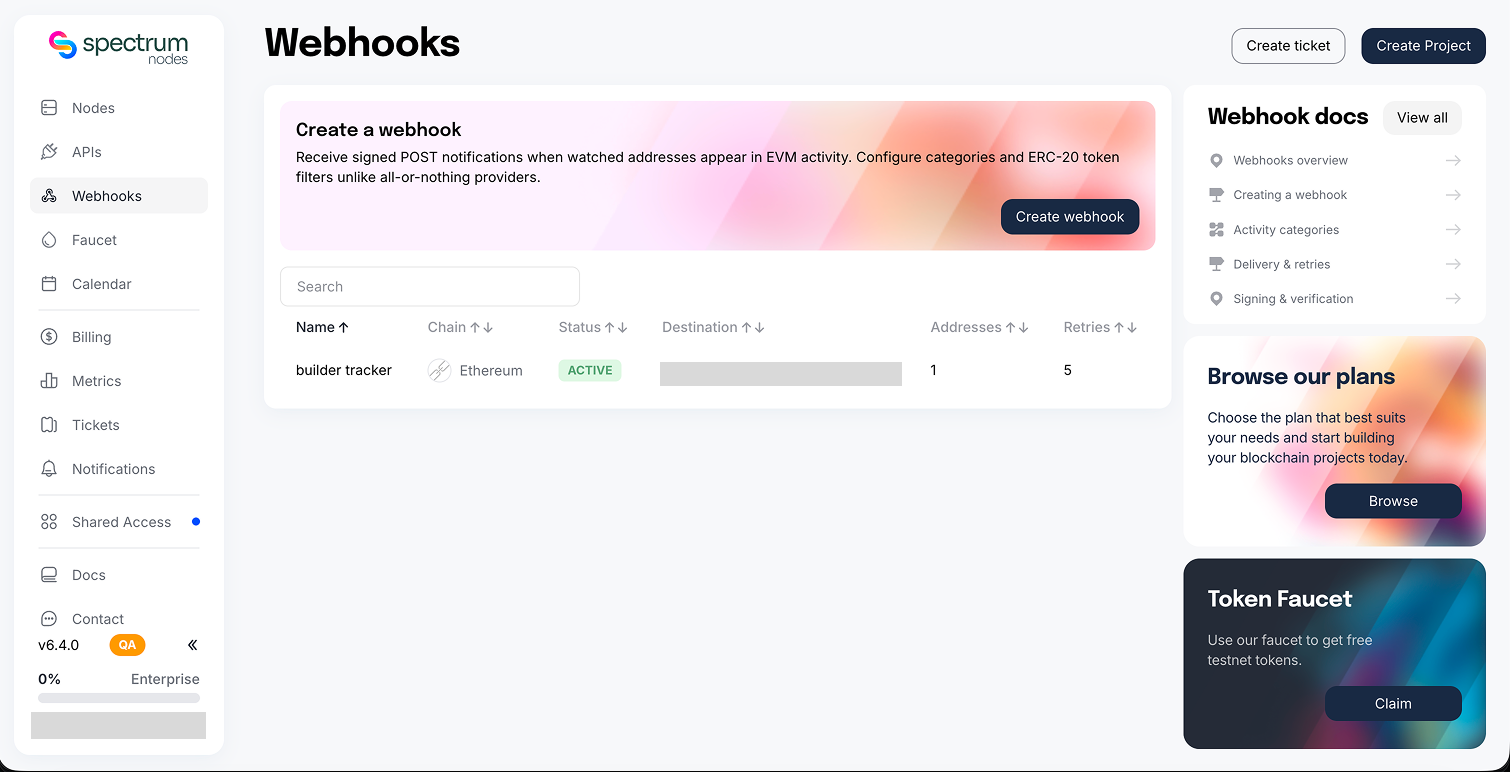
You create and manage webhooks from the Webhooks section of the Spectrum dashboard.
Next steps
- Creating a Webhook: choose a webhook type, filters, and destination; HTTPS users also save a signing key.
- Activity Categories: what Address Activity captures and what each category delivers.
- Contract Events: select a contract and events with ABI fragments or raw topic hashes.
- Destinations: configure HTTPS, Slack, or Telegram and create bot credentials.
- Delivery & Retries: the payload, headers, retry policy, idempotency, reorgs, and monitoring.
- Signing & Verification: verify signatures and rotate keys.
Webhooks are created and managed from the Webhooks section of the Spectrum dashboard. This section explains how to configure them and how to receive and verify the events they deliver to your server.